Most coins in a jar of change are worth exactly what is stamped on them. A small number are worth more, sometimes far more, and the difference is usually written on the coin itself: the metal it is made of, the year, a tiny letter showing where it was struck, and how much wear it has taken.
This guide shows you how to read those clues on a US coin, how to tell the two kinds of coin value apart, and which coins are worth a second look before you spend them.
Is There Value in Coins?
Yes, but for most circulating coins the value is face value. A coin is worth more than face value for one of two reasons: it contains precious metal worth more than its denomination, or collectors want it because it is scarce, old or unusual. Pre-1965 US silver coins, some wheat pennies and buffalo nickels, and coins with striking errors are the usual places to look.
The Two Kinds of Coin Value: Melt and Collector
Every coin has two possible values, and the higher one sets its price.
Melt value is the worth of the metal in the coin. For a modern clad quarter it is a few cents. For a silver coin it can be many times the face value, and it moves every day with the price of silver.
Collector value is what collectors will pay for the coin as a coin. It depends on how many were made, how many survive, the condition of this particular example, and how much demand there is for that date and type. A common silver quarter in worn condition sells close to melt value. A scarce date in excellent condition can sell for hundreds of times its melt value.
So the first question for any old coin is whether it is silver. If it is, you already have a floor under its value.
Silver Coins: The Easiest Value to Spot
Until the mid-1960s, US dimes, quarters and half dollars were made of 90 percent silver. The Coinage Act of 1965 replaced silver in the dime and quarter with the copper and nickel "clad" coins we still use, and cut the half dollar to 40 percent silver.
That gives you a simple rule: any US dime, quarter or half dollar dated 1964 or earlier is 90 percent silver. Kennedy half dollars dated 1965 to 1970 are 40 percent silver.
The amount of pure silver in each 90 percent coin follows from its weight:
| Coin (1964 and earlier) | Total weight | Pure silver |
|---|---|---|
| Dime | 2.50 g | 0.0723 troy oz |
| Quarter | 6.25 g | 0.1808 troy oz |
| Half dollar | 12.50 g | 0.3617 troy oz |
To find the melt value of a coin today, multiply its silver content by the current spot price of silver per troy ounce. Dealers usually buy silver coins a little below melt value and sell them a little above it.
There is a quick way to sort a handful of quarters without reading every date: look at the edge. A clad coin shows a copper stripe between two silver-coloured layers. A 90 percent silver coin is the same silver colour all the way through.
Nickels have their own exception. During World War II, nickel was needed for the war effort, so five-cent coins dated 1942 to 1945 were made with 35 percent silver. You can recognise these "war nickels" by the large mint mark above the dome of Monticello on the back. They were also the first US coins to carry a "P" for Philadelphia.
Read the Date and the Mint Mark
The date tells you which series and which year you have. The mint mark tells you where it was struck, and it matters because each mint produced different quantities. The same date and design can be common from one mint and scarce from another.
Current US coins use four mint marks, according to the US Mint:
- P for Philadelphia
- D for Denver
- S for San Francisco
- W for West Point
Older coins can carry O for New Orleans or CC for Carson City, both found on Morgan silver dollars. Philadelphia coins often have no mint mark at all: the "P" was rare before the 1980s, and it appeared on circulating pennies for the first time in 2017.
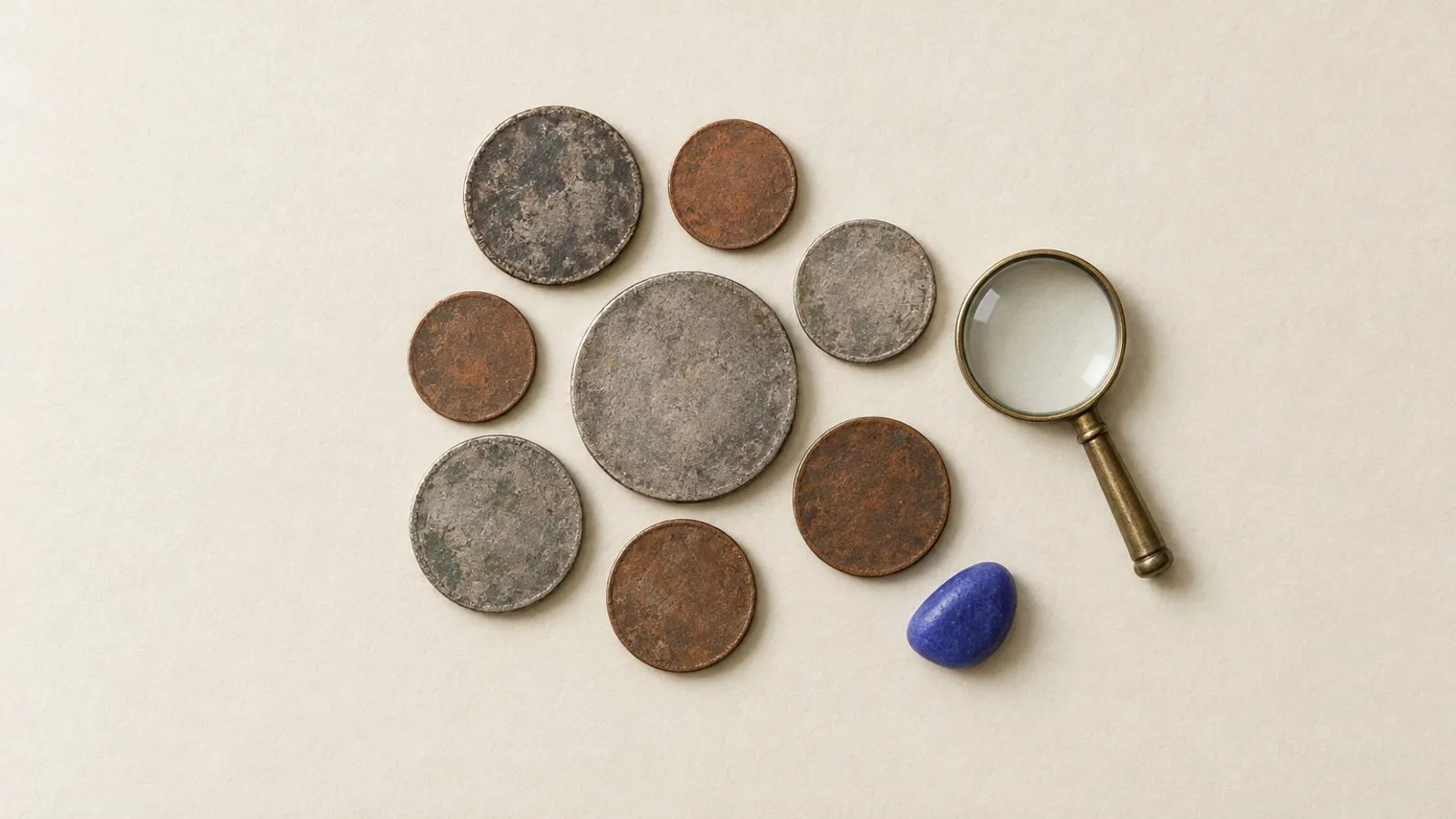
The mint mark is small, and its position depends on the coin and the year. On a modern Lincoln cent it sits under the date. On older coins it is often on the back. A magnifying glass or a phone camera zoomed in makes it much easier to read.
Condition Changes Everything
Two coins with the same date and mint mark can differ enormously in value because of condition. Collectors look at how much detail remains on the highest points of the design, such as the hair above the ear on a portrait or the feathers on an eagle, and at whether the coin still has its mint lustre, the soft frosty shine of a coin that has never circulated.
A coin with heavy wear, where the date is hard to read, usually sells close to its melt value or face value. The same coin with sharp detail and full lustre can sell for many times more.
One rule matters above all: never clean an old coin. Polishing or scrubbing removes metal and leaves fine scratches that collectors spot immediately, and it can cut a coin's collector value sharply. If a coin is dirty, leave it as it is.
Coins Worth Checking Before You Spend Them
A few series turn up often in old jars and inherited collections, and they are worth a careful look:
- Wheat pennies. Lincoln cents from 1909 to 1958 have two wheat ears on the back. Most are common, but collectors look hard for the 1909-S VDB, the 1914-D and the 1955 doubled die, which ranks among the most valuable pennies.
- 1943 cents. Almost all pennies from 1943 were made of zinc-coated steel to save copper for the war, and they stick to a magnet. A small number were struck in bronze by mistake; those do not stick, and they are rare.
- Buffalo nickels. Made from 1913 to 1938, with a Native American portrait on the front and an American bison on the back. Many have worn dates, but readable ones are worth checking by mint mark.
- Morgan silver dollars. Struck from 1878 to 1904 and again in 1921. Each contains about three quarters of a troy ounce of silver, and some dates and mint marks carry large collector premiums.
- Any dime, quarter or half dollar from 1964 or earlier. Even a worn one is worth its silver.
Where Coin Prices Come From
Printed price guides and coin value charts are a good starting point, but they list typical retail prices, and those can lag the market or assume a better condition than your coin has. The strongest evidence is the same as for any collectible: what coins of the same date, mint mark and condition have recently sold for.
Recent eBay sold listings are the largest public record of those sales for common and mid-range coins. Search for the exact date, mint mark and series, filter to sold items, and compare the photos of the coins that sold with yours, paying close attention to wear. For scarce coins, major auction house archives show prices for the best examples.
Remember that a dealer buying your coin needs to resell it, so a dealer's offer will sit below these retail sale prices.
Using a Photo for a First Read
If you have a handful of coins and want to know which ones deserve a closer look, a photo is a fast way to sort them. Primo Worth has a Coin mode: you snap a photo of a coin and it reads the denomination, year and mint mark, explains what makes that coin common or scarce, and checks the value against recent eBay sales where they exist, showing the sold listings it compared so you can judge them yourself.
A photo cannot do everything. It cannot weigh a coin, test its metal or judge fine wear the way someone holding the coin under a lamp can, and it cannot tell you whether a rare-looking coin is a copy. Treat the result as an AI estimate, not a professional appraisal. For a coin that looks valuable, take it to a reputable coin dealer in person before you sell it.
Coin Value, in Short
A coin is worth the higher of its melt value and its collector value. Check first whether it is silver: US dimes, quarters and half dollars from 1964 or earlier are 90 percent silver, and war nickels from 1942 to 1945 contain 35 percent. Then read the date and mint mark, judge the wear honestly, never clean it, and compare with recent sold prices for the same coin. Most coins will turn out to be worth face value, which makes the few that are not all the more worth finding.