An old-looking object is not always an antique, and a plain-looking one sometimes is. Before you can put a value on a piece, you need a rough idea of what it is, who made it and when. You do not need an expert eye for the first pass. Most of the evidence is on the object itself, if you know where to look.
This guide covers what "antique" and "vintage" actually mean, where to find marks, and the construction clues that help date furniture, china and glass.
Antique or Vintage: How Old Is Old Enough?
An antique is generally an item at least 100 years old. That is the threshold US Customs uses for antiques, and the one most dealers and auction houses follow. Vintage is usually used for items at least 20 years old but younger than antique. Etsy, for example, sets 20 years as its minimum age for vintage items.
So a 50-year-old piece is vintage, not antique. That distinction matters when you search for comparable sales, because buyers and sellers use the two words for different markets.
Age alone does not make something valuable. Plenty of 100-year-old objects were mass-produced and survive in large numbers. Value comes from age combined with maker, quality, condition and demand.
How Do I Find Out if Something Is an Antique?
Start by collecting evidence from the object itself, in this order:
- Look for a mark or label. It is the fastest route to a maker and a date.
- Check how it was made. Hand work and machine work leave different traces.
- Look at the materials and hardware. Some were only used in certain periods.
- Read the wear. Real age leaves wear where hands and feet touched it most.
No single clue proves age. What you are looking for is a set of clues that agree with each other.
Where to Find Maker's Marks
Marks are usually somewhere you do not see when the object is in use:
- Pottery and porcelain: on the base, stamped, painted, impressed into the clay or printed under the glaze.
- Silver and metalwork: on the underside, the back of a handle or near the rim, often as a row of small stamps.
- Furniture: inside drawers, on the back panel, under the seat or on the underside of a tabletop, sometimes as a paper label or a stencil.
- Glass: an acid-etched or moulded signature near the base, often faint enough that you need to tilt it into the light.
- Clocks and watches: on the dial, the movement or inside the case back.
Photograph the mark in sharp focus, then search for it alongside the type of object, such as "crown and anchor mark porcelain". Mark reference books and collector sites list thousands of marks with the years each was in use.
Country Marks as a Date Clue
From 1891, the McKinley Tariff required goods imported into the United States to be marked with their country of origin. That gives you a useful clue: a piece of imported china marked with just "Japan", "Germany" or "England" was most likely made after that date. Japanese goods marked "Nippon" generally date from 1891 to 1921, when US customs began requiring "Japan" instead.
Watch out for the phrase "Made in". It was not common on imports until the early 20th century, so a "Made in England" mark usually points later than a mark reading "England" alone.
An item with no country mark at all is not automatically older, since many pieces were made for a home market or marked only on a removable label. Treat it as one clue among several.
Construction Clues on Furniture
Furniture carries some of the clearest age evidence, because building methods changed with machinery:
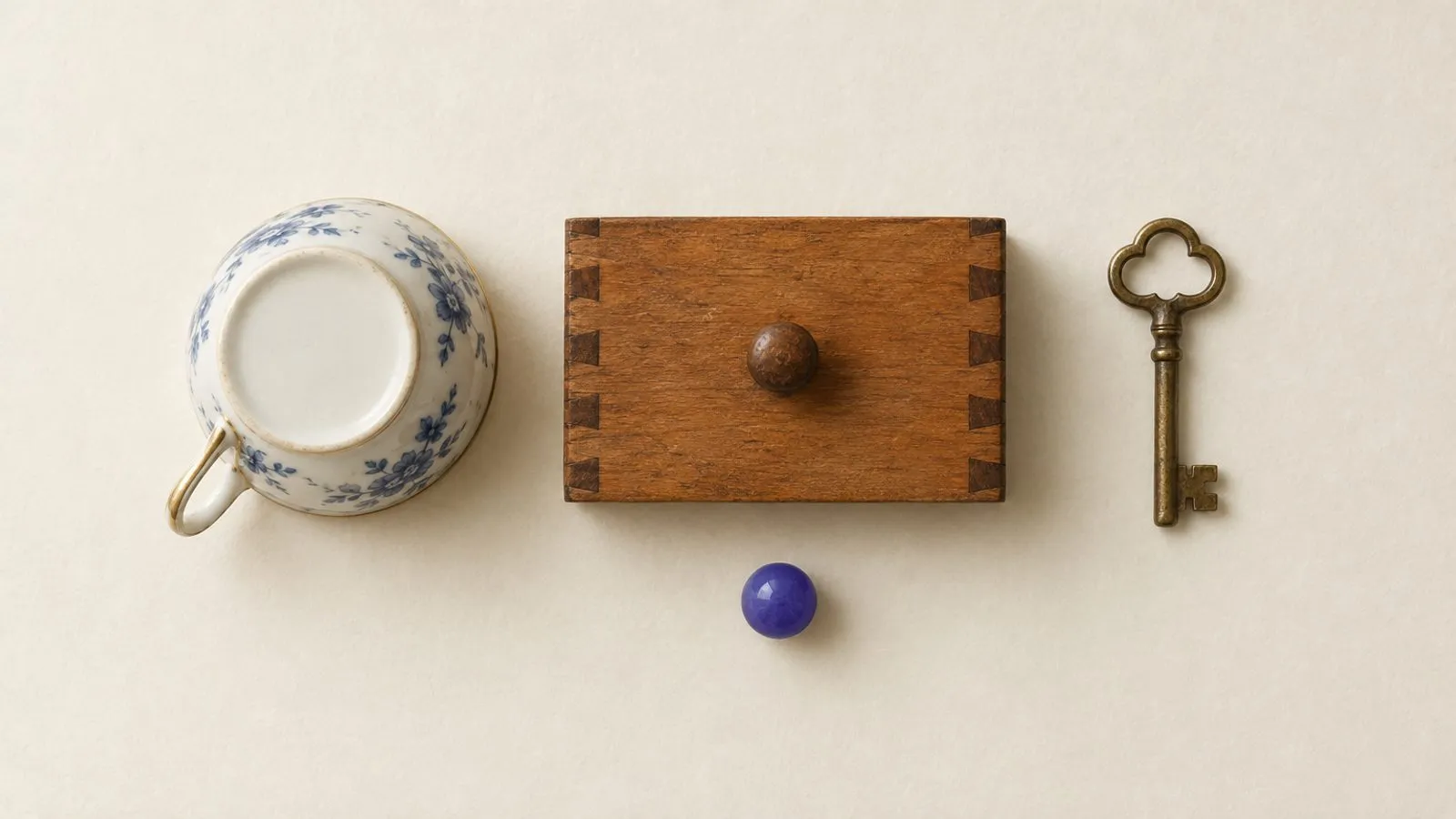
- Dovetail joints. Open a drawer and look where the front meets the side. Hand-cut dovetails are slightly uneven and usually few and wide. Machine-cut dovetails are perfectly even and closely spaced.
- Saw marks. Straight, parallel saw marks on the back or underside suggest a hand or early mill saw. Curved, regular arcs come from a circular saw, which became common in the 19th century.
- Screws. Old handmade screws have uneven threads and off-centre slots. Phillips screws, with a cross-shaped head, were introduced in the 1930s, so a piece built with original Phillips screws is unlikely to be older.
- Shrinkage. Wood shrinks across the grain over many decades, so a round tabletop that measures slightly oval across the grain is a sign of real age.
Check whether the hardware is original. Ghost marks, extra holes or a different patina around handles suggest replacements, which a buyer will notice.
Clues on China and Glass
On ceramics, look at the base. Wear on the foot ring, the unglazed rim that touches the table, should be even and fine, the result of decades of being set down. Grinding marks that look fresh, or a foot ring that is dirty only in patches, can suggest artificial ageing.
On glass, small bubbles, slight waviness and a rough or ground mark on the base where it was snapped from the rod can indicate hand blowing. Moulded seams running up the side point to machine production. Neither tells you the date on its own, but together with a mark they narrow it down.
Signs of a Reproduction
Reproductions copy the look of an antique, and some are made to deceive. A few warning signs:
- Wear in the wrong places, or wear that looks the same all over, as if the piece was sanded or tumbled.
- Marks that look too crisp or are printed rather than stamped, painted or impressed the way the original maker did it.
- Modern materials hidden inside, such as plywood, staples or modern glue.
- A price that seems too low for what the piece claims to be.
If something looks like an important antique, the safest step is to have it examined in person.
What an Antique Is Worth
Once you know roughly what you have, the value comes from recent sales of close matches, not from price guides or asking prices. Search the maker, the type of object and the period, filter to sold listings, and compare condition carefully. Our guide on finding what something is worth walks through that method step by step.
A photo can speed up the first pass. Primo Worth has an Antique mode: you snap a photo, and it reads the materials, visible marks and likely period, adds a short backstory, explains what drives the value of that kind of piece, and checks recent eBay sales where they exist, showing the sold listings it compared. A photo cannot confirm age or maker, and it is not a professional appraisal. For anything that looks valuable, a specialist dealer or an auction house that has handled similar pieces is the next step.
Identifying Antiques, in Short
An antique is generally at least 100 years old, and vintage at least 20. To identify one, look for a mark first, then let the construction, materials, hardware and wear tell you whether the story holds together. Country marks help with dates, Phillips screws and machine dovetails rule out early ones, and wear that looks too even is a warning. When the clues agree, compare recent sold prices for close matches to see what the piece is worth today.