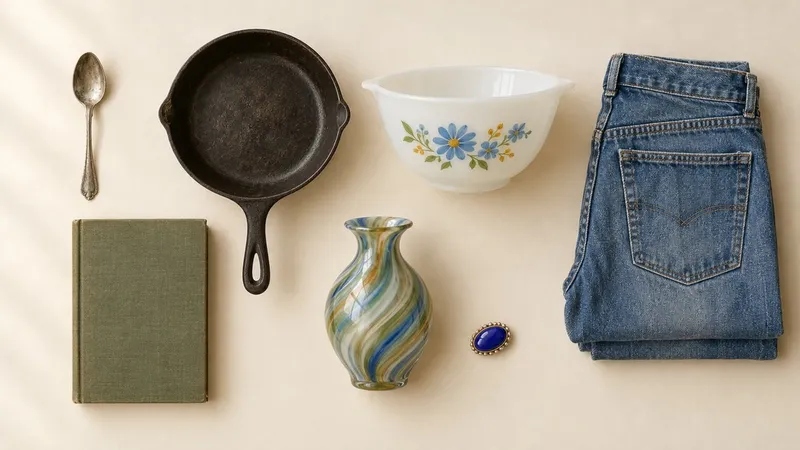
Good garage sale pricing comes down to one rule and one exception. The rule: price most used items at roughly 10 to 30 percent of what they cost new, in round numbers, so they sell on the day. The exception: anything that might be worth far more than that gets pulled out and checked before it ever gets a sticker.
Most guides stop at the rule. That is how a rare bowl ends up on a folding table for a few dollars. This guide treats pricing as a short process you run once before the sale, in five stages, so the everyday items move fast and the few valuable ones are priced on evidence instead of a guess.
Garage Sale Pricing at a Glance
Here is the whole system before the detail. Each stage gets its own section below.
- Sort out the maybes. Before pricing anything, set aside items that could be worth more than a garage sale price.
- Check sold prices for the maybes. Look at what comparable items actually sold for, then decide whether they belong in the sale at all.
- Price everything else with a simple rule. A percentage of retail, adjusted for condition, with fixed prices per category.
- Build in room for haggling. Decide your floor for anything over a few dollars.
- Label, group and mark down. Clear stickers, bins with one price, and a plan for the last hours.
The order matters. Once a box of mixed items has a "$1 each" sign on it, nobody goes back through it, and neither will you.
Stage 1: Pull Out Anything That Might Be Worth More
The single most expensive pricing mistake at a garage sale is not overpricing. It is pricing something valuable at the same level as everything around it.
The famous examples are extreme, but they are real. A small porcelain bowl bought for $35 at a Connecticut yard sale turned out to be a 15th-century Chinese piece, and NPR reported that it sold at Sotheby's in March 2021 for $721,800. In 2013, BBC News reported that a bowl bought for $3 at a New York garage sale in 2007 sold for $2.2 million at the same auction house. Someone priced both of those as ordinary dishes.
What to Set Aside Before Pricing
You do not need to expect a museum piece to justify this stage. You only need a short list of item types that deserve a second look before they get a sticker:
- Anything marked sterling, 925, 10K, 14K or 18K, including jewelry that looks like costume pieces
- Pottery, porcelain and glass with a maker's mark on the base
- Old coins, banknotes, stamps and medals
- Signed artwork, prints and anything framed that looks older than you
- Vintage toys, video games, cameras, watches and designer clothing or bags
If an item is on that list, it goes in a separate box until you have checked it. The same instinct that makes a reseller pick it up at a sale should make you hold it back. Our guide to thrift store finds worth money covers the categories buyers hunt for, and it works just as well as a list of what not to sell for a dollar.
Stage 2: Check Sold Prices for the Set-Aside Pile
For the maybes, the question is not what the item cost new. It is what similar items have recently sold for. Asking prices on listing sites tell you what sellers hope for; sold prices tell you what buyers paid.
A pricing tip sheet published by the Village of Westchester, Illinois, makes the same point: look at what similar items sold for on eBay, Craigslist and Facebook Marketplace to set a baseline, and mark anything higher value as "firm" if you will not negotiate. On eBay, that means filtering to sold listings rather than active ones.
This is the stage where a phone is useful. With Primo Worth you snap a photo of an item and get it identified, with an estimated value checked against recent eBay sales where they exist and the sold listings shown so you can judge whether the matches are really the same thing. It is an AI estimate, not a professional appraisal: a photo cannot confirm the metal, the maker or the age, and the estimate is not a promise of what a buyer will pay. For the jewelry, coins and marked pottery that usually fill this pile, Primo Worth's Jewelry, Coin and Antique modes add details such as hallmarks and karat, year and mint mark, or maker and era.
Keep It, Sell It Elsewhere or Hold It Back
Once you have a rough number, sort the pile three ways:
- Worth a garage sale price after all. Most of the pile ends up here, and it rejoins the sale at a slightly higher sticker.
- Worth more than your shoppers will pay. Sell it online, through a consignment shop or a dealer, and keep it off the table.
- Not sure. Keep it out of the sale until you know more. You can always sell it next time.
Our guide on how to find the value of almost anything goes deeper on reading sold prices for items with no obvious brand or label.
Stage 3: Price Everything Else With a Simple Rule
With the maybes handled, the rest of the sale is everyday goods, and speed matters more than precision. Pick one rule and apply it to everything.
Three rules come up again and again. The 50-30-10 rule, as Northwestern Mutual describes it, prices new and unused items at 50 percent of retail, slightly used items at 30 percent, and used items at 10 percent. The simpler 10 percent rule prices everything at a tenth of what it cost new, going up to 20 percent for handmade or luxury-brand pieces. The rule of thirds starts at about one third of what the item cost, so a $30 mirror is marked $10, then shaves a little off for scuffs.
Those rules disagree at the top end, and the reason is condition. A June 2026 resale guide from Commonplace splits it into four tiers: like-new with box or tags at 50 to 70 percent of retail, good and fully working at 30 to 50 percent, fair with visible wear at 15 to 30 percent, and rough or for parts at 10 percent or less. Brand and demand override the formula in both directions.
For a typical garage sale crowd, start at the low end of those ranges. Shoppers came for deals, and anything still on the table at the end of the day earns you nothing.
Garage Sale Pricing Guide by Category
Percentages are hard to apply to items when you have long forgotten what they cost. Fixed prices per category are faster. These figures come from the pricing guides at Real Simple and Dusty Old Thing, and they are rules of thumb, not market data.
| Category | Suggested price |
|---|---|
| Used books | 50 cents to $1, art books $5 to $10 |
| Toys | 25 cents to $5 |
| Board games and puzzles | $1 to $5 |
| Kitchen gadgets | $1 to $5 |
| Dishes and glasses | $5 to $30 for an eight-piece set |
| Lamps | $5 to $30 |
| Blankets | $2 to $5 |
| Rugs | $20 to $25 |
| Costume jewelry | 50 cents to $2 |
| Inexpensive furniture | Up to $30 |
| Dining chairs | $25 to $150 each |
| Coffee tables | $50 to $100 |
Real Simple puts flat-pack furniture at 30 to 50 percent of what it cost new, and Dusty Old Thing warns that better furniture still follows the rule of thirds, which means a buyer will haggle hard over a $2,000 sofa marked at nearly $700.
Pricing Clothes at a Garage Sale
Clothes are the category where sellers overprice most often. Dusty Old Thing's guideline is $1 to $3 for baby clothes and $2 to $5 for adult clothes, less for anything stained or torn, and $5 to $7 for shoes in good condition.
The exceptions are leather, designer pieces, true vintage in very good condition, and anything with the store tags still on. Those belong back in Stage 2, because they sell for far more online than any garage sale shopper will pay.
Stage 4: Build in Room for Haggling
Haggling is part of the event, so decide in advance how you want to handle it. Northwestern Mutual suggests pricing about 10 to 20 percent above the figure you have in mind if you enjoy negotiating, and pricing at fair value from the start if you do not.
For anything over a few dollars, set a floor in your head before the sale opens. When a buyer makes an offer, you already know your answer, and you are not deciding under pressure with three people waiting to pay.
Two habits keep negotiation from eating the day. Mark the few items you will not move on as firm, right on the sticker. And save your real discounts for later: NC Realtors advises keeping haggling for the last day or the afternoon, once the morning rush is over, because early shoppers will often pay the marked price.
Stage 5: Label, Group and Mark Down
The best price is useless if nobody can read it. Every item needs a visible price, and the prices themselves should be easy to pay.
Round numbers do most of the work. Martha Stewart's yard sale guide recommends whole numbers like $1, $5 and $10 so people can buy without having to ask, and NC Realtors suggests 25-cent increments for small items so quarters are the only change you need.
Grouping saves hours. Instead of stickering 200 paperbacks, put them in one box with one sign. All records at $1, all kitchen gadgets at $2, all toys in a bin at 50 cents. Bundle offers such as three books for $2 move volume and give hagglers an easy yes.
Then plan the end of the sale. A sign that drops prices by half after noon, or a "fill a bag for $5" offer in the last hour, clears the tables. Whatever is left goes to donation that same day, so it does not drift back into the house.
A Sale Priced Start to Finish
Picture a two-car garage of household items after a move. Sorting the maybes first turns up a silver-colored bracelet stamped 925, a stack of old coins from a desk drawer, a marked ceramic vase and a box of 1990s video games.
Each one gets a photo in Primo Worth and a look at the sold listings behind the estimate. The bracelet and the coins have enough recent sales behind them that they are worth more than a garage sale crowd will pay, so they go online instead. The vase comes back with sold prices around what it would fetch in a yard, and it rejoins the sale at $15 instead of $3. The video games are a mix, so the two titles with strong sold prices are held back and the rest go in a bin.
Everything else is priced in an evening with the category table: books in a $1 box, clothes on a rack at $3, furniture at a third of what it cost. The coffee table is marked $60 with $45 as the floor. By the afternoon of day two, everything left is half price, and the last hour is a bag sale.
Checking the maybes was the smallest job of the weekend, and the only one that decided whether the valuable items sold for what they are worth.
Key Takeaways
Garage sale pricing works best as a short process rather than a pile of stickers. Set aside anything that might be valuable before you price, and check what comparable items actually sold for. Price everything else at 10 to 30 percent of retail, lower for worn items and higher for like-new ones, and use fixed category prices to go fast.
Decide your floor before you negotiate, keep the deeper discounts for the afternoon and the last day, and use round numbers and grouped bins so buyers can pay without asking. The few minutes you spend on the maybes protect you from the one mistake a discount cannot fix.