A diamond color chart is the D-to-Z scale the Gemological Institute of America (GIA) uses to grade how much yellow or brown a white diamond shows. D means completely colorless, Z means an obvious light yellow or brown, and the 23 letters in between fall into five groups. The further down the alphabet a stone sits, the less it costs: on one dated price table, a one-carat K costs 62.5% less per carat than a D of the same clarity.
If you are looking at a ring you own, a stone you are about to buy, or a grading report with a letter on it, the letter alone tells you little. This guide shows what each group looks like, what the grades cost in 2026, why the same letter can look whiter or warmer depending on the setting, and what the color grade means for a diamond you already have.
The Diamond Color Chart at a Glance
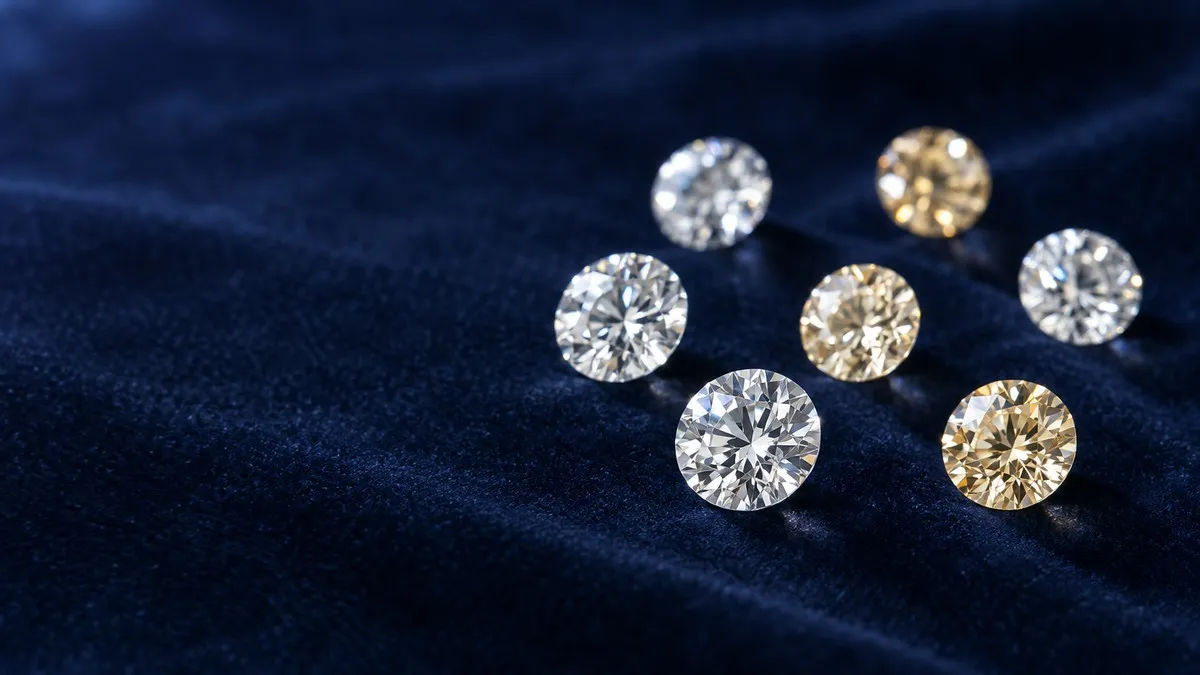
GIA's own color scale page describes 23 grades split into five subcategories. Each letter stands for a narrow range of color, a mix of tone and saturation that GIA calls depth of color.
| Grades | Group | What an untrained eye sees |
|---|---|---|
| D, E, F | Colorless | No color. The most chemically pure stones on the scale |
| G, H, I, J | Near colorless | Color usually unseen except by trained graders |
| K, L, M | Faint | Color still hard to see |
| N to R | Very light | Color visible in larger stones |
| S to Z | Light | Distinctly yellow or brown in many sizes, but not a fancy color |
The distinctions between neighboring grades are so small that most people cannot see them, yet they move the price a great deal. That gap between what you can see and what you pay is the whole reason the chart matters.
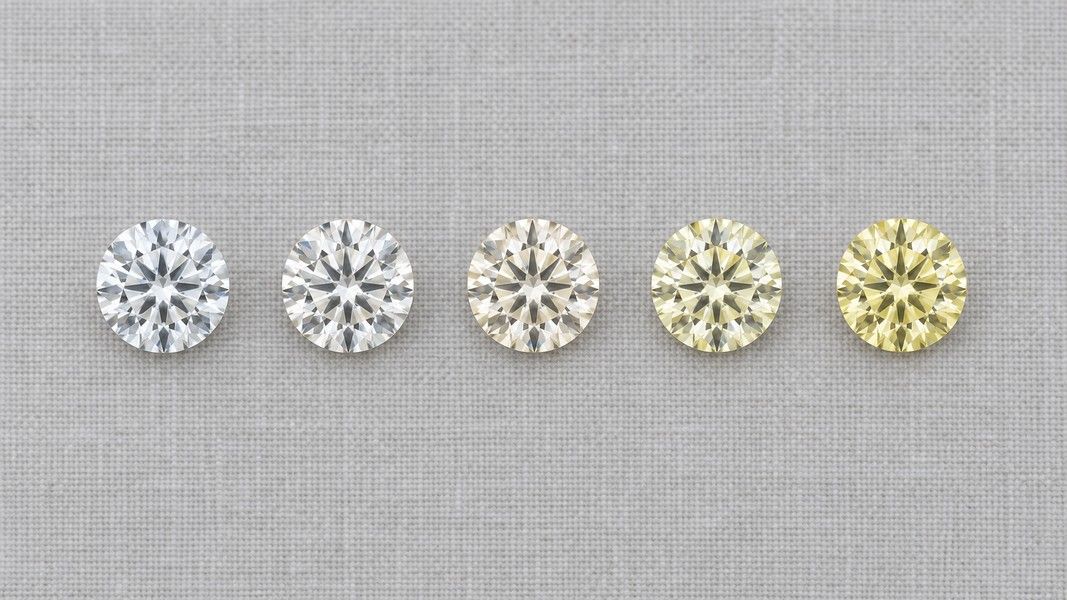
How Diamond Color Grades Are Assigned
A color grade is not read off a ring under shop lights. GIA grades every diamond in a standardized viewing environment, with the stone placed table down in a white tray and compared side by side with a set of master stones, each one a known grade.
Turning the diamond face down matters. Face up, the facets of a cut stone give it a complex appearance of light and sparkle, and viewing it table down reduces that so the body color can be compared. GIA also requires at least two graders to enter independent opinions on each stone, and the grade is set only when enough of them agree.
Why the scale starts at D
Before GIA built the scale in the early 1950s, the trade used a mix of A, B and C grades, numbers and phrases such as "blue white" that meant different things to different sellers. GIA started at D so the new letters would carry no link to any older system. If you see a ring described with one of those old terms, it was never graded on the modern scale.
Each letter is a range
Every grade covers a band of color, not a single point. Any diamond that shows less color than the E master stone becomes a D, which is why GIA needs no D master at all. Two stones with the same letter can therefore differ slightly, and a stone at the top of the G band sits closer to an F than to an H.
What Each Color Grade Costs
Color is one of the two quality ladders that set a diamond's price, the other being clarity. Carat Capital's natural price list applies Rapaport's color aggregates from 31 December 2025 to the median asking price of a one-carat round at five online retailers on 30 July 2026, with clarity held at VS1.
| Color | Group | Index (H = 100) | Retail asking per carat |
|---|---|---|---|
| D | Colorless | 176 | $8,135 |
| E | Colorless | 154 | $7,118 |
| F | Colorless | 139 | $6,425 |
| G | Near colorless | 118 | $5,454 |
| H | Near colorless | 100 | $4,622 |
| I | Near colorless | 87 | $4,021 |
| J | Near colorless | 74 | $3,420 |
| K | Faint | 66 | $3,051 |
Read the table as the shape of the curve, not as a quote for your stone. The figures are asking prices, cut and fluorescence vary within each row, and another index will land on different dollars. On 23 October 2026, StoneAlgo's price calculator put a one-carat round G VS2 natural diamond at $3,589, with a range of $1,775 to $5,584.
The colorless premium
The steepest steps are at the top. Going from E to D adds about 14% per carat on this table, while going from J to I adds about 18% from a much lower base. A D commands that premium because colorless stones are scarce, not because anyone can see the difference across a room.
Near colorless and faint
G through J is where most of the price drop happens without much visible change. Moving from a G to a J cuts the asking price per carat by about 37% on this table, while GIA describes both grades as near colorless. K is the first faint grade, and the price table stops there.
Color and clarity together
People often search for a diamond color and clarity chart because the two grades are priced together. On the same Carat Capital page, an SI2 one-carat round costs 59.6% less than an IF of the same color. Color and clarity each move the price of a one-carat round by more than a factor of two, so neither one tells you the value of a stone alone.
What Is the Best Diamond Color?
There is no single best diamond color, only the lowest grade that still looks white to you in the setting you have. Three things shift where that line falls.
The setting metal
GIA notes that a white metal such as platinum or white gold emphasizes the absence of color in a colorless or near colorless stone, while yellow gold can make a diamond lower on the scale look whiter by comparison. A J set in yellow gold can read as white on the hand, where the same J in platinum next to a whiter stone may look warm.
Fluorescence
Some diamonds glow under ultraviolet light, including the UV in daylight. According to GIA's fluorescence guide, about 25% to 35% of diamonds show some fluorescence and more than 95% of those glow blue. Blue cancels yellow, so strong blue fluorescence can make an I to M stone look closer to colorless in sunlight. The grade on the report does not change, because grading happens in controlled light.
The effect runs the other way at the top. Stones from D to H with blue fluorescence are often considered less desirable in the trade and sell for less, even though GIA says their color and transparency are most likely unaffected. Fewer than 0.2% of the fluorescent diamonds GIA receives look hazy or oily.
Shape and size
Color shows more in a larger stone, which is why GIA describes the very light group as visible "in larger stones". Clairamor calls the round brilliant the shape that hides color best, so the same letter can look warmer in another shape of the same weight.
Beyond Z: Fancy Color Diamonds
The chart ends at Z, and a diamond with more color than that is no longer a weak white stone. GIA classes any diamond outside the D-to-Z range as a colored diamond, often called a fancy color. These are graded on a separate scale, from Faint and Very Light through Fancy Light, Fancy, Fancy Intense and Fancy Vivid to Fancy Dark and Fancy Deep.
On that scale, more color means more value, the opposite of the D-to-Z chart. GIA says Fancy Intense and Fancy Vivid stones generally command the highest prices, and pink, blue and green diamonds are especially prized.
Lab-Grown Diamonds and Color
Lab-grown diamonds use the same letters, but the letter does far less to their price. In a sample of its own stock on 2 October 2026, the jeweler Clairamor found its lab-grown stones priced with little regard to color: moving from G to D at the same clarity changed the cheapest round by $170, and E was sometimes cheaper than D. Growers produce top colors in volume, so a D is not rare the way a mined D is.
The overall gap is wide. On StoneAlgo's averages read on 14 October 2026, a one-carat natural diamond averaged $3,820 and a one-carat lab-grown diamond $502. If you are not sure which kind of stone you have, our guide on moissanite and lab diamonds covers how the three compare, and a gemologist can tell you for certain.
What the Color Grade Means for a Diamond You Already Own
The prices above are what retailers ask for loose stones. Selling a diamond is a different market. Regal Studio, a jeweler in Atlanta, puts typical resale for natural diamonds at 25% to 50% of the original retail price, and lab-grown stones at 10% to 30%. A better color helps a stone hold interest with buyers, but it does not close that gap.
Find the grade you already have
If your diamond came with a grading report, the color letter is printed on it along with the scale itself. GIA reports carry a report number you can look up, and many stones have that number laser inscribed on the girdle. Keep the report with the ring, so a buyer can check the grade against the stone.
If there is no report, nobody can give you a color grade from a picture. Lighting, the camera and the setting metal all change how white a stone looks on a screen. A jeweler or a gemologist with master stones can grade it, and a lab report settles it. Before that, our guide on testing a diamond at home covers the simple checks and their limits.
A first idea of resale value
If you want a rough sense of what a ring sells for before you visit a dealer, Primo Worth gives an estimate from one photo. Its Jewelry mode reads the metal, karat, stones and hallmarks it can see and checks the piece against recent eBay sales where they exist, showing the sold listings so you can judge the matches yourself.
Primo Worth cannot grade a diamond's color, tell a natural stone from a lab-grown one, or confirm what a stone is, because a photo cannot show any of that. Its result is an AI estimate, not a professional appraisal, and it is not a promise of what a buyer will pay.
Key Takeaways
The diamond color chart runs from D, colorless, to Z, light yellow or brown, in 23 grades and five groups. Neighboring grades are hard to tell apart by eye, yet on a 2026 price table a one-carat K costs 62.5% less per carat than a D, and a J about 37% less than a G.
The best color for you is the lowest grade that looks white in your setting: yellow gold, blue fluorescence and a round cut all make a lower grade look whiter. Past Z the rules flip, and fancy color diamonds rise in value with stronger color. Lab-grown stones carry the same letters, but color barely moves their price. For a diamond you own, the grade on a lab report is what a buyer trusts, and a resale offer will sit well below any retail figure on the chart.