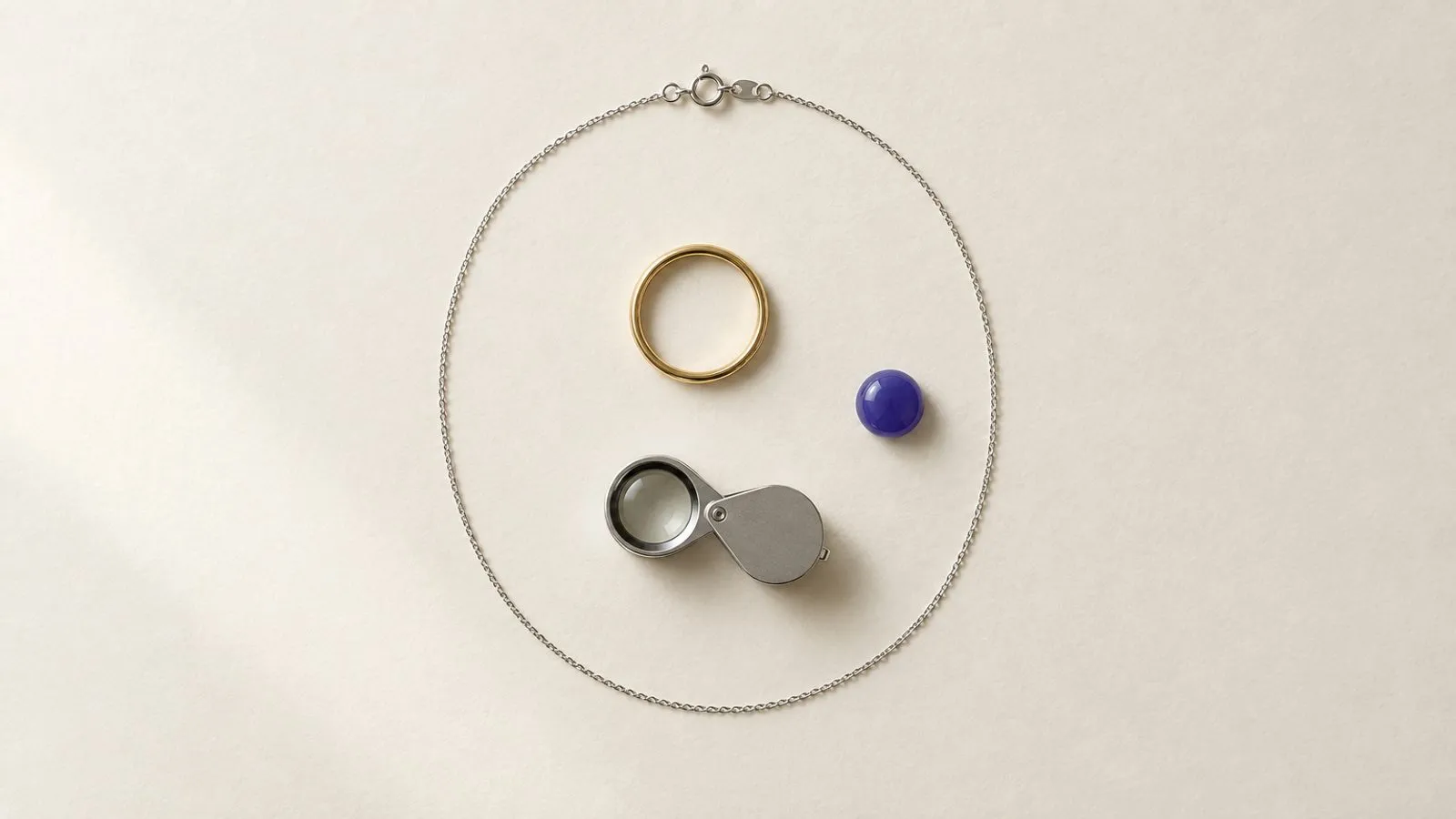
Turn a ring over, or look closely at the clasp of a necklace, and you will often find a tiny stamp: a number, a few letters, sometimes a small logo. Those marks are the quickest way to tell what a piece of jewelry is made of, and the metal is the first thing that decides what it is worth.
This guide explains what the common stamps mean, how to tell solid metal from plated, and the simple checks you can do at home before you take a piece to a jeweller.
Where to Find the Stamps
Jewelry marks are small and placed where they will not show when the piece is worn:
- Rings: on the inside of the band.
- Necklaces and bracelets: on the clasp, or on a small tag next to it.
- Earrings: on the post, the back or the hook.
- Pendants and brooches: on the back, or on the bail that the chain passes through.
A jeweller's loupe or a phone camera zoomed in helps a lot. Stamps wear down over years of use, so a faint mark is normal on an older piece.
Gold Karat Marks
Gold purity is measured in karats, out of 24. Pure gold is 24 karat. Lower karats are alloys, mixed with other metals for strength and colour. You will see the purity written either as a karat mark or as a three-digit number showing parts per thousand:
| Karat mark | Number mark | Gold content |
|---|---|---|
| 10K | 417 | 41.7% |
| 14K | 585 | 58.5% |
| 18K | 750 | 75% |
| 22K | 916 | 91.6% |
| 24K | 999 | 99.9% |
The number marks are common on European jewelry. "K" and "KT" both mean karat. In the United States, 10 karat is the lowest purity that can be sold as gold, under the Federal Trade Commission's Jewelry Guides.
Higher karat gold is softer and more yellow. That is why everyday rings are often 14K, while 22K and 24K are more common in some regional traditions and in bullion.
Silver Marks
The standard mark for sterling silver is 925, meaning 92.5 percent silver. You may also see "STER", "STERLING" or "925" combined with a maker's mark. Other numbers you might find:
- 999: fine silver, almost pure. Soft, so it is used more for bullion and some handmade pieces than for rings.
- 900 or 800: coin silver and continental silver, common on older European and some American pieces.
On antique British silver, purity is shown by a symbol rather than a number: the lion passant, a walking lion, marks sterling. It usually sits in a row with other symbols showing the assay office, the date letter and the maker.
Platinum and Palladium Marks
Platinum is usually marked PT, PLAT or PLATINUM, often with a number such as PT950 or 950 PLAT, meaning 95 percent platinum. Palladium follows the same pattern with PD or PALL. Both are white metals, so a stamp is often the easiest way to tell them apart from white gold or silver.
Stamps That Mean Plated or Filled
Some stamps tell you the piece is not solid precious metal. These are worth knowing, because the base number can look like a solid gold mark at a glance:
- GP: gold plated. A very thin layer of gold over a base metal.
- HGE or HGP: heavy gold electroplate. Still plated, just with a thicker layer.
- GF: gold filled. A thicker layer of gold bonded to a base metal, often written as a fraction such as "1/20 14K GF".
- RGP: rolled gold plate. Similar to gold filled, with a thinner layer.
- Vermeil: gold over sterling silver.
A "14K GF" stamp means gold filled, not 14 karat gold. The value of plated and filled jewelry comes mainly from the design, the maker and demand, not from the metal.
How to Check if Jewelry Is Real at Home
A stamp is strong evidence, but stamps can be missing, worn or, on fakes, simply wrong. A few checks you can do without tools:
- Magnet test. Gold, silver and platinum are not magnetic. If a piece snaps firmly to a strong magnet, it is not solid precious metal, although small springs in clasps can be magnetic on a real piece.
- Look for wear. On plated jewelry, the gold layer wears through first on edges and high points, showing a different coloured metal underneath.
- Check for discolouration. Green or black marks on the skin, or a coppery tint showing through, point to base metal.
- Look for a maker's mark. Under US law, a karat or silver quality mark must be accompanied by a registered trademark of the maker or seller, so a karat stamp with no maker's mark beside it deserves a closer look.
None of these replaces an acid test, an electronic tester or an X-ray fluorescence reading, which jewellers use to measure the metal directly. If a piece might be valuable, ask a jeweller to test it.
What About the Stones?
Stamps tell you about the metal, not the stones. Telling a diamond from a cubic zirconia, or a natural gemstone from a synthetic one, takes specialist tools and training, and gemstone value depends on grading that only a qualified gemologist can do. For a valuable stone, look for a lab report or have one made.
From Identification to Value
Once you know the metal and purity, the next question is what similar pieces have sold for. For gold and silver with no special design or maker, the metal content sets a floor, which you can work out from the weight, the purity and the day's metal price. For signed or designer pieces, recent sold prices for the same maker and design matter far more. Our guide on finding what something is worth covers that step.
A photo can help with the first pass. Primo Worth has a Jewelry mode: you snap a photo, and it reads the visible stamps and materials, explains what drives the value of that kind of piece, and checks recent eBay sales where they exist, showing the sold listings it compared. It cannot test metal or grade a stone, so it is not proof that a piece is real, and it is an AI estimate, not a professional appraisal.
Reading Jewelry Stamps, in Short
Look inside rings and on clasps for the stamps. 10K, 14K, 18K and 24K, or 417, 585, 750 and 999, are gold. 925 is sterling silver. PT950 is platinum. GP, HGE, GF and RGP mean plated or filled, not solid. A magnet and a close look at wear can rule out obvious fakes, but for anything valuable, a jeweller's test is the answer.