Pottery marks are the names, symbols, numbers and codes on the base of a plate, vase or figure, and they are the fastest way to identify who made it and roughly when. Read the method first (pressed into the clay, printed, painted or scratched), then the words, which often set a date before which the piece cannot have been made. A mark tells you the maker and a date range; the value comes from what similar pieces in similar condition have actually sold for.
If you have turned over a cup at a thrift store or a vase from a relative's cabinet and found a stamp you do not recognise, this guide walks through it the way a dealer would: how the mark got there, what its wording proves, which makers used date codes, which marks are copied most, and how to get from the mark to a price.
What Pottery Marks Tell You and What They Don't
A pottery mark is a claim made by whoever applied it. Most of the time the claim is true, and a clear factory mark is the best single clue you have. Conservators at Cardiff University sort marks into three kinds, the factory mark, the workman's mark and the pattern mark, and a busy base can carry all three.
The mark can tell you the factory, the pattern name, the country it was exported from, and a "not before" date set by the wording. Some makers added a date code that narrows it to a year.
It cannot tell you the condition, whether the piece was restored, or whether the mark was copied from a better-known factory. Many pieces carry no mark at all, and the same model can turn up marked one way, marked another way and unmarked. Treat the mark as one strong clue, then check it against the body, the glaze and the decoration.
Four Ways a Mark Gets onto the Base
Before you read the words, work out how they got there. The guide to British ceramics from Hungerford Arcade lists four methods, and each says something about where and when the mark was applied.
Impressed and incised marks
An impressed mark is pressed into the soft clay with a stamp or seal before firing, which gives it a neat, mechanical look with depth you can feel with a fingernail. The Wedgwood name is the classic example. Because it was made before the kiln, it is hard to add one afterwards.
An incised mark is cut or scratched into the clay by hand. It is uneven, and it often comes from a small workshop or a studio potter rather than a large factory. Studio potters frequently used small personal seals instead of a factory name, so a tiny square stamp next to the foot ring can be the most important mark on the piece.
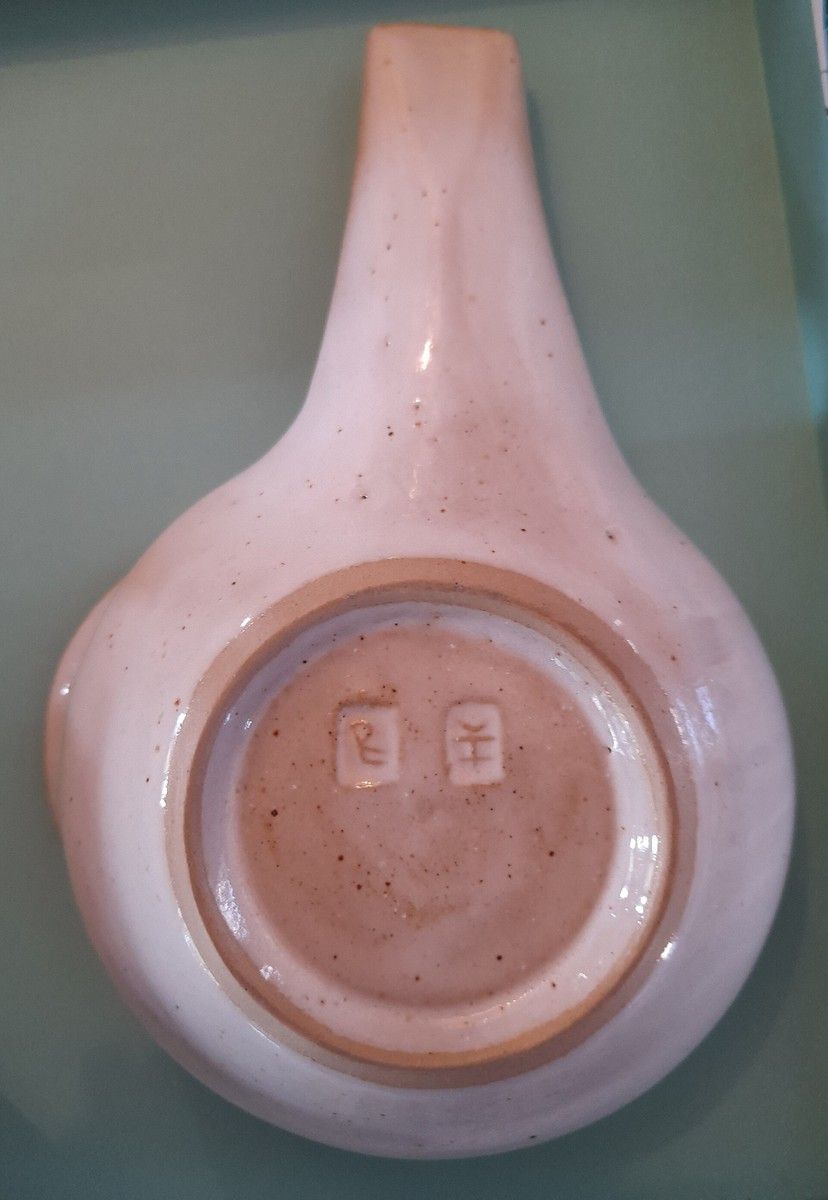
The cup above carries two seals pressed into the unglazed foot, one for each potter who worked on it. Marks like these are small and easy to miss, so turn the piece under a strong light before deciding it is unmarked.
Printed and painted marks
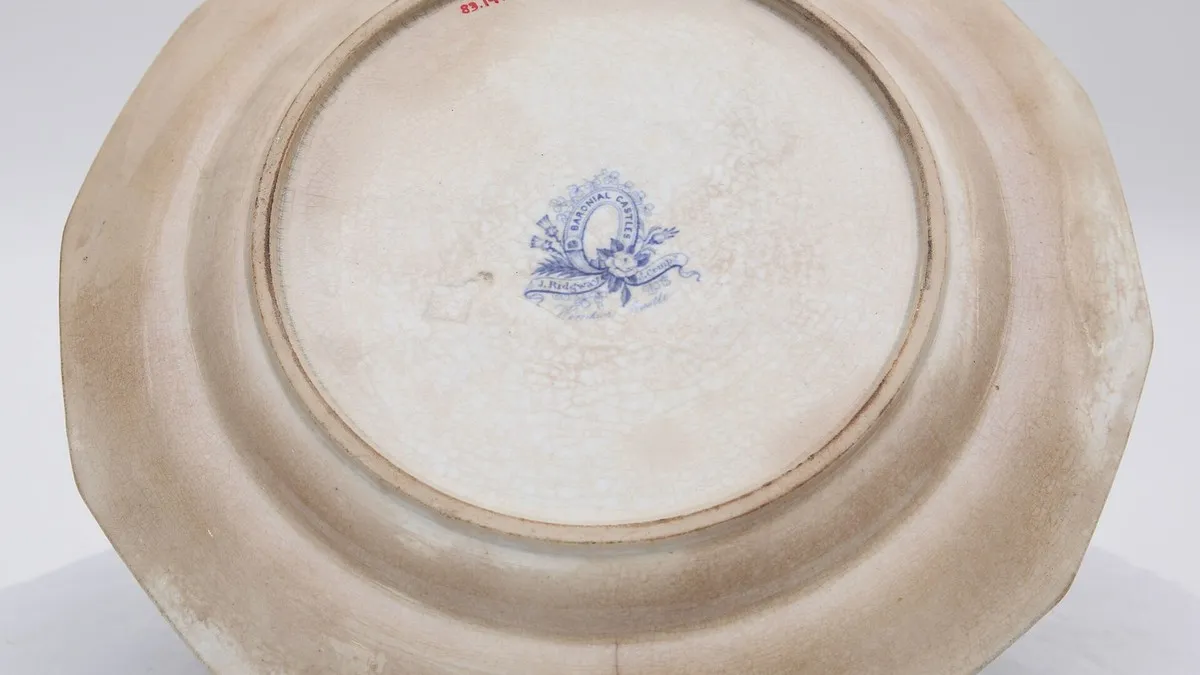
Printed marks were transferred from engraved copper plates at the time of decoration. Most 19th century marks are printed, often in blue under the glaze when the main pattern was also underglaze blue. A printed mark is flat to the touch, and it often carries the pattern name as well as the maker.
Painted marks were brushed on by hand, usually as a name or initials, and usually over the glaze at the time of decoration. The auction house Roseberys notes that marks painted or printed under the glaze on porcelain were done in blue before 1850, with other colours appearing after that. A mark you can catch with a fingernail sits on top of the glaze, which matters later when you check famous marks for copies.
Dating Pottery Marks From the Wording
Most of the dating on a British mark comes from ordinary words that a law or a customs rule pushed makers to add. Each one sets a floor: the piece is unlikely to be older than the date in the table, but it can be much newer, since many firms kept the same wording for decades. The dates below follow the Hungerford Arcade guide unless noted.
| On the mark | Not before | What it means |
|---|---|---|
| Pattern name in the backstamp | 1810 | English china marks began naming patterns |
| Diamond registration mark | 1842 (ends 1883) | The design was registered, see below |
| Staffordshire knot | 1845 | Used most between 1870 and 1890 |
| "Royal" in the maker's name | The 1850s | A dating clue on its own |
| "Ltd" or "Limited" | 1861 | The firm had become a limited company |
| "Trade Mark" | 1862, normally after 1875 | Followed the trade mark laws of those years |
| "Rd No" and a number | 1884 | Replaced the diamond |
| "England" | 1891 | Country of origin for the US market |
| "Made in England" | 1900 | A later form of the country mark |
| "Bone China" | The 20th century | The ware itself is 20th century |
Country names and royal arms
The country words have a clear cause. In 1890 the United States passed the McKinley Tariff, which required the country of origin on imported goods, so Roseberys dates wares marked ENGLAND, GERMANY or JAPAN as likely after 1891. Our guide to how to identify antiques covers the same rule across other materials, including the shift from "Nippon" to "Japan" on Japanese wares.
A Royal coat of arms on the mark usually means the 19th century or later. Hungerford Arcade adds that arms with a small extra shield in the centre point to before 1837, and arms without it to after. Cardiff's conservators warn that many potters who held no Royal Warrant used the arms anyway, so the arms show ambition rather than royal custom.
Reading the Registration Diamond and Rd No
The diamond-shaped mark with "Rd" in the middle is the most useful date clue on Victorian British pottery. According to the National Archives, a diamond mark on its own tells you the design dates from between 1842 and 1883, and the letters and numbers inside it give the day, month and year of registration.
The layout changed in 1868. From 1842 to 1867 the year letter sits at the top of the diamond, and from 1868 to 1883 a number for the day sits at the top and the year letter moves to the right-hand point. Kovels' table of English registry marks gives the class numeral in the small circle at the very top, and Roman numeral IV means a ceramic. The year and month letters follow no alphabetical order (1842 is X, 1843 is H, 1844 is C), so you need the decoding table rather than guesswork.
From 1884 the diamond was dropped for "Rd No" followed by a running number. The numbers climb year by year, so a printed table converts one to a year. Kovels gives the example that a piece marked Rd No 821265 was registered in 1937.
Both systems date the design, not the piece. A popular shape could stay in production for years after it was registered, so read the registration date as "made in or after", never "made in".
Maker Date Codes: The Wedgwood Example
Some factories dated their own output with a private code, and Wedgwood, Royal Worcester and Derby are the best known. Wedgwood's is the easiest to follow.
From 1860, Wedgwood added three impressed letters beside its name. The first stood for the month, the second for the potter and the third for the year. 1860 is O, 1861 is P and so on through the alphabet. The cycle restarted in 1886, so each year letter appears twice. The Handbook of Pottery and Porcelain Marks gives the examples YOR for May 1863 and LOE for July 1902.
The code changed twice afterwards. In 1907 a number 3 replaced the month letter to show which cycle was running, and that became a 4 in 1924. From 1930 the code used the month as a number and the last two digits of the year, so a mark ending in 32 means 1932.
If your Wedgwood piece carries the name alone with no code, that is not a problem in itself. It simply means the code is missing or worn, and the shape, glaze and decoration have to carry the dating instead.
Pottery Makers Marks That Get Copied
The more a mark is worth, the more often it appears on pieces its owner never made. Some copies were meant to deceive, and many were honest imitations by other factories or later potters paying tribute to an earlier style.
Meissen's crossed swords
Roseberys calls the Meissen crossed swords the mark with the largest number of imitators. Factories across Europe used versions of it, and so did English works at Bristol, Caughley, Chelsea, Derby, Lowestoft and Worcester. Samson of Paris, founded to make high quality reproductions of museum pieces, marked its copies with its own variants of the marks it imitated.
Christie's goes further and says that for Meissen the mark is only a very small part of the puzzle, since many early pieces carry no mark at all. Specialists judge the weight, the colour of the porcelain and the way the glaze pulls back at the foot rim before they trust the swords.
Chinese reign marks
A six-character reign mark names a dynasty and an emperor, and it is the mark most likely to mislead a first-time reader. Christie's explains that Chinese potters copied earlier reign marks for centuries out of respect for those periods, and such marks are called apocryphal. It is not uncommon to find 15th century Ming marks on Kangxi period blue and white (1662 to 1722), and the Xuande and Chenghua marks are the two most copied.
The stakes are why this matters. For its September 2026 sale Christie's offered a famille rose bowl with a Yongzheng mark, catalogued as of the period (1723 to 1735), at an estimate of $400,000 to $600,000. A later piece carrying the same characters is a different object, and the characters alone cannot tell you which one you hold.
Roseville and McCoy
American art pottery has its own copying problem. Pieces made from 1927 to 1935 carried no stamped Roseville trademark, often only a paper label; from 1936 it used a die-impressed "Roseville" with a shape number and size, and from about 1940 a raised "Roseville U.S.A." with the same numbers, so a Lotus vase in shape L4 standing 10 inches tall reads "L4-10". Reproductions made overseas often carry a Roseville name on lines that should have a different mark or none, and on many reproduction marks the letters stand straight where the factory lettering leans slightly to the right.
The McCoy collectors society describes the same tangle from the other side. Nelson McCoy marks started out incised and later became embossed, identical shapes were reissued years apart with different marks or none, and the society warns that recent reproductions carry marks that look right and fool unwary collectors.
From the Mark to the Value
Once you know the maker and a date range, the question becomes what pieces like yours sell for. Three things move the number more than the mark itself:
- The specific pattern, shape and size. A maker's best lines and its everyday tableware can sell for very different amounts under the same backstamp.
- Condition. Chips, cracks, crazing and restoration all count. Christie's notes that collectors of Chinese ceramics now consider restored pieces and hairline cracks that they would have refused twenty years ago, but damage still changes the price.
- What buyers actually paid. Asking prices are wishes; sold prices for close matches are the closest thing to a market value.
Where an AI estimate fits
This is where Primo Worth fits for a first idea. Snap a photo and Antique mode suggests a maker, era, origin and material with a short backstory, and the result is checked against recent eBay sales where they exist, with the sold listings shown so you can judge whether they match your piece. Keep your own close-up of the base so you can compare your mark with the ones in those listings.
It is an AI estimate, not a professional appraisal. A photo cannot confirm a piece's age or maker, and it cannot tell a factory mark from a copied one, so a high-value find still goes to a ceramics specialist or an auction house. If you are sorting a box of finds, our guide to thrift store finds worth money covers which categories deserve that second look.
Primo Worth is free to download and you can try three scans free, which is enough to check whether a marked piece belongs in the keep pile or the sell pile before you spend money on an expert.
Key Points to Remember
Read pottery marks in order: the method first, then the words, then any code. An impressed or underglaze mark went on at the factory; a mark you can catch with a fingernail sits on top of the glaze.
The wording sets a floor date. Pattern names, "Ltd", "Trade Mark", "England", "Made in England" and "Bone China" each rule out earlier dates, and a registration diamond or Rd No dates the design rather than the piece.
Famous marks are the most copied. Meissen swords, Chinese reign marks and Roseville names need the body, glaze and decoration to agree before you trust them.
Value comes last and comes from comparable sold prices and condition, not from the mark alone.