A worn, common Walking Liberty half dollar is worth its silver, about $18.72 at the spot price of $51.76 an ounce on November 11, 2026. The Walking Liberty half dollar value climbs past melt when the coin carries a scarce date and mint mark, above all the 1916-S, the 1917-S with its mint mark on the front, the 1919-D, all three 1921 coins and the 1938-D, or when it survives in uncirculated condition.
If you found one in a drawer or inherited a roll, the date and the tiny letter near the rim decide almost everything. This guide shows where to look, what the key dates bring in each condition, and why two coins from the same year can sit hundreds of dollars apart.
Walking Liberty Half Dollar Value at a Glance
The series ran from 1916 to 1947 and was struck at Philadelphia, Denver and San Francisco. According to the PCGS collector guide, Adolph A. Weinman designed it, and it was introduced in 1916 alongside the Mercury dime and the Standing Liberty quarter. The figure of Liberty striding toward the sun proved popular enough to return on the American Silver Eagle in 1986.
Values fall into three bands, and knowing which band your coin belongs to is the first step:
- Common dates in worn condition, mostly 1934 to 1947, trade at or slightly above melt.
- Common dates in uncirculated condition bring a collector premium, usually tens of dollars to low hundreds.
- Key dates from 1916 to 1921 and the 1938-D carry a premium even when heavily worn, and run into the thousands in mint condition.
Most Walking Liberty halves sit in the first band, so start with the silver and work up from there.
How Much Silver Is in a Walking Liberty Half Dollar
Every coin in the series is 90% silver and 10% copper, weighs 12.50 grams and is 30.6 mm across. That works out to 0.3617 troy ounces of pure silver per coin, the figure PCGS and Greysheet both list.
Melt value is that weight times the spot price. Kitco listed live silver at $51.76 per troy ounce on November 11, 2026 at 3:27 p.m. ET, which puts one Walking Liberty half at about $18.72 in metal. USA Today reported that silver traded at $51.29 a year earlier, so the melt floor has barely moved over twelve months, even though silver set an all-time high of $121.67 on January 29, 2026 according to Kitco.
Why melt is a floor, not the price
The Greysheet price guide notes that low-condition Walking Liberty halves trade among investors and collectors as junk silver, at spot or at very small premiums above melt. So a worn common date is priced like silver, and the premium starts only where the date or the condition gives a collector a reason to pay it.
Recalculate melt on the day you sell, because a move in spot moves every common coin in your pile at once.
Where to Find the Mint Mark
The mint mark is a single letter: D for Denver, S for San Francisco. Philadelphia coins carry no letter at all. Where that letter sits depends on the year.
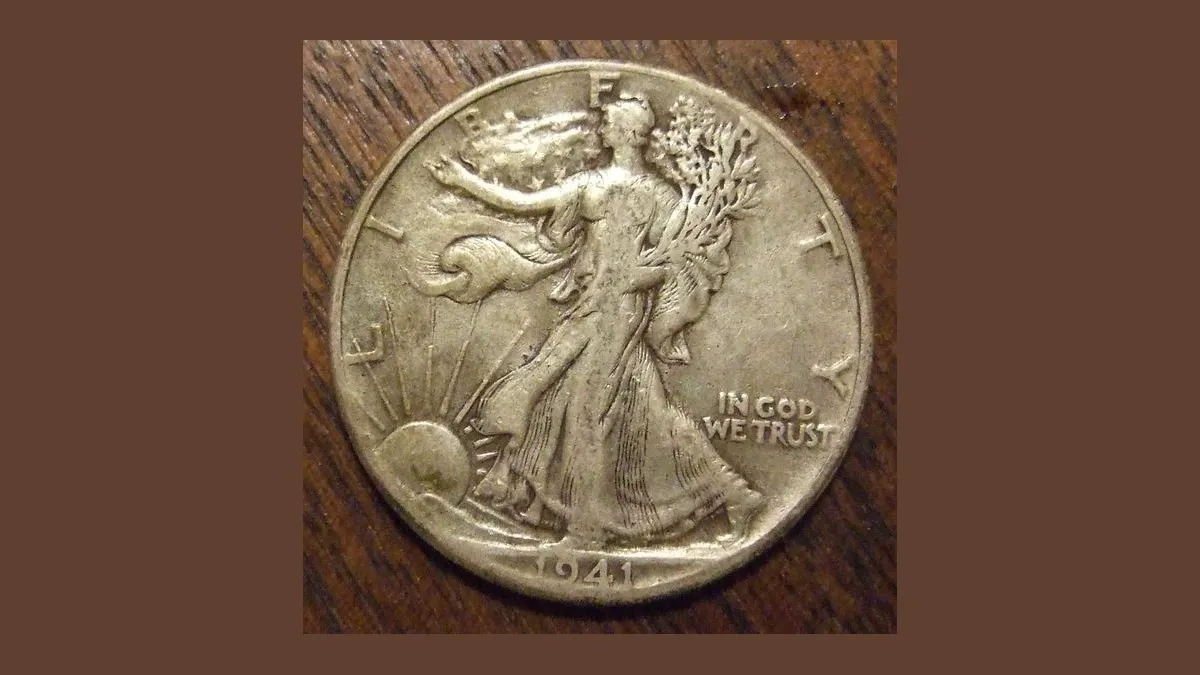
On the 1916 coins and some from 1917, the mint mark is on the front, right under the motto IN GOD WE TRUST. Later in 1917 it moved to the reverse, slightly above and to the left of the word HALF, near the rim under the branch, and it stayed there until 1947. PCGS points out that 1917 coins can have the mark in either place, which is why price guides list the 1917-D and the 1917-S twice.
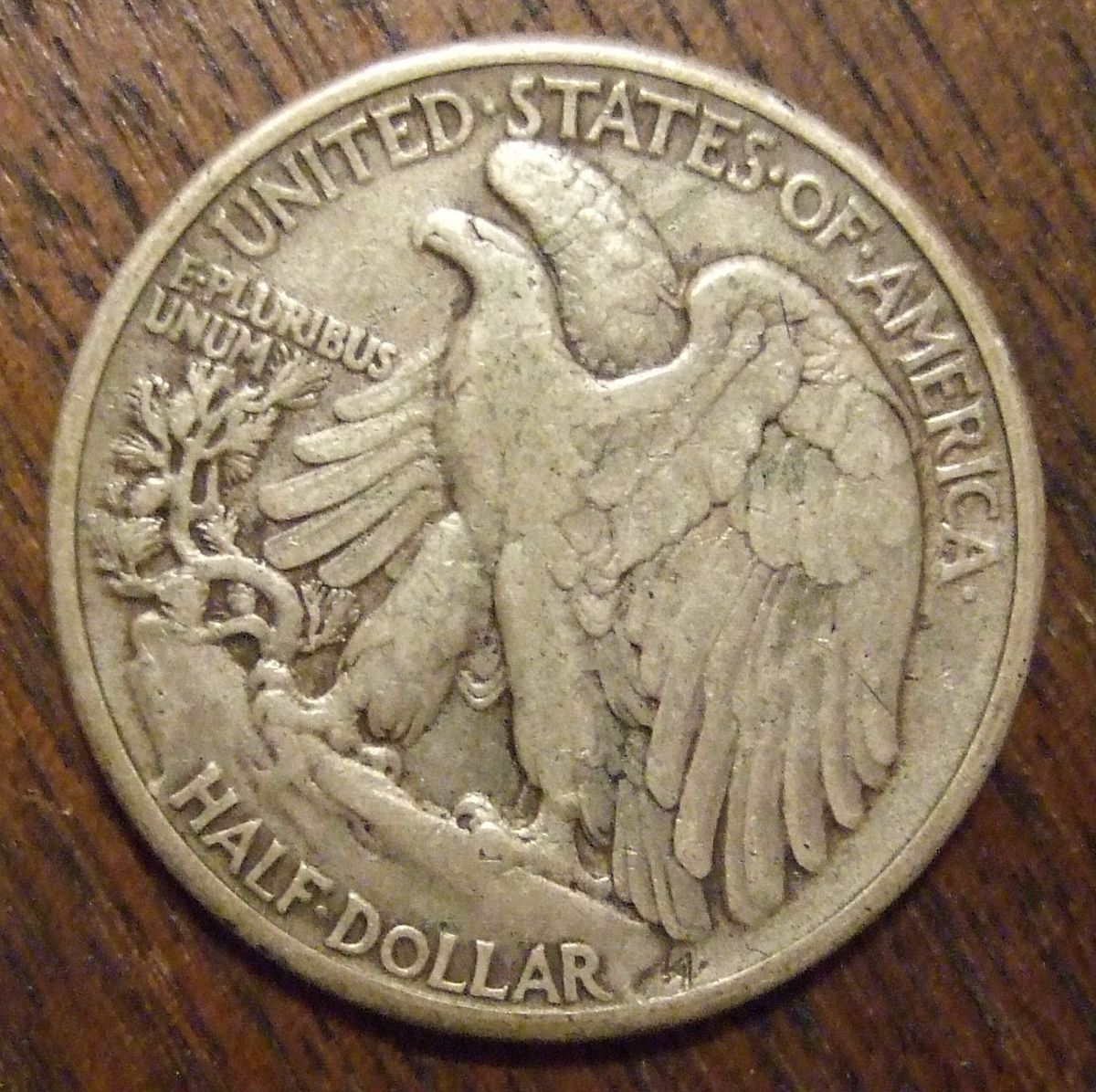
The coin above is a 1941 from Philadelphia, so the spot to the left of HALF is empty. On a Denver or San Francisco coin, a small D or S sits there. Use a loupe or a phone camera zoomed in, and tilt the coin under a lamp; on worn coins the letter can be faint.
Years with no Walking Liberty halves
Not every year has a coin. Greysheet's catalog lists no Walking Liberty halves dated 1922, 1924 to 1926, or 1930 to 1932. If your coin seems to read one of those years, look again under better light, since a worn 3 or 8 is easy to misread.
Key Dates: The Walking Liberty Half Dollars Worth the Most
The table below uses the USA CoinBook value chart, whose collector values were last updated in February 2026. Columns run from heavily worn (Good) through Fine and Extremely Fine to Mint State 63, a typical uncirculated coin.
| Coin | Mintage | Good | Fine | Extremely Fine | MS63 |
|---|---|---|---|---|---|
| 1916-S | 508,000 | $148 | $329 | $807 | $3,517 |
| 1917-S, mark on front | 952,000 | $54 | $194 | $1,014 | $6,847 |
| 1919-D | 1,165,000 | $59 | $164 | $1,260 | $11,502 |
| 1921 | 246,000 | $191 | $415 | $2,847 | $10,036 |
| 1921-D | 208,000 | $297 | $738 | $4,087 | $15,269 |
| 1921-S | 548,000 | $116 | $329 | $5,237 | $38,848 |
| 1938-D | 491,600 | $77 | $134 | $202 | $946 |
These are guide values for coins with no problems, not offers. Prices move with demand, and a coin with a scratch, a hole or a cleaning sells well below them.
The 1921 trio
The three 1921 coins are the heart of the series. The 1921-D had a mintage of only 208,000, and PCGS estimates that perhaps 5% survive, which is why even a heavily worn one is worth several hundred dollars. The 1921-S is the opposite story: plentiful in worn condition, rare without wear. Greysheet's catalog values for a 1921-S in mint condition reach $235,000 at the very top.
1916 coins and the 1917 obverse marks
All three 1916 coins carry premiums. USA CoinBook lists the 1916 Philadelphia coin at $85 and the 1916-D at $85 even in Good condition, with the 1916-S well above both. For 1917, check where the mint mark is. A 1917-D with the mark on the front lists at $59 in Good against $43 for the reverse version, and the front-mark 1917-S is the bigger prize, with a Greysheet catalog value of $168,000 for the finest examples.
The 1938-D
The 1938-D is the one later coin to know by heart. PCGS calls it the only date after 1933 that carries a substantial premium in anything below uncirculated condition, because fewer than half a million were struck. USA CoinBook lists it at $77 in Good, roughly four times melt.
Common Dates From 1934 to 1947
Most halves found in old collections are late dates, such as a 1937, 1942 or 1943 Walking Liberty half dollar. These were struck by the millions: USA CoinBook lists 24,207,412 for the 1941 Philadelphia coin and 31,502,000 for the 1945. In worn condition they trade as silver.
The premium appears once the coin has no wear. USA CoinBook lists a 1944 or 1945 Philadelphia coin at $77 in MS63, a 1941 at $85, and a 1942-S at $116. Sold prices tell a similar story. PriceCharting's sales data for the 1943 Philadelphia half showed loose, unslabbed coins at $19.99 as of November 9, 2026, at about five sales a day, against $62.30 for an MS62 coin and $184 for an MS66.
Condition rarity in the late dates
Some late dates are common worn and rare perfect. PCGS uses the 1941-S as its example: worth no more than any other date in circulated condition, it has fetched as much as $90,000 in MS67. The same guide adds that the chance of owning an unslabbed Walking Liberty in that condition is slim, so treat a late date as a silver coin unless it looks untouched.
How Condition Changes the Price
Two coins of the same date can differ by a factor of ten or more, and the reason is wear. The jump between columns in the table above is almost all condition.
Wear on the high points
Wear shows first on the highest parts of the design, which on this coin means Liberty's figure on the front and the eagle on the back. A coin in Good condition keeps the outline of the design with most fine detail gone, while an Extremely Fine coin shows only light wear on those high points.
Greysheet notes that every Walking Liberty half struck before 1934 is scarce in Extremely Fine or better, and that every pre-1934 coin in MS65 or higher is rare. If you have an early date with sharp detail, that coin deserves a second look before anyone treats it as silver.
Weak strike is not wear
The design has fine detail that the dies often failed to bring up fully. PCGS notes that the skirt lines on 1916 to 1920 coins are often faint even on unworn pieces, that the center where Liberty's hand crosses her waist is weakly struck throughout the series, and that many San Francisco coins from the 1930s and 1940s are soft. A weak strike lowers value less than wear does, but it can make an unworn coin look worn in a photo.
Cleaning and varieties
Never polish or dip a silver coin before selling it, because collectors pay less for a cleaned surface. Greysheet's catalog also lists varieties such as the 1946 doubled die reverse, so a 1946 coin with odd-looking lettering on the back is worth showing to a specialist.
Checking Your Coin With Primo Worth
When you have a pile of halves and want a first read, Primo Worth can speed up the sorting. In Coin mode you snap a photo, and the app identifies the denomination, year and mint mark, adds a note on rarity and what drives the value, and checks the coin against recent eBay sales where they exist.
The estimate is the median of those comparable sales, and the sold listings sit beside it with photo, price, condition and sold date, so you can judge whether the matches look like your coin. Primo Worth gives an AI estimate, not a professional appraisal: a photo cannot confirm the condition a dealer would assign, spot a cleaned surface reliably, or prove that a mint mark has not been added.
If the result points to a 1921 or another key date, take the coin to a dealer or a third-party service. If it points to a common late date, you have your answer: it is a silver coin.
Selling a Walking Liberty Half
Common worn halves sell easily by weight, and any coin shop or bullion dealer will quote you a price tied to spot. Compare two or three offers, because the spread on junk silver varies from shop to shop. Our guide on where to sell coins covers the trade-offs between dealers, auctions and online buyers.
Key dates and uncirculated coins are a different sale. Those reach the highest prices once PCGS or NGC has examined them and sealed them in a holder, because buyers pay for certainty about condition. If you also have later silver halves, the Kennedy half dollar guide explains which of those years are 90% silver and which are 40%.
Putting the Value Chart to Work
A Walking Liberty half dollar is worth its silver, about $18.72 on November 11, 2026, unless its date, mint mark or condition lifts it higher. Check the mint mark first: on the front for 1916 and some 1917 coins, left of HALF on the back for the rest. Then look for the key dates: the 1916 coins, the 1917-S with its mark on the front, the 1919-D, the three 1921 coins and the 1938-D.
Late dates from 1934 to 1947 are worth melt in worn condition and a modest premium without wear. Early dates in sharp condition are scarce, and a coin that has never been cleaned keeps more of its value. Sort by date first, keep the key dates apart, and price the rest against the day's silver.