Most Mercury dimes are worth their silver: about $3.75 each at the silver price of November 5, 2026. Mercury dime value climbs well above that only for a short list of dates and varieties. The 1916-D is the big one, worth over a thousand dollars even badly worn, and the 1921, 1921-D, 1926-S and the two 1942/1 overdates follow it.
So the job with a jar of Mercury dimes is sorting, not pricing every coin. You check each date and mint mark against a handful of keys, set the rest aside as silver, and look closely only at the few that could be special. This guide gives you the dates to look for, the price guide figures behind them, and the reason a sharp strike on the reverse adds a premium to an uncirculated coin.
Mercury Dime Value Chart for Key Dates
The table below uses the PCGS price guide, last updated September 29, 2026. The columns are four common condition points: Good (heavily worn, date readable), Fine (worn but with clear detail), Extremely Fine (light wear on the high points) and Uncirculated (no wear at the bottom of the mint state range).
| Date and mint mark | Good | Fine | Extremely Fine | Uncirculated |
|---|---|---|---|---|
| 1916-D | $1,750 | $4,500 | $9,500 | $18,000 |
| 1921 | $85 | $180 | $550 | $1,775 |
| 1921-D | $110 | $275 | $775 | $2,100 |
| 1926-S | $20 | $55 | $350 | $2,200 |
| 1931-D | $15 | $25 | $60 | $125 |
| 1942/1 overdate | $425 | $535 | $925 | $3,150 |
| 1942/1-D overdate | $400 | $450 | $700 | $4,000 |
| 1941 to 1945, common dates | $9 | $9 | $10 | $17 |
These are retail benchmarks for coins in a PCGS holder, not what a dealer pays for a loose dime. A guide figure can sit well above a dealer's buying price, and a raw coin in a jar usually trades closer to its silver. Use the chart to tell which coins deserve a second look, not to total up a collection.
The common-date row is the one most of your dimes will fall into. The first column for a 1944 or a 1942 is $9, and it barely moves until the coin is uncirculated.
Mercury Dime Melt Value: What the Silver Is Worth
Every Mercury dime from 1916 to 1945 is 90% silver and 10% copper, weighs 2.50 grams and holds 0.07234 troy ounces of pure silver, according to the PCGS collector guide. Multiply that by the spot price and you have the melt value.
PCGS showed silver at $51.79 an ounce on the evening of November 5, 2026. At that price:
| Quantity | Silver content | Melt value, Nov 5, 2026 |
|---|---|---|
| 1 dime | 0.07234 oz | about $3.75 |
| 10 dimes ($1 face) | 0.7234 oz | about $37.46 |
| Roll of 50 ($5 face) | 3.617 oz | about $187.32 |
Silver moves every day, so multiply the current spot price by 0.07234 to get today's figure for a single dime. The same PCGS guide notes that a premium of around 10% over melt is typical for common silver coins, which is where a worn 1941 or 1944 Mercury dime usually lands.
If the same box holds pre-1965 quarters, the silver quarter melt guide works the same arithmetic with a heavier coin.
How to Read the Date and Mint Mark
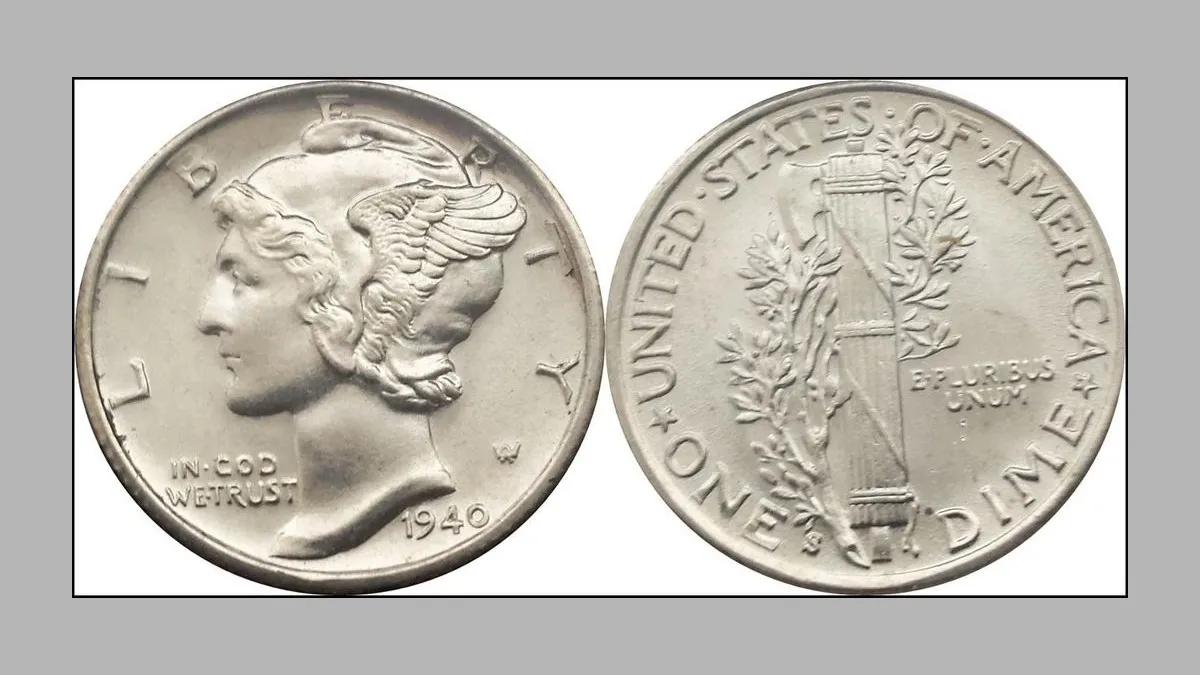
The date sits on the obverse, below Liberty's chin and to the right of her neck. On a worn coin it is often the first thing to fade, so tilt the dime under a single light to catch the edges of the numbers.
The mint mark is on the reverse, at the lower left of the fasces (the bundle of rods in the center), just after the word ONE. A D means Denver and an S means San Francisco. No letter at all means Philadelphia.
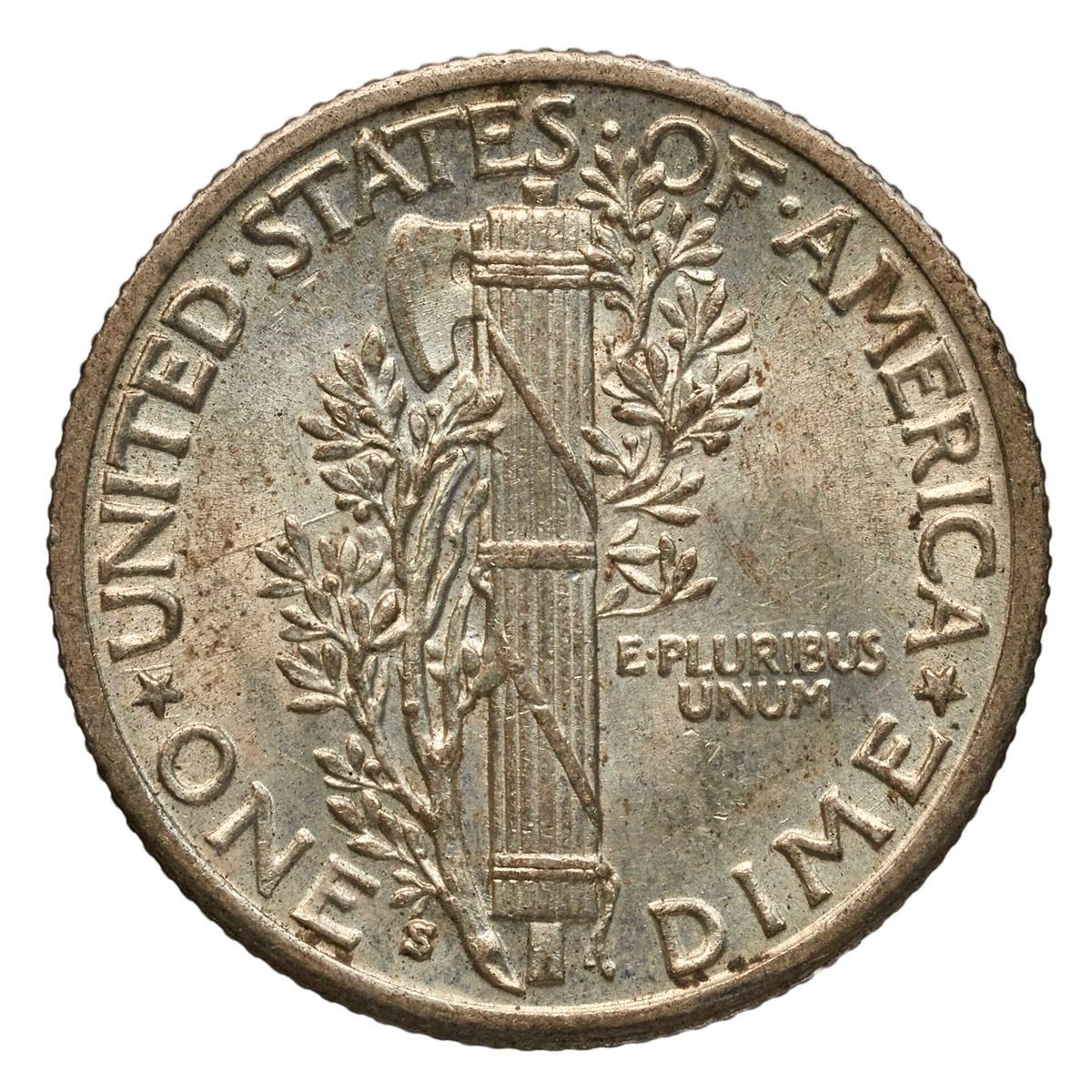
The mint mark is tiny and easy to confuse with a scratch or a bit of grime. A 10x loupe helps, and so does comparing the shape with a dime you already know is a D or an S.
The 1916-D: The Key Date Worth Thousands
Denver struck only 264,000 dimes in 1916, the first year of the design. Philadelphia struck 22,180,080 the same year and San Francisco 10,450,000. That gap is why the 1916-D is the key to the whole series, and why the price guide starts at $1,750 for a coin in Good condition.
PCGS's CoinFacts page notes that the Denver Mint seems to have stopped making dimes after the first run to concentrate on quarters, and that the first 1916-D dimes were not delivered until December 29. They reached circulation in 1917.
Top examples sell for far more. The same page records a PCGS MS64+ example selling at Heritage for $31,720 on May 2, 2026, and a superb Full Bands coin that sold for $300,000 at Stack's Bowers in March 2020.
Why a 1916-D needs a second opinion
The 1916-D is one of the most counterfeited US coins, and the usual trick is adding a D to a common 1916 Philadelphia dime. PCGS's experts advise buying one only in a PCGS or NGC holder, even in the lowest condition. If you find what looks like a 1916-D in a family collection, treat it as a possible fake until a coin dealer or a service such as PCGS or NGC has examined it.
The tells are the style and placement of the D and the surface right around it, judged under magnification. That is specialist work, so a photo or a quick look at home will not settle it.
1921, 1921-D and 1926-S: The Semi-Keys
The early 1920s recession cut coin production across the board. The 1921 Philadelphia dime has a mintage of 1,230,000 and the 1921-D just 1,080,000, the second-lowest in the series after the 1916-D. Both are usually found heavily worn, and the price guide puts them at $85 and $110 in Good.
The 1926-S had a larger run, 1,520,000, and is cheaper in worn condition at $20 in Good. Its value jumps sharply higher up the scale, to $2,200 uncirculated, because San Francisco struck many of them weakly. A well-struck 1926-S is much harder to find than its mintage suggests.
The 1931-D is not on PCGS's short list of keys, but it is worth setting aside. At $15 in Good and $60 in Extremely Fine, it still beats silver several times over.
1942 Mercury Dime Value and the 1942/1 Overdates
An ordinary 1942 Mercury dime is a common date worth its silver, about $9 in the price guide in worn condition. The coins to look for are the 1942/1 and 1942/1-D overdates, where a 1 shows underneath the 2 at the end of the date.
The mistake happened at the die stage. According to a PCGS article, two obverse working dies were impressed with a 1941 hub and then a 1942 hub late in 1941. One die stayed in Philadelphia and the other went to Denver. PCGS estimates that about 3,600 of the Philadelphia overdates survive and about 3,200 of the Denver ones.
In the September 2026 price guide, the 1942/1 starts at $425 in Good and the 1942/1-D at $400, rising to $3,150 and $4,000 uncirculated. Die wear, damage and filled dies can make an ordinary 1942 look like it has something under the 2, so these are coins to have attributed by PCGS or NGC rather than judged from a photo.
1944 Mercury Dime Value and Other Common Dates
Ron Guth's summary of the series on CoinFacts is that apart from the 1916-D and the 1942 overdates, most dates can be obtained with little difficulty. The 1941, 1942, 1943, 1944 and 1945 issues from all three mints sit at $9 in Good and $17 uncirculated in the PCGS guide.
The 1944 is one of the most searched single dates, and the answer is the same as for its neighbors: a worn 1944, 1944-D or 1944-S is worth its silver plus a small premium. The same goes for a silver Mercury dime of any common date with ordinary wear.
There is one variety in these years worth a look. The 1945-S Micro S has a noticeably smaller S mint mark than the usual one. It is the most common of the series' varieties and sits at $9 in Good, but it reaches $35 uncirculated, about twice an ordinary 1945-S at that level.
How Full Bands Changes the Price
Full Bands, written FB on a holder, describes the strike rather than the wear. The bands are the horizontal ties around the fasces on the reverse. On a weakly struck coin they merge; on a sharply struck one the central pair shows a complete split down the middle.
PCGS's Full Bands standard normally applies only to uncirculated coins, with exceptions for the 1916-D and both 1942/1 overdates, which can carry it from About Uncirculated 50 up. Nicks or marks that interrupt the split rule it out.
For uncirculated coins, Full Bands is a separate premium on top of the date and the condition. CoinFacts notes that a 1916-D with Full Bands sells at about a 50% premium at the MS63 level. On weakly struck dates such as the 1926-S, a Full Bands coin is far scarcer than the mintage alone would suggest.
PCGS also warns that people cut across the bands with a sharp tool to fake the split. A worn dime will not have Full Bands, so the question only matters for coins that show no wear at all.
How to Sort a Jar of Mercury Dimes
Sorting goes fastest in a fixed order, with good light and a loupe:
- Pull every dime dated 1916, 1921, 1926 and 1931, and every 1942, then check each mint mark against the chart.
- Look under the 2 on each 1942 for a 1 showing through, and set aside any that look doubled.
- Set aside every uncirculated-looking coin and check the reverse bands, whatever the date.
- Count the rest as silver at 0.07234 ounces each.
The coins in your first three piles are the ones to show a coin dealer. Do not clean any of them: cleaning is one of the things that changes what a buyer will pay for a collectible coin.
For the wider method of checking an old coin, including condition and handling, the guide to what an old coin is worth walks through it step by step.
Checking a Dime With Primo Worth
Primo Worth can help with the first pass when you are unsure what you have. In Coin mode, you snap a photo and it identifies the denomination, year and mint mark, with a read-out on rarity and what drives the value. The estimate is checked against recent eBay sales where they exist, and the sold listings are shown so you can judge whether the matches fit your coin.
Primo Worth gives an AI estimate, not a professional appraisal. A photo cannot tell an added D from a real Denver mint mark, cannot confirm a 1942/1 overdate and cannot judge whether the bands are fully split. Any dime that looks like a key date or a variety belongs with a coin dealer, or with PCGS or NGC, before you sell it. You can try three scans free.
Key Points on Mercury Dime Value
Most Mercury dimes are worth their silver: 0.07234 troy ounces each, about $3.75 at the November 5, 2026 spot price, plus a small premium for common dates.
The coins that matter are the 1916-D, the 1921 and 1921-D, the 1926-S and the 1942/1 and 1942/1-D overdates, with the 1931-D as a smaller bonus. Read the date on the obverse and the mint mark at the lower left of the fasces on the reverse.
Full Bands matters only for uncirculated coins, where it can add a large premium. The 1916-D and the overdates are faked often enough that any you find should be examined by a specialist before you price or sell them.