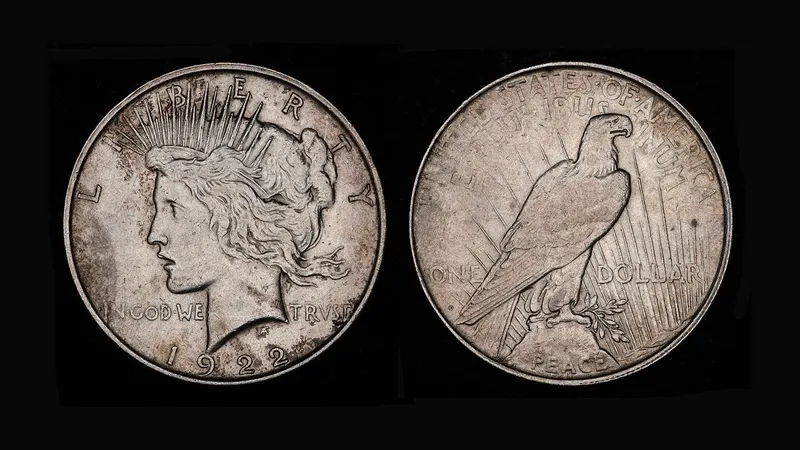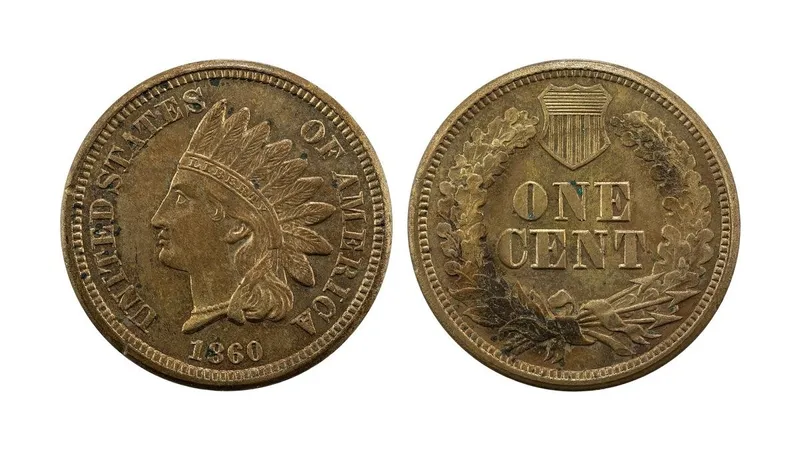
A silver quarter is any United States quarter dated 1964 or earlier, and a common one is worth the silver inside it. The NGC melt table put a 1932-1964 Washington quarter at $9.23 on 2 November 2026, with silver bid at $50.90 and offered at $51.05 an ounce. Silver quarter value starts at that melt price and climbs above it only for key dates, rare varieties and coins in exceptional condition.
That makes a jar of old quarters easy to sort once you know three things: which years are silver, how the melt price is worked out, and which few dates are worth far more than their metal. This guide covers all three, plus the edge and weight tests that tell a silver quarter from a clad one in seconds, the silver quarters dated after 1964 that most people miss, and where the prices in any guide actually come from.
Which Quarters Are Silver
Every circulating quarter the US Mint struck through 1964 is 90% silver and 10% copper. According to the US Mint, silver came out of the quarter in 1965, when the composition became copper-nickel clad: 8.33% nickel and the rest copper, weighing 5.670 grams.
The three silver designs a reader is likely to hold all share one standard. APMEX gives the Barber quarter (1892-1916), the Standing Liberty quarter (1916-1930) and the Washington quarter (1932-1964) the same total weight of 6.25 grams, or 0.2009 troy ounces, and the same pure silver content of 0.1808 troy ounces. A worn 1898 Barber and a crisp 1964 Washington therefore carry the same silver floor.
| Quarter | Years | Silver | Weight | Pure silver |
|---|---|---|---|---|
| Barber | 1892-1916 | 90% | 6.25 g | 0.1808 oz |
| Standing Liberty | 1916-1930 | 90% | 6.25 g | 0.1808 oz |
| Washington | 1932-1964 | 90% | 6.25 g | 0.1808 oz |
| Bicentennial, 1976-S collector issue | 1976 | 40% | 5.75 g | 0.0739 oz |
| Silver proof, S mint | 1992-2018 | 90% | 6.25 g | 0.1808 oz |
| Silver proof, S mint | 2019 on | 99.9% | 6.343 g | about 0.2037 oz |
| Washington and later designs, clad | 1965 on | none | 5.67 g | 0 |
The last four rows matter because they break the simple rule. A 1965 or later quarter is clad unless it came from a collector set, and those exceptions have their own section further down.
Silver Quarter Melt Value: How the Number Is Worked Out
Melt value is the pure silver weight multiplied by the spot price. For a 90% quarter that is 0.1808 troy ounces times spot, so at the $51.05 offer price NGC listed on 2 November 2026, one quarter holds $9.23 of silver. Four quarters, one dollar of face value, hold 0.7232 ounces, about $36.92 at the same price.
Spot moves every trading day, and in 2026 it has moved a lot. The silver ticker on PCGS CoinFacts read $54.00 on 28 October, $49.16 on 30 October and $50.68 on 2 November. The PeerMetals guide priced the same quarter at $11.83 on 3 September 2026, when silver stood at $65.44. A melt figure is only true for the day it was written, so multiply 0.1808 by the price on the day you sell.
Worn coins hold a touch less silver than new ones, because circulation rubs metal away. Bulk buyers account for that: the PeerMetals table counts a $1,000 face value bag of circulated 90% coins as 715 troy ounces, against the 723.2 ounces the same face value would hold unworn.
What a dealer will actually pay
Melt is the value of the metal, not an offer. On 3 September 2026, PeerMetals reported APMEX selling a roll of circulated silver quarters for $483.34 while dealers were bidding $357 to $408 for the same roll. The gap between a dealer's buy price and sell price is how a bullion business pays its costs, so a seller of common dates should expect something at or under melt.
Bulk silver, often called junk silver, is also priced by face value rather than by date. A dealer buying a bag pays the same for a 1934 quarter as for a 1964 one. That is fine for common dates and a poor deal for a key date, which is why it pays to look at every coin before a jar goes to a bullion buyer.
How to Tell a Silver Quarter From a Clad One
Three checks settle almost every quarter, and none of them needs more than a minute. Run them in this order, because each one is quicker than the next:
- Read the date: 1964 or earlier is silver. 1965 or later is clad, apart from the collector issues described further down.
- Look at the edge: a silver quarter has a solid silver-gray edge all the way round.
- Weigh it: a silver quarter weighs 6.25 grams and a clad one 5.67 grams.
The edge test
Stand the coin on its side and look at the reeded edge. A clad quarter shows a copper stripe running through the middle of the reeding, because the copper core between its outer layers shows through. A 90% silver quarter is the same alloy all the way through, so its edge is one even silver-gray colour.
The edge test is the fastest way to sort a roll. Stack the coins, look at the side of the stack, and the silver ones stand out as the bands with no copper line. A heavily toned silver quarter can look dark, but it will still lack the bright copper stripe.
The weight test
The gap between 6.25 and 5.67 grams is 0.58 grams, so any scale that reads to a tenth of a gram will show it. Weight is the better test when the date is worn flat or the edge is dirty, and it is the only quick check for the one exception that matters most: a 1965 quarter struck on silver.
The 1965 quarter on a silver planchet
When the Mint switched to clad in 1965, a few leftover 90% silver blanks were struck with the new date. Coinrollhunting.org describes these transition errors as extremely scarce, with only a handful of confirmed examples. A 1965 quarter that weighs 6.25 grams and shows a solid silver edge belongs with PCGS or NGC for examination, never in a bag sold for melt.
Silver Quarter Value by Key Date: 1932-D and 1932-S
The Washington quarter has only two dates struck in fewer than one million coins, and both are from its first year. PCGS records a mintage of 436,800 for the 1932-D and 408,000 for the 1932-S, against 5,404,000 for the 1932 struck in Philadelphia. Neither was meant to be rare. PCGS notes that regional banks simply had little need for new coins, and both were still for sale from the US Treasury at face value plus postage as late as 1934.
The USA Coin Book price chart, with numismatic values last updated in February 2026, shows how far these two sit above an ordinary silver quarter in every condition:
| Coin | Mintage | Good | Very Fine | Mint State 60 | Mint State 65 |
|---|---|---|---|---|---|
| 1932 (Philadelphia) | 5,404,000 | $17.06 | $24 | $39 | $353 |
| 1932-D | 436,800 | $121 | $202 | $1,252 | $12,168 |
| 1932-S | 408,000 | $111 | $156 | $536 | $3,094 |
Even a heavily worn 1932-D or 1932-S is worth more than ten times melt, which is why every 1932 quarter deserves a look at its reverse.
Why the two key dates differ in top condition
In worn condition the 1932-D and 1932-S trade close together. In Mint State they split, and the table shows the 1932-D at almost four times the 1932-S in Mint State 65. PCGS's David Hall explains why: the two are about equally rare in circulated condition, but Mint State 1932-D quarters are nearly twice as rare as Mint State 1932-S quarters.
The auction records show the same split at the very top. The PCGS CoinFacts record for the 1932-S is $76,250 for an MS66+ coin sold by Heritage Auctions on 18 July 2026, while the 1932-D record is $143,750 for an MS66 coin sold by Bowers and Merena in 2008. Bullion Exchanges, writing about the 2026 sale, warns that a record like this describes an extraordinary coin and should not be used to price a typical circulated one.
Where the mint mark sits
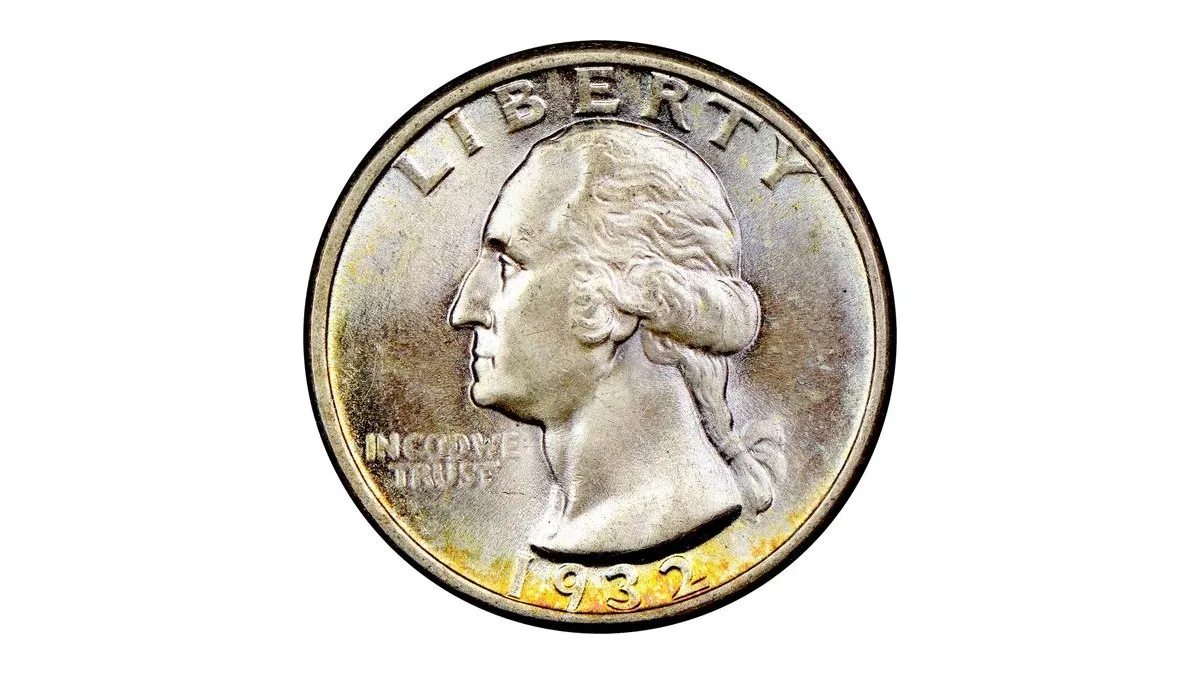
On a 1932 to 1964 Washington quarter, the mint mark is on the reverse, below the olive branches under the eagle. A D means Denver and an S means San Francisco. Philadelphia coins of these years carry no mint mark at all, as on the 1932 coin below. On a Barber quarter the O, S or D sits on the reverse under the eagle's tail feathers.
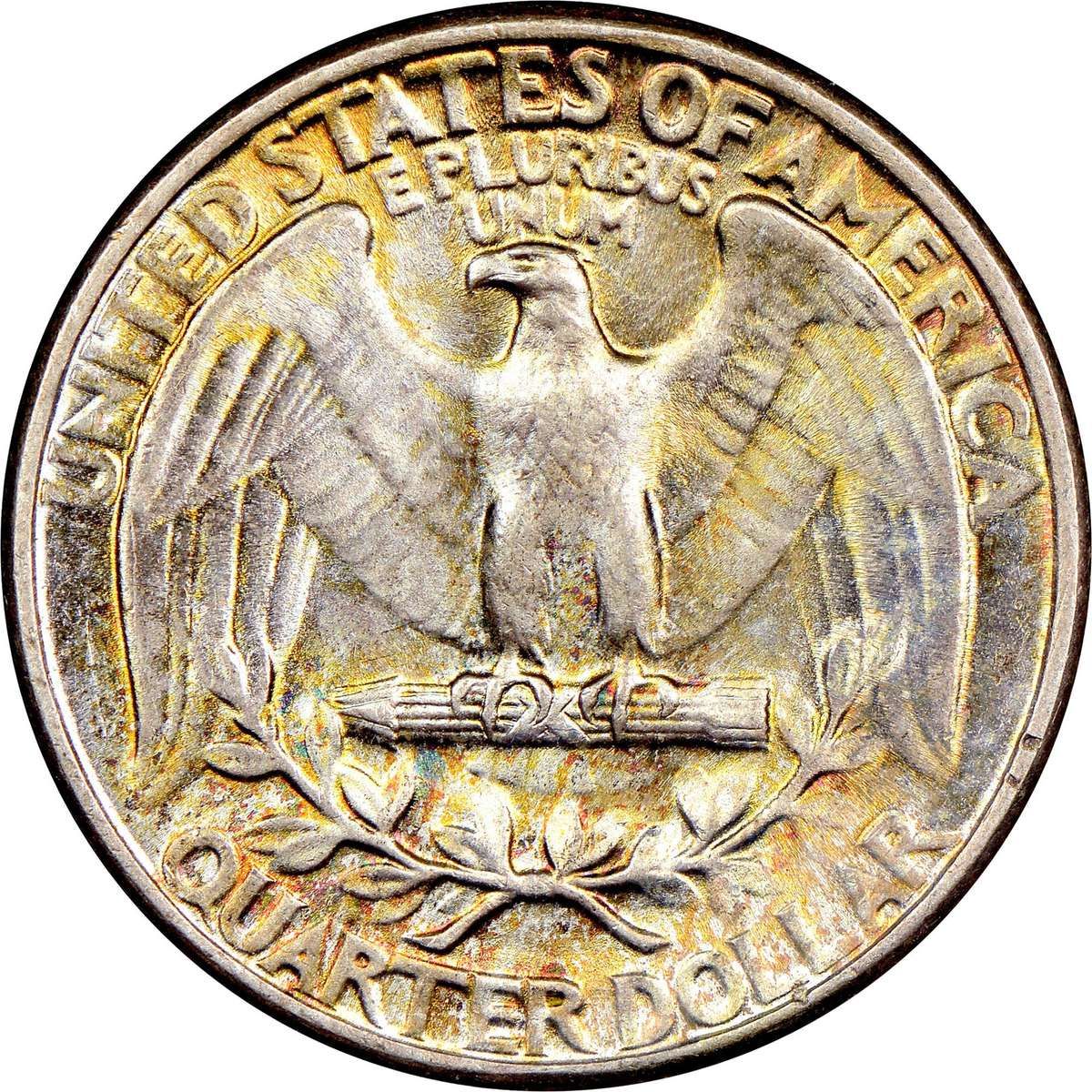
PCGS also warns about sliders on the 1932-S, coins with slight rub on the high points that get offered as Mint State. The difference between those two descriptions is several hundred dollars in the table above, so a coin that looks unworn still needs a second opinion before it is priced as one.
Washington Silver Quarter Varieties Worth More Than Melt
After the two 1932 key dates, the silver Washington quarters worth real money are varieties rather than dates. A doubled die is a die error in which a second, slightly misaligned image is impressed on top of the first, so letters and numbers look doubled. An over mint mark is one mint's letter punched over another's.
The APMEX key dates guide lists these silver-era varieties:
| Variety | Very Fine | About Uncirculated | Choice Uncirculated |
|---|---|---|---|
| 1934 doubled die obverse | $200 | $600 | $1,200 |
| 1937 doubled die obverse | $500 | $1,500 | $2,825 |
| 1943 doubled die obverse | $2,600 | $6,000 | $9,500 |
| 1943-S doubled die obverse | $200 | $400 | $850 |
| 1950-D, D over S | $125 | $200 | $775 |
| 1950-S, S over D | $185 | $350 | $450 |
APMEX published these figures in 2023, so read them as a ranking of which varieties matter rather than as today's prices. The pattern holds either way: the premium on a real variety is many times the silver in the coin, so a doubled date or a strange mint mark is worth checking under a loupe before anything else happens to it.
1964 Quarter Silver Value and Other Common Dates
The 1964 quarter is the last 90% silver year, and the one people ask about most. In circulated condition a 1964 quarter is a common date, so its value is its melt value: $9.23 on 2 November 2026. The PeerMetals guide answers the question of whether common pre-1965 quarters are worth more than melt with a single word: no.
The same holds for nearly every Washington quarter from 1934 to 1964. APMEX notes they were struck by the millions, so circulated examples trade by their silver. The exceptions are the varieties above and coins that survive in top Mint State, where condition, not silver, sets the price. The 1932 Philadelphia quarter in the key date table shows the shape of that curve: $17.06 in Good, $39 in Mint State 60, and $353 in Mint State 65.
Barber and Standing Liberty quarters sit on the same 0.1808-ounce floor. Their key dates are a study of their own, so check the exact date and mint mark against a price guide before selling one for melt.
If the same jar holds half dollars, the Kennedy half dollar guide covers the 1964 silver halves and the 40% silver years that followed, which work the same way.
Silver Quarters Dated After 1964
Two groups of quarters dated after 1964 contain silver, and both were made for collectors rather than for circulation. Each carries an S mint mark from San Francisco, which is the first thing to look for on a late date that seems heavy.
The 1976-S 40% silver Bicentennial quarter
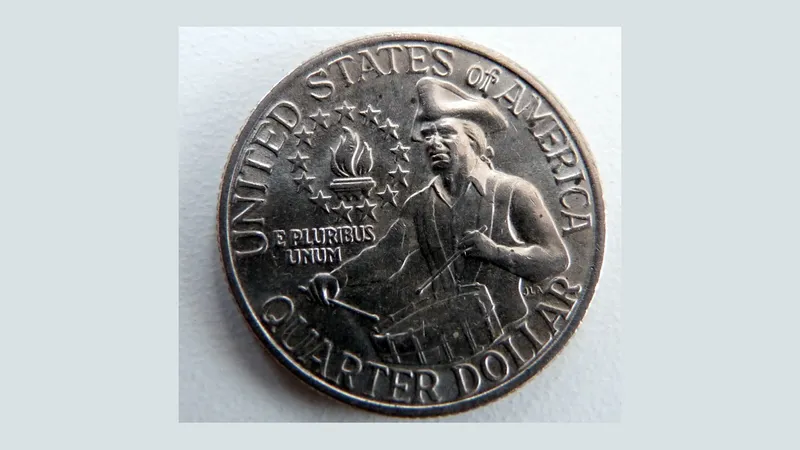
The 1776-1976 quarter with the drummer boy reverse was struck by the hundreds of millions in clad for circulation. A Philadelphia coin with no mint mark or a Denver coin with a D is clad and worth 25 cents in circulated condition.
The San Francisco Mint also struck a 40% silver version, sold only in uncirculated Mint sets and in a three-piece silver proof set with the half dollar and dollar. GreatCollections describes its make-up: outer layers of 80% silver bonded to a core of about 21% silver, 40% overall. It weighs 5.75 grams and holds 0.0739 troy ounces of silver, about $3.77 at the 2 November 2026 price. USA Coin Book values the 40% silver 1976-S at $12.08 in Mint State 65 and $13 as a proof.
Weight is the reliable way to separate it from the clad 1976-S proof, but the gap is only 0.08 grams, so this one needs a scale that reads to a hundredth of a gram.
Silver proof quarters from 1992 on
The Mint has issued a Silver Proof Set every year since 1992, with the dime, quarter and half dollar in 90% silver through 2018. From 1999 the set held five State quarters, and later the America the Beautiful designs, all in silver. In 2019 the Mint switched those coins to 99.9% fine silver, which makes a 2019 or later silver proof quarter weigh 6.343 grams and hold about 0.2037 ounces, roughly $10.40 at the same price.
These coins are mirror-finished proofs with an S mint mark, and they reached the public only in sets. A 1992 or later set still in its box says Silver Proof Set on the packaging and certificate, which is the simplest check. A loose S-mint proof quarter of those years could be silver or clad, so weigh it before assuming either.
Where Silver Quarter Prices Come From
Every price in this guide comes from one of four kinds of source, and each answers a different question. A melt table, such as the NGC one, gives the metal value for one day. A retail price guide, such as USA Coin Book, gives what collectors typically pay at a stated date. An auction record gives the most one exceptional coin ever brought. A dealer bid gives what you would receive today for coins sold in bulk.
A FinanceBuzz review of valuable quarters, updated in October 2026, makes the point that listings are not sales: several coins it checked were listed on eBay for over $200 but marked "or best offer", with dozens of the same coin on offer. Its advice is to check a price guide from PCGS or the American Numismatic Association and then look at recent sold prices for comparable coins. That order works for silver quarters too. If the general method is new to you, the guide on how to tell what an old coin is worth walks through it step by step.
For a common date, melt is the whole answer. For a key date, a variety or a coin that looks unworn, the sold prices of coins in the same condition are what decide.
Checking a Silver Quarter From a Photo
Reading a worn date, finding a tiny mint mark and then checking each combination against several guides takes time when a jar holds dozens of quarters. Primo Worth shortens the first step. It is free to download, with three free scans, then a weekly or yearly subscription. In Coin mode you snap a photo and it identifies the denomination, year and mint mark, with a read-out on rarity and what drives the value, checked against recent eBay sales where they exist and with those sold listings shown so you can judge the matches.
Primo Worth gives an AI estimate, not a professional appraisal. A photo cannot weigh a coin or see its edge, so it cannot confirm that a quarter is silver, and it cannot tell a 1965 silver error from an ordinary 1965 or settle whether a 1932-S is a slider. Use the edge and weight tests for the metal, and take any coin that looks like a key date, a doubled die or a silver 1965 to a specialist.
Silver Quarter Value in Short
Every quarter dated 1964 or earlier holds 0.1808 troy ounces of silver, worth $9.23 on 2 November 2026, and most of them are worth exactly that. The 1976-S Bicentennial and the S-mint silver proofs from 1992 on are the only later quarters with silver, and both came from collector sets.
The edge and the weight separate silver from clad: a solid silver-gray edge and 6.25 grams against a copper stripe and 5.67 grams. The money above melt sits in the 1932-D and 1932-S key dates, worth more than ten times melt even when worn, and in a short list of doubled dies and over mint marks. Dealers buying in bulk pay by face value at or under melt, so the coins that might be special are the ones to set aside and check one by one before a jar is sold.