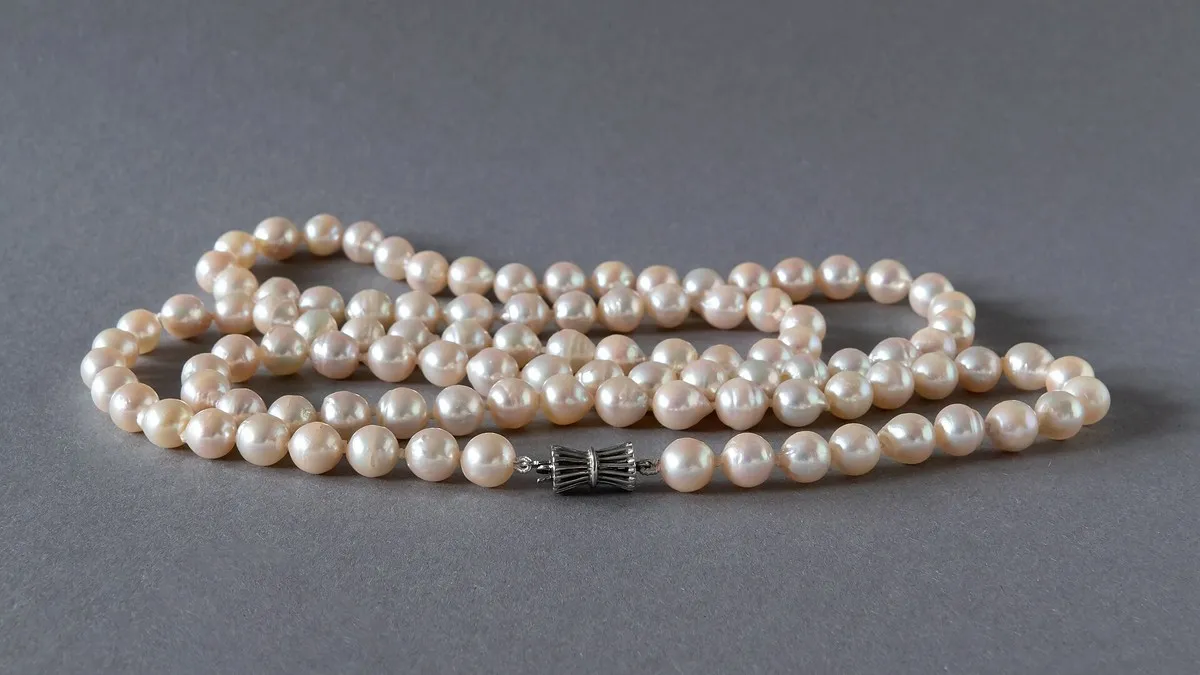
The quickest answer to how to tell if pearls are real is to rub one gently along the edge of your front teeth: a natural or cultured pearl feels slightly gritty, like fine sandpaper, while an imitation feels smooth as glass. That single check catches most fakes, but it is not proof. Good imitations, such as coated shell beads, can come close enough in look and heft to blur the result.
If you inherited a strand, found earrings at an estate sale or bought a necklace secondhand, you want a straight answer before you wear it, sell it or insure it. This guide walks you through seven checks you can do at home, what each one can and cannot tell you, and the point where only a gemologist with an X-ray can settle the question.
What You'll Need
You need very little. Most of these checks use your hands, your teeth and good light.
- Clean teeth and clean hands, so oils and residue do not mask the surface texture.
- A 10x jeweler's loupe or a strong magnifying glass, to look at the surface and into the drill holes.
- Daylight or a bright white lamp, so you see the surface and color as they are.
- A second pearl you know is real, if you have one, for side-by-side comparison.
- Your phone camera, to photograph the clasp, any stamps and the drill holes so you can zoom in.
Real, Cultured or Imitation: What the Checks Separate
Before you start, it helps to know what "real" means here. Jewelers sort pearls into three groups. Natural and cultured pearls are both real pearls, grown inside a mollusk that coats an irritant with layers of nacre. The only difference is that a cultured pearl starts with a bead or tissue placed there by a farmer.
Imitation pearls have no connection to the pearl-growing process. According to the Jewelers of America buying guide, most are glass beads dipped in a solution made from fish scales, and their high luster may fade over time. Others are shell, ceramic or plastic beads under a lacquer coating. They are sold under names like faux, simulated, man-made, organic or Mallorca, so a label alone does not make a strand real.
The home checks below separate real pearls from imitations. They cannot tell you whether a real pearl is natural or cultured. That distinction matters a great deal for value, and it takes lab equipment.
How to Tell If Pearls Are Real: 7 Checks at Home
Run several of these checks, not just one. As the insurer Jewelers Mutual puts it, no single test settles the question, and a combination reduces the chance of error.
1. The tooth test
Hold the pearl and rub it gently, side to side, along the biting edge of your front teeth. Real pearls feel gritty or sandy because nacre is built from tiny overlapping crystal platelets. Imitations feel slippery and smooth, because their surface is molded or painted onto a smooth bead.
The tooth test has a long history in the trade. A 1990 study in GIA's journal of Majorica imitation pearls found saltwater cultured pearls felt gritty while every Majorica bead tested felt smooth. The same study warns that the test can damage a pearl, so be gentle and only test pearls you own.
2. Rub two pearls together
If the strand has more than one pearl, rub two of them lightly against each other. Imitation pearls glide across each other. Cultured pearls catch slightly and feel gritty, the same nacre texture your teeth pick up. Jewelers of America recommends this pearl-on-pearl check because it needs no tools. Wipe the pearls with a soft cloth afterward.
3. Look at the drill holes
The drill hole is where an imitation gives itself away most often. Under 10x magnification, a cultured pearl's hole has sharp, well-defined edges, and you can often see a thin darker line where the nacre meets the bead nucleus inside.
An imitation's hole tends to show ragged edges, with the coating chipping or peeling around the opening and no clear layer between coating and core. GIA's New York lab described exactly this in shell pearl imitations: a thin coating chipped near the drill holes, exposing white shell bead underneath. Peeling or flaking around the hole is the strongest home sign of a fake.
4. Check the surface under magnification
Look closely at the pearl's skin. Real pearls are rarely perfect: small bumps, ridges, pits and tiny spots are normal, because each pearl grew inside a living animal. A 10x loupe is enough to spot them; under a lab microscope, real nacre shows overlapping platelets.
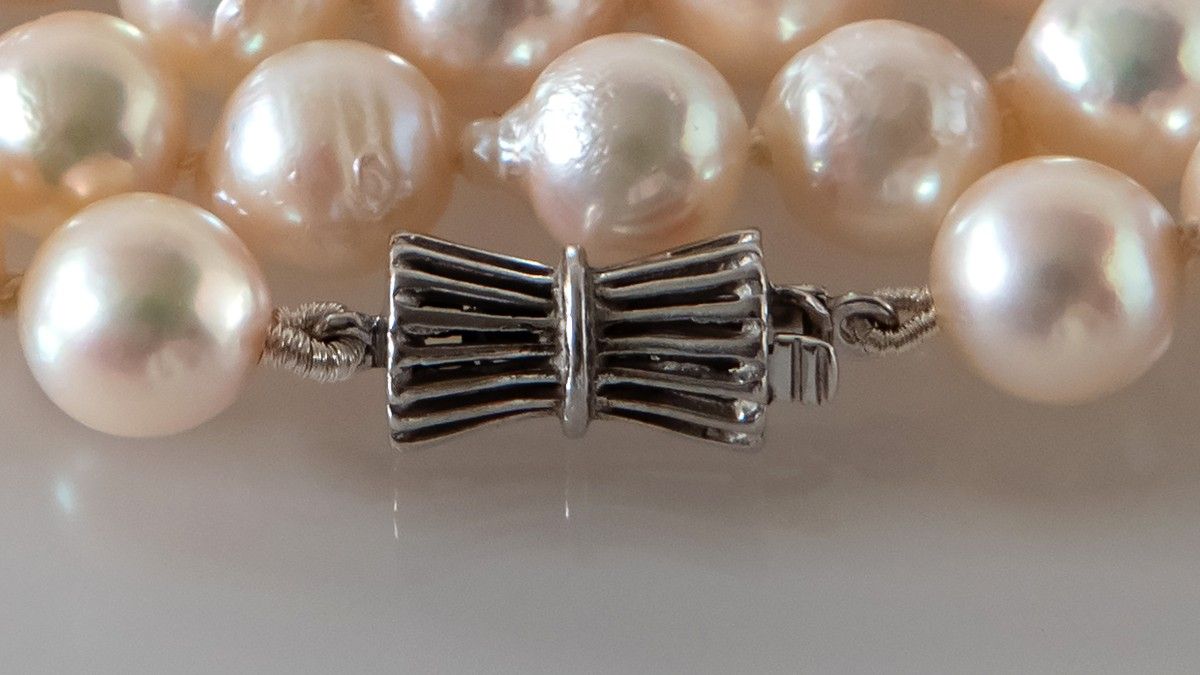
Imitations often look too clean. The GIA shell pearl samples showed a glittery coating instead of overlapping nacre platelets, and the 1990 Majorica study noted that very high luster, distinct iridescence and an absence of blemishes together point to an imitation. A flawless, mirror-bright surface on every bead deserves suspicion, not admiration.
5. Compare shape, size and color across the strand
Lay the strand flat in daylight and look along it. Real pearls vary. Even a well-matched strand shows slight differences in roundness, size and overtone from one pearl to the next, and GIA notes that freshwater pearls are most often near-round or oval rather than perfect spheres.
Imitations tend to be identical. If every bead is the same size, the same shape and the very same color, treat that as one more point against the strand. Variation alone does not prove a pearl is real, but perfect uniformity is a warning.
6. Feel the temperature and weight
Hold the pearls in your palm. Real pearls usually feel cool at first and then warm slowly against your skin, while imitations stay at room temperature. Real pearls also tend to feel heavier for their size.
The Cultured Pearl Association describes appraisers using exactly this handling check: real pearls may feel colder and heavier, fakes warmer and lighter. Glass imitations are the exception. Jewelers Mutual warns that some glass pearls have enough weight to pass, which is why you combine this check with the tooth test and the drill holes.
7. Read the clasp, knots and label
The clasp is evidence about the jewelry, not about the pearls, but it still helps. Fine pearl strands are usually knotted between each pearl, so neighbors do not rub together. A gold or platinum clasp with a karat stamp suggests someone spent money on the strand.
Stamps can mislead, so learn how to read hallmarks and karat stamps before you trust one. Check any card, box or tag too: words like faux, simulated, organic or shell pearl mean imitation, whatever the clasp says.
How a Jeweler or Lab Confirms Real Pearls
Home checks narrow the question. A professional answers it. An experienced jeweler can often spot an imitation by eye and can look down the drill hole with better magnification and lighting than you have at home.
The definitive answer comes from a gem lab. Labs use X-radiography to see inside the pearl: a bead nucleus, the growth structure of a natural pearl, or the solid core of an imitation. Pearls drove the first gem labs: a 2024 article in GIA's journal notes that the London Chamber of Commerce lab (1925), the Laboratoire Français de Gemmologie (1929) and GIA (1931) all began by focusing on separating natural from cultured pearls.
What a pearl report tells you
GIA issues different pearl reports for different questions. According to GIA's pearl guide, a Pearl Identification Report states whether a pearl is natural or cultured and whether it formed in saltwater or freshwater. A Cultured Pearl Classification Report describes quality instead, and a combined report does both for cultured saltwater pearls, including whether the pearl was treated.
If your home checks all point to real and the pieces look old, a report is worth considering. Natural pearls are far rarer than cultured ones, and only a lab can tell them apart.
What Real Pearls Are Worth
Knowing your pearls are real is only half the answer. Value depends on type and quality, and the range is wide.
Pearl type sets the starting point
GIA sorts the four main cultured types like this: freshwater pearls are generally the most affordable, akoya and Tahitian sit in the mid-range to high, and South Sea pearls typically command the highest prices. Size counts heavily within each type. Akoya pearls usually measure 6 to 9 mm, Tahitian 8 to 14 mm and South Sea 8 to 18 mm, and pearls above those typical sizes are rarer and pricier.
The seven value factors
GIA evaluates cultured pearls on seven value factors: size, shape, color, luster, surface, nacre and matching. Bright, sharp luster, a clean surface, thick nacre, a round shape and a well-matched strand all push value up. A spotted, bumpy or cracked surface pulls value down, and so does nacre thin enough that light shows the bead inside.
Resale is lower than retail
Secondhand pearls usually sell for far less than they cost new. In a Cultured Pearl Association article, appraisers said pearls on the resale market can command as little as a tenth of what they cost new, with branded pieces and well-kept strands as the exceptions. One appraiser in that piece suggests deducting 30% for an auction commission to get an idea of value at auction. An insurance replacement value is a different number again and is not a resale price.
Checking what a strand like yours sells for
Once you know the pearls are real, Primo Worth can give you a first idea of value. Snap a photo in Jewelry mode and the app reads the metal, karat, stones and hallmarks it can see, then checks the piece against recent eBay sales where they exist and shows those sold listings so you can judge the matches yourself.
Primo Worth does not tell a real pearl from an imitation: a photo cannot confirm what a pearl is made of, so run the checks above first. The result is an AI estimate, not a professional appraisal, and it is not a promise of what a buyer will pay.
Tips for Better Results
Test in daylight, near a window, rather than under warm indoor bulbs, so luster, overtone and surface flaws show as they are.
Compare against a known pearl when you can. If a relative owns a strand with its receipt or a lab report, a side-by-side tooth test and surface check gives you a reference point for what real nacre feels like.
Photograph before you test. Take close-ups of the clasp, any stamps and two or three drill holes. Zooming in on a phone photo can show coating damage you miss with the naked eye, and you will want those photos if you later ask a jeweler or list the piece.
Be gentle. The tooth test, rubbing pearls together and scratching at a drill hole can all mark a pearl's surface. Skip pin scratches, flame tests and chemicals, which can ruin a real pearl. Our guide on testing a diamond at home follows the same rule: the home check points you in a direction, and a professional confirms it.
Troubleshooting Common Results
The pearls feel gritty but look perfect. Grittiness is a strong sign of nacre. High-quality cultured pearls can look very clean, so a perfect look with a gritty feel usually means good cultured pearls. A lab report settles natural versus cultured.
The pearls feel smooth on your teeth. Smoothness usually means imitation, but the tooth test is one data point. Check the drill holes and the surface under magnification before you decide.
The tests disagree. This is common with glass imitations, which feel cool and heavy, and with coated shell beads, which have the heft of cultured pearls. When the checks split, the drill hole is the tiebreaker at home, and a jeweler is the tiebreaker after that.
The strand mixes pearl types. Appraisers quoted by the Cultured Pearl Association have seen strands mixing freshwater and South Sea pearls. If colors and sizes jump around, have a professional sort the strand before you price it.
The Bottom Line
Real pearls feel gritty against your teeth, show small surface flaws, vary slightly across a strand and have clean, sharp drill holes. Imitations feel smooth, look too perfect and often peel around the hole. Run several checks rather than trusting one.
Home checks separate real from imitation, but only a gem lab with X-ray equipment can tell natural pearls from cultured ones. Value then comes down to pearl type and the seven quality factors, and resale prices for secondhand pearls usually sit well below what they cost new.