Morgan silver dollar value starts with the silver inside the coin. On October 24, 2026, each vintage Morgan held about 41.70 dollars of silver, and common dates in worn condition trade a little above that. The real money sits in a short list of dates and mint marks, where even a worn coin can bring hundreds or thousands of dollars and the finest known example has sold for more than 2 million.
So the useful question is rarely what a Morgan dollar is worth in general. It is which of the dozens of date and mint combinations you have, and how much wear it picked up after it left the press. This guide covers both: how to read the coin, where the silver floor sits today, what each part of the series lists for, the dates that carry most of the value, and the fakes made to imitate them.
Morgan Silver Dollar Value at a Glance
Before going date by date, it helps to know where most coins land. These ranges come from the price guides and auction records cited further down, all read in October 2026.
- Common dates, worn: close to the silver value, so roughly 40 dollars and up at late October's silver price.
- Common dates, uncirculated: about 150 dollars in Mint State 63 and 500 dollars in Mint State 65 in a May 2026 dealer chart.
- Carson City and other better dates: from about 100 dollars to a few thousand, depending on the date and the wear.
- Key dates: the 1893-S, 1889-CC and 1895 Philadelphia start at several hundred to tens of thousands of dollars even when worn, and reach six or seven figures in top condition.
Silver sets the floor and collector demand sets everything above it. For a common date, the floor is most of the value. For a key date, the silver hardly matters.
How to Identify a Morgan Silver Dollar
The coin is named after its designer, George T. Morgan. According to PCGS CoinFacts, it was struck without interruption from 1878 to 1904, then again in 1921, after Congress passed the Bland-Allison Act of 1878 to have the Mint buy large quantities of silver and turn it into dollars.
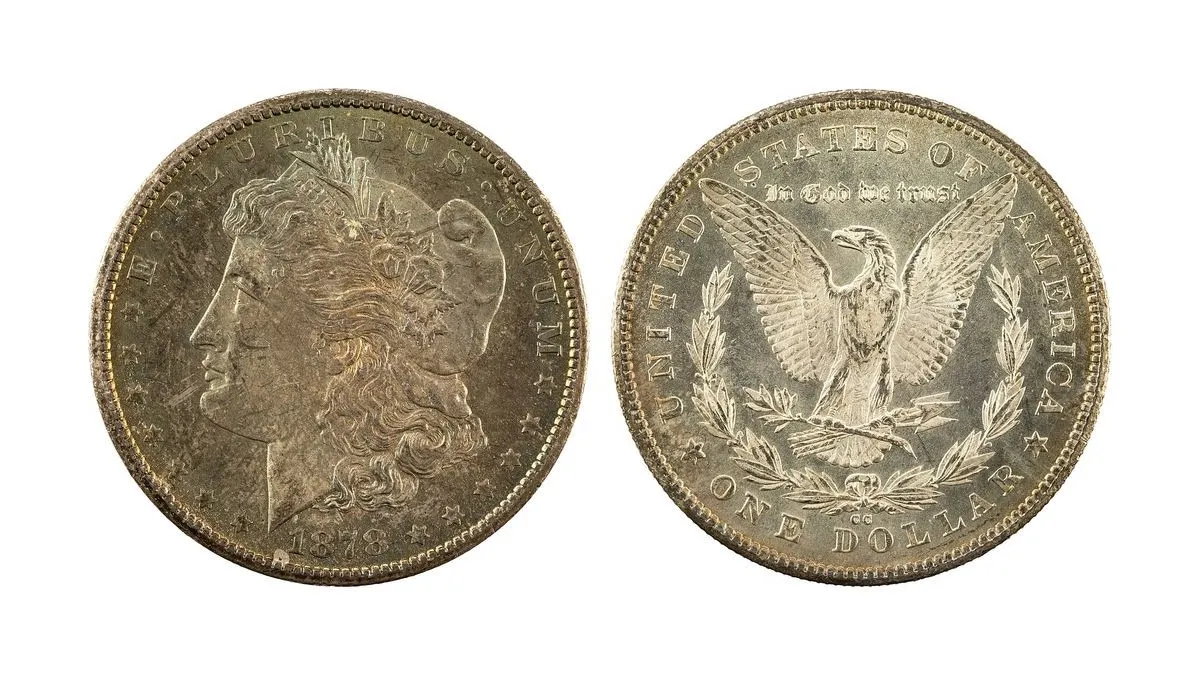
The front shows Liberty's head facing left, with E PLURIBUS UNUM above her and the date below. The back shows an eagle with spread wings inside a wreath, with ONE DOLLAR along the bottom rim. Each coin weighs 26.73 grams, measures 38.10 millimeters across, has a reeded edge and is 90% silver and 10% copper.
Many of them no longer exist. Over 270 million Morgan dollars were melted for their silver under the Pittman Act of 1918, according to GOVMINT, and PCGS estimates that probably several hundred thousand 1893-CC dollars alone went into the melting pot. Mintage figures therefore overstate how many coins survive, which is why two dates with similar mintages can be worth very different amounts.
Where the mint mark is
Turn the coin to the eagle side and look just below the ribbon bow that ties the wreath, directly above the letters DO in DOLLAR. CC means Carson City, O means New Orleans, S means San Francisco and D means Denver, which struck Morgans only in 1921. No letter means Philadelphia.
The mint mark often matters more than the date. In the dealer chart used below, an 1893 from Philadelphia lists at 52 dollars in heavily worn condition, while an 1893-S from San Francisco lists at 3,700 dollars. Use a magnifier, because on a worn coin the letter can be faint.
Modern Morgan dollars are a different coin
Since 2021, the US Mint has struck Morgan dollars again as collector coins, starting with a centennial release of about 175,000 coins per version according to GOVMINT. The US Mint lists its 2026 Enhanced Uncirculated coin at 99.9% silver and 0.859 troy ounce of silver, with a "1776 ~ 2026" dual date and a Liberty Bell privy mark.
A Morgan dated 2021 or later is therefore a modern issue, and none of the vintage prices below apply to it. Its value follows its silver content and the demand for that particular release.
The Melt Value Floor
Each vintage Morgan contains 0.7734 troy ounces of pure silver. On October 24, 2026, with spot silver at 53.92 dollars an ounce, a live melt value tracker put that at 41.70 dollars per coin. The same site notes that collector demand keeps even worn common dates a few dollars above melt, so the floor is rarely the price.
Silver has moved hard this year. Moneycontrol reports that it reached a record of nearly 117 dollars an ounce on January 28, 2026, and by late October it traded around 54. At that peak, the silver in one Morgan was worth roughly 90 dollars; nine months later it was worth less than half that.
That swing matters for any printed chart. A guide set when silver was higher or lower than today can be wrong by tens of dollars on a common coin, while key dates barely notice. For a common date in worn condition, check today's silver price before you trust any chart.
The dealer wholesale guide Greysheet shows the same pattern from the other end. Its October 2026 figures for an uncirculated 1921 start at about 40 dollars, right at the silver value, and climb to 45,000 dollars for the finest examples.
Morgan Silver Dollar Value by Year and Mint Mark
The table below shows a selection of dates from the PGS price chart, which gives retail values for problem-free coins as of May 2026, read on October 27, 2026. Good is a heavily worn coin with a readable date, Fine and Extremely Fine show progressively more detail, and the last two columns are uncirculated coins. They are dealer guide figures, not sold prices.
| Date and mint | Good | Fine | Extremely Fine | Mint State 63 | Mint State 65 |
|---|---|---|---|---|---|
| Common dates (1881-S, 1885, 1887, 1896, 1898-O and others) | $34 | $38 | $48 | $150 | $500 |
| 1878-CC | $120 | $155 | $210 | $575 | $3,200 |
| 1879-CC | $145 | $240 | $525 | $3,800 | $28,000 |
| 1881-CC | $310 | $340 | $365 | $510 | $1,600 |
| 1884-S | $38 | $72 | $340 | $6,500 | $52,000 |
| 1885-CC | $475 | $510 | $540 | $700 | $2,000 |
| 1886-O | $34 | $52 | $155 | $4,200 | $38,000 |
| 1889-CC | $785 | $1,800 | $5,200 | $38,000 | $200,000+ |
| 1892-S | $48 | $110 | $340 | $10,500 | $75,000+ |
| 1893 | $52 | $85 | $195 | $1,200 | $8,500 |
| 1893-CC | $210 | $395 | $850 | $6,800 | $48,000 |
| 1893-O | $48 | $85 | $240 | $3,200 | $28,000 |
| 1893-S | $3,700 | $6,500 | $14,000 | $72,000 | $350,000+ |
| 1894 | $85 | $175 | $425 | $2,600 | $16,000 |
| 1895-O | $95 | $240 | $750 | $10,000 | $85,000+ |
| 1895-S | $155 | $310 | $575 | $3,800 | $22,000 |
| 1899 | $85 | $120 | $165 | $395 | $1,400 |
| 1901 | $40 | $72 | $265 | $8,500 | $65,000+ |
| 1903-O | $240 | $260 | $280 | $395 | $1,200 |
| 1903-S | $52 | $110 | $310 | $3,800 | $28,000 |
| 1904-S | $48 | $85 | $210 | $2,200 | $14,000 |
| 1921 | $32 | $34 | $38 | $80 | $310 |
| 1921-D | $32 | $34 | $38 | $95 | $475 |
| 1921-S | $32 | $34 | $38 | $110 | $1,600 |
One caution on the cheapest rows. At 32 to 34 dollars, the Good column for common dates and 1921 now sits below the 41.70 dollar melt value of October 24, so for those coins the silver is the more realistic floor.
Common dates
Most Morgan dates are common, and the 1921 is the most common of all. It was struck at three mints after the Pittman Act melting, with Gainesville Coins listing mintages of about 44.7 million at Philadelphia, 21.7 million at San Francisco and 20.3 million at Denver. Those coins and the large-mintage dates of the 1880s and late 1890s make up most of what turns up in inherited collections.
For these coins, value comes down to silver plus condition. A worn common date is a silver coin with a small collector premium. An uncirculated one with clean surfaces is worth several times that, and a coin sealed in a holder by one of the big examination services carries a further premium: PCGS lists an ordinary 1889-O at 92 dollars in its holder across most worn conditions in its price guide, read October 27, 2026.
Carson City dates and the GSA hoard
The CC mint mark adds value on almost every date, because the Carson City Mint was small and struck far fewer dollars than the others. Look at the table, though, and some Carson City dates behave oddly: the 1885-CC lists at 475 dollars worn and only 700 dollars uncirculated.
The reason is a hoard. According to APMEX, the Treasury reviewed its vaults in the 1960s and found about 3 million silver dollars, roughly 2.8 million of them Carson City Morgans. GOVMINT reports that the General Services Administration sold them in seven sales starting October 31, 1972 and ending in 1980. So many uncirculated coins of a few low-mintage dates reached collectors that, for those dates, an unworn coin is barely scarcer than a worn one.
Coins still in their GSA packaging are collected as a category of their own, and Greysheet lists a Carson City type coin in the hard GSA package at 320 to 5,400 dollars.
The Key Dates Worth the Most
A handful of coins carry most of the value in the series. PCGS names three as the key dates, the 1889-CC, the 1893-S and the 1895 proof, and several more are rare in particular conditions.
1893-S
The 1893-S is the coin collectors call the king of Morgan dollars. San Francisco struck only 100,000 after the repeal of the silver purchase law cut dollar production, and NGC notes that San Francisco and New Orleans stopped striking dollars as early as January 1893.
On its CoinFacts page, PCGS calls it the most challenging coin in the series to find uncirculated, with fewer than 100 uncirculated examples known. The finest, once the centerpiece of Jack Lee's collection, has sold for more than 2 million dollars, and a toned example tied for second finest sold at GreatCollections in August 2026 for over 1 million.
Even worn coins are serious money, at 3,700 dollars in Good in the PGS chart. That is also why the 1893-S is one of the most imitated dates, which the section on fakes covers below.
1889-CC
Carson City struck 350,000 dollars in 1889, according to GOVMINT, and few survive in any condition. The PGS chart lists 785 dollars in Good and 1,800 dollars in Fine, which makes it the most expensive worn regular-issue Morgan in the chart after the 1893-S. Uncirculated, it jumps to 38,000 dollars in Mint State 63 and more than 200,000 dollars in Mint State 65.
The 1889-CC is a good example of why a CC on the back changes everything. An 1889 from Philadelphia is a common date at about 34 dollars in Good.
1895 Philadelphia
The 1895 is the strangest key date, because Philadelphia struck no regular dollars for circulation that year. According to PCGS, only 880 proofs were made, special coins struck for collectors with mirror fields, and they are the only 1895 Philadelphia Morgans there are.
Prices reflect that. The PCGS price guide lists a heavily worn example at 29,000 dollars, and the auction record is 150,000 dollars for a Proof 66 coin sold at Sotheby's in May 2018. An 1895-O or 1895-S is worth far less, which is exactly why counterfeiters try to remove those mint marks.
1893-CC and the other 1893 coins
Every 1893 Morgan is scarce, because dollar production stopped early that year at all four mints. NGC lists the mintages as 100,000 at San Francisco, 300,000 at New Orleans, 378,000 at Philadelphia and 677,000 at Carson City.
The 1893-CC was the last year of coinage at Carson City, which gives it extra appeal. It lists at 210 dollars in Good and 6,800 dollars in Mint State 63, and PCGS records an auction high of 161,000 dollars for a Mint State 66 coin sold by Legend Rare Coin Auctions in July 2013.
Condition rarities: 1884-S, 1892-S, 1901 and 1895-O
Some dates are common worn and very rare unworn. PCGS calls these condition rarities, and they are the coins where the gap between columns in the table is widest.
The 1884-S is the clearest case: 38 dollars in Good, 340 dollars in Extremely Fine, then 6,500 dollars in Mint State 63 and 52,000 dollars in Mint State 65. The 1901 runs from 40 dollars worn to 8,500 dollars in Mint State 63, the 1892-S from 48 dollars to 10,500 dollars, and the 1895-O from 95 dollars to 10,000 dollars.
A worn 1884-S or 1901 is a 40 dollar coin; the same date with no wear is a four or five figure coin. With these dates, deciding whether a coin is truly uncirculated is the whole question.
How Condition Changes Morgan Dollar Value
Collectors and dealers describe condition on a scale from 1 to 70. Coins below 60 show wear, and coins from 60 to 70, called Mint State, show none. The PGS guide describes the main steps for a Morgan.
In Good, Liberty's hair is mostly smooth. In Fine, some hair detail remains above her ear. In Extremely Fine, only the high points show light wear, most hair strands are visible and the eagle's breast feathers show detail. In About Uncirculated, there is slight wear on Liberty's cheekbone and the highest curls, and most of the mint luster remains.
To judge a coin yourself, look at three places under good light: Liberty's cheek, the hair above her ear and the eagle's breast. Those are the high points, and they wear first.
Mirror surfaces add a premium
Some Morgans left the press with fields that shine like a mirror. Dealers call these prooflike, or deep mirror prooflike when the effect is strong, and price them separately. Greysheet lists an uncirculated 1881-CC at 195 to 50,000 dollars and a deep mirror prooflike one at 660 to 78,000 dollars, depending on condition.
Never clean a Morgan dollar
Cleaning removes the surface collectors look for, and they spot it quickly. The PGS guide notes that cleaned or damaged coins may sell for 30% to 50% below its chart figures. If a coin is dirty or toned, leave it exactly as it is.
Fakes and Altered Mint Marks
The valuable dates attract counterfeiters, and the most common trick is changing the mint mark. According to NGC's counterfeit guide, a mint mark can be added to a cheaper coin or removed from one, for example taking the O off an 1895-O to imitate the far rarer 1895. NGC has also documented a Philadelphia 1893 with an added CC, made to pass as an 1893-CC.
Added mint marks are getting harder to see. CoinWeek reported in May 2026 on altered 1889 Morgans with an embossed S, made by drilling a tiny hole through the edge and pushing the letter up from inside. One check it gives is the edge: an 1889-S from San Francisco shows 186 or 187 reeds, and the fake did not.
Weight alone does not clear a coin. NGC examined a fake 1879-CC that weighed 26.75 grams, well within tolerance, but it was noticeably thicker than it should be because it was not silver. Weigh a suspect coin, measure it, and look for soft or porous detail in Liberty's hair.
For any Morgan that could be a key date, an independent opinion is worth the fee. PCGS and NGC, the two best-known coin examination services, describe a coin's condition and seal it in a labeled holder, and serious buyers expect that for coins worth thousands.
Where Morgan Dollar Prices Come From
Several kinds of numbers circulate, and they mean different things. Retail charts like the PGS guide show what a dealer might ask. Greysheet shows what dealers pay each other. The PCGS price guide covers coins already in PCGS holders. Auction records, from houses such as Heritage, Stack's Bowers, Legend and GreatCollections, show what the best coins brought on a given day, sometimes years ago.
Marketplace sold listings show what ordinary coins changed hands for recently, which makes them the most useful source for a typical worn Morgan. For a key date in top condition, auction records matter more. Either way, compare like with like: the same date, the same mint mark, the same condition, sold recently and after any big move in silver.
If you want the broader method behind this, the guide on how to tell what an old coin is worth covers melt value, silver coins and condition across all US coins.
Checking a Morgan Dollar From a Photo
Reading the date, the mint mark and the wear on a dark, toned coin takes practice, and checking each combination against several guides takes time. Primo Worth shortens the first step. It is free to download, with three free scans, then a weekly or yearly subscription. In Coin mode, you snap a photo and it identifies the denomination, year and mint mark, with a read-out on rarity and what drives the value.
The estimate is the median of comparable sales, checked against recent eBay sales where they exist, and the sold listings appear below it so you can judge whether the matches fit your coin. When there are no comparable sales, the app falls back to a web estimate, and sometimes shows no value at all.
Primo Worth gives an AI estimate, not a professional appraisal. A photo cannot spot an added or removed mint mark or settle the fine line between About Uncirculated and Mint State, so a coin that looks like a key date or a condition rarity still belongs with a specialist. If the same box holds older nickels, the buffalo nickel value guide covers those key dates the same way.
Morgan Silver Dollar Value in Short
Most Morgan dollars are common dates worth a little more than their silver, about 41.70 dollars of it at the October 24 spot price, and a few hundred dollars when they are uncirculated. The value climbs with three things: a scarce date and mint mark, such as the 1893-S, 1889-CC, 1893-CC or 1895 Philadelphia; a condition rarity in unworn condition, such as the 1884-S, 1892-S or 1901; and the strength of the silver market for everything at the common end.
Read the mint mark above DO in DOLLAR first, then the date, then the wear on Liberty's cheek and the eagle's breast. Leave the coin uncleaned, compare it against recent sales of the same date, mint and condition, treat any key date as a possible alteration until an examination service has seen it, and remember that a coin dated 2021 or later is a modern issue with its own market.