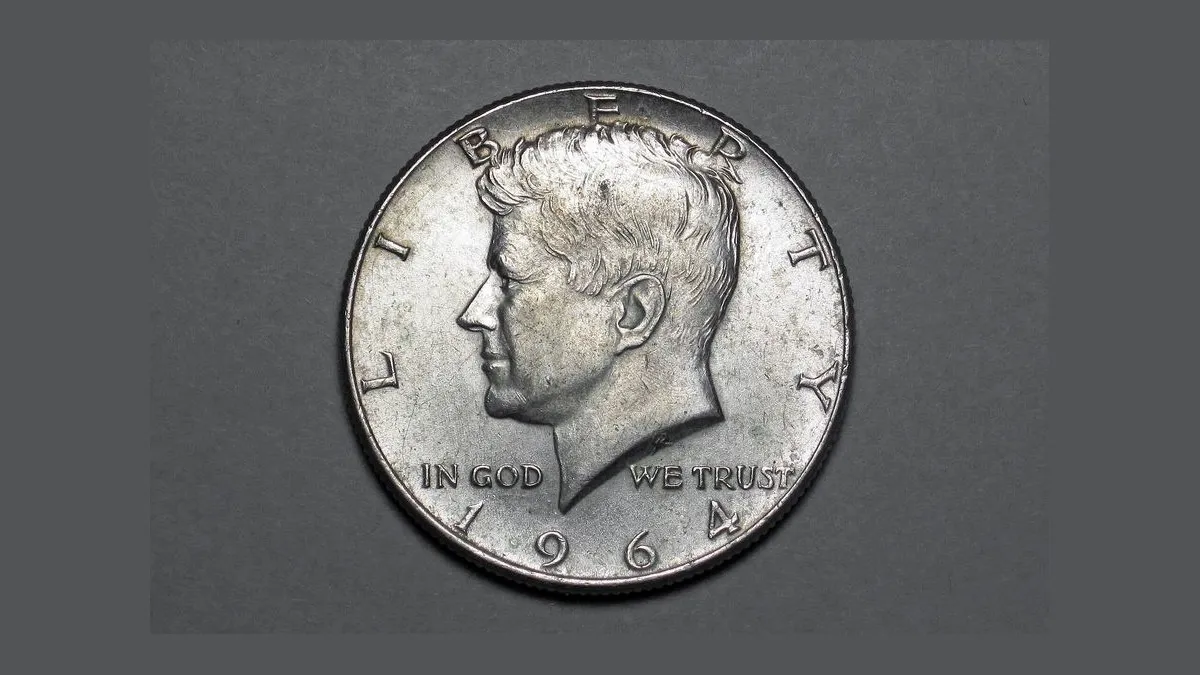
Most Kennedy half dollar value comes down to one question: how much silver is in the coin. A 1964 half is 90% silver and held about $19.45 in metal when silver traded at $53.77 an ounce on October 28, 2026. A half dated 1965 to 1970 is 40% silver and held about $7.95. A circulated half from 1971 or later has no silver and is usually worth its face value of 50 cents.
That covers almost every Kennedy half in a drawer or a coin jar. The exceptions are a short list of rare varieties, mint-set coins and coins in exceptional condition, and some of them have sold for thousands of dollars. This guide walks through the silver years first, then the varieties worth checking, so you can sort your own coins in a few minutes.
Kennedy Half Dollar Value Chart by Year
The Kennedy half has been struck since 1964, and its metal changed twice. Congress passed the Coinage Act of 1965 as silver prices rose and coins vanished from circulation. As CoinWeek explains, the law cut the half dollar from 90% to 40% silver, and from 1971 the Mint switched circulating halves to copper-nickel clad.
| Years | Composition | Silver per coin | Melt value, Oct 28, 2026 |
|---|---|---|---|
| 1964, 1964-D | 90% silver, 10% copper | 0.3617 oz | about $19.45 |
| 1965 to 1970 | 40% silver | 0.1479 oz | about $7.95 |
| 1971 to date (circulating) | copper-nickel clad | none | face value, 50 cents |
The melt figures use the Kitco spot price of $53.77 per troy ounce at 3:15 p.m. ET on October 28, 2026, multiplied by the silver weights CoinWeek and Greysheet list. Silver moves every day, so multiply the current spot price by 0.3617 for a 1964 half or 0.1479 for a 1965 to 1970 half to get today's figure.
Melt value is the metal in the coin, not a selling price. A collector pays more than melt only when the date, variety or condition is special.
1964 Kennedy Half Dollar Value: The 90% Silver Year
The 1964 half is the only circulating Kennedy half struck in 90% silver, which makes it the one most people are hoping to find. It weighs 12.5 grams and contains about 0.3617 troy ounce of silver.
The Mint made a lot of them. Philadelphia struck more than 273 million and Denver struck 156,205,446, according to the mintage tables at Kennedy Half Dollars and Wikipedia. Most were saved as souvenirs of the late president rather than spent, and many were later melted for their silver.
What a Typical 1964 or 1964-D Half Is Worth
A circulated 1964 half from either mint is worth its silver, about $19.45 at the October 28 spot price. A sharp uncirculated example can bring a little more from a collector, but with this many coins saved, the premium is small for ordinary pieces.
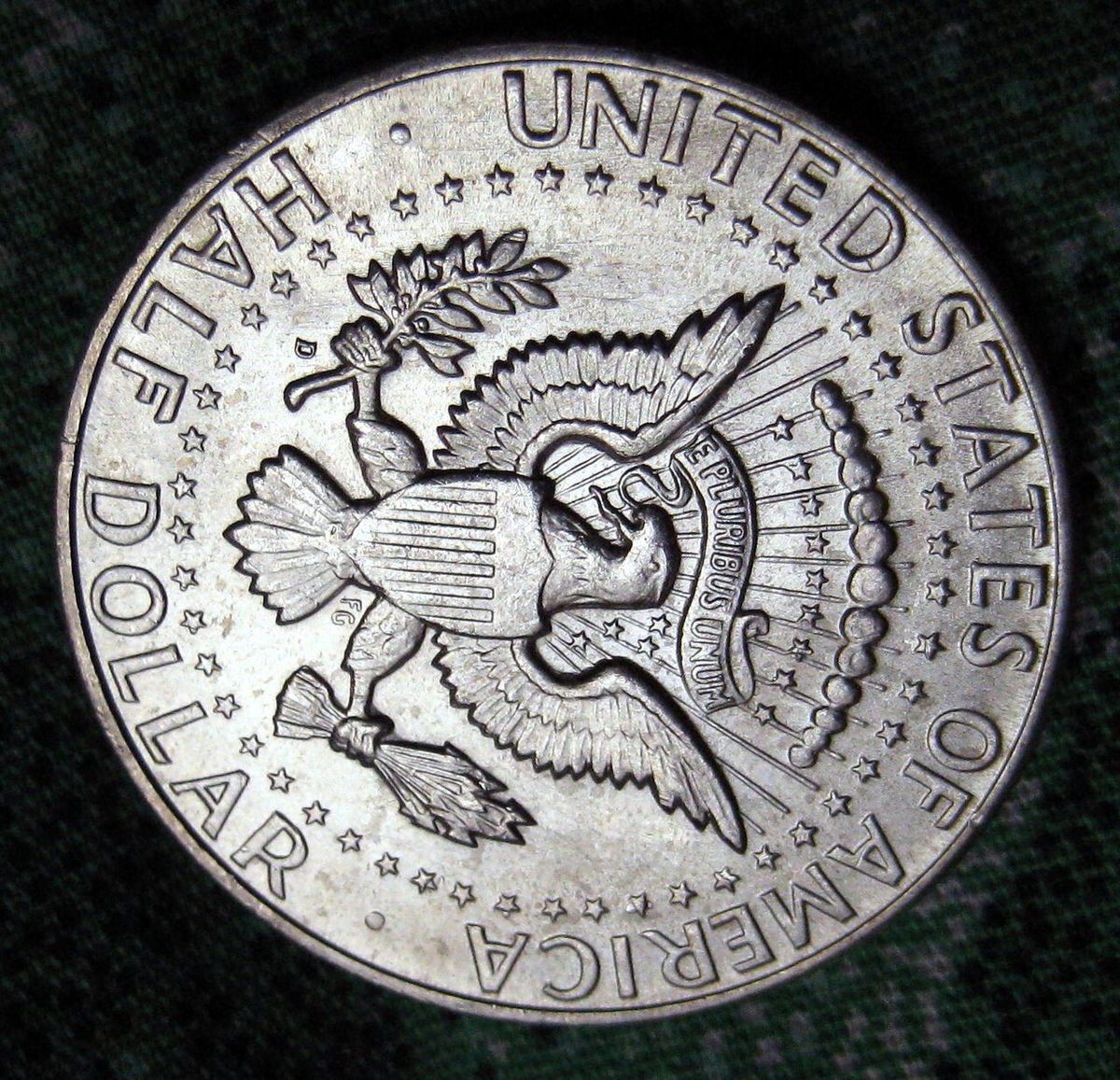
On 1964 coins the mint mark sits on the reverse. A Denver coin shows a small D to the left of the olive branch the eagle holds, and a Philadelphia coin has no mint mark at all.
1964 Proofs and the Accented Hair Variety
The Mint also struck 3,950,762 proof halves in 1964 for collectors. Proofs were sold to collectors in sets rather than released in change.
A small share of those proofs carry the Accented Hair variety. PCGS describes it as extra hair detail just above Kennedy's ear and a missing lower left serif on the I in LIBERTY. Jacqueline Kennedy reportedly asked for the hair to be softened, so the design was changed the same year, and PCGS estimates that fewer than 5% of 1964 proofs show it. One near-perfect deep cameo example sold for $46,800 at Heritage Auctions on January 14, 2024.
The 1964 SMS Rarity
A handful of 1964 halves were struck with a special finish now catalogued as SMS, short for Special Mint Set. They are among the rarest Kennedy halves, and a Stack's Bowers sale on August 20, 2019 set the published auction record for the issue at $156,000. Coins like this almost never turn up in circulation, but they explain why a 1964 half with an unusual finish deserves a second look.
Value of 1965 to 1970 Kennedy Half Dollars
Halves dated 1965 through 1970 are 40% silver. The Mint used this composition for circulating halves for six years before dropping silver entirely.
For most dates in this range, silver sets the value. A 1967 Kennedy half dollar, for example, had a mintage of 295,046,978, so a circulated one is worth its silver, about $7.95 on October 28, 2026. The same is true of 1965, 1966, 1968-D and 1969-D halves in circulated condition.
Why the 1970-D Is the Key Date
The 1970-D is the one 40% silver half collectors chase. It was never released into circulation: the Mint sold it only in 1970 Mint Sets, and just 2,150,000 were made. As the PCGS CoinFacts entry notes, a 1970 Mint Set cost about $2.50 and held ten coins with a face value of $1.33. Tens of thousands of sets were opened to pull out the half.
That makes it the lowest mintage circulation-type Kennedy half from 1964 to 2005. A typical example is still affordable, but the best ones are not: a toned uncirculated 1970-D in top condition sold for $14,287.50 at GreatCollections on December 1, 2024.
1971 Kennedy Half Dollar Value and Later Clad Halves
From 1971 on, circulating Kennedy halves are copper-nickel clad with no silver. Mintages were huge in the early years: 155,164,000 at Philadelphia and 302,097,424 at Denver in 1971 alone. A circulated 1971 half, or any common clad date, is worth 50 cents.
Clad halves are worth more only when they are in exceptional uncirculated condition, part of a low mintage issue sold only in sets, or one of the varieties below. The 1987 halves, for instance, were not issued for circulation and were sold only in Mint Sets and souvenir sets.
Collector issues add some silver back into the series. The 1976-S bicentennial halves were also struck in 40% silver for sets, about 11,000,000 of them, though many were melted in 1982. From 1992 the Mint sold 90% silver proof halves in special proof sets, and silver proofs since 2019 are .999 fine. In these years San Francisco struck proofs, so a half with an S mint mark usually came from a collector set.
Rare Kennedy Half Dollar Varieties Worth Checking
A handful of varieties lift an ordinary-looking half far above its silver or face value. The PCGS series history names the No FG dates, the 1974-D doubled die and the 1998-S matte finish among the most collected. The figures below come from the APMEX key-date guide, published in October 2023, in three condition bands.
| Variety | What to look for | Very Fine | About Unc. | Choice Unc. |
|---|---|---|---|---|
| 1964 doubled die obverse | Doubling in the lettering | $35 | $80 | $160 |
| 1964 Accented Hair (proof) | Extra hair above the ear | n/a | n/a | $75 |
| 1970-D | D mint mark, 40% silver | $5 | $8 | $20 |
| 1972-D No FG | Missing FG initials | $250 | $600 | $1,000 |
| 1974-D doubled die | Doubled IN GOD WE TRUST | $7 | $10 | $30 |
| 1982-P No FG | Missing FG initials | $8 | $20 | $40 |
| 1998-S matte finish | Matte, non-mirror surface | n/a | n/a | $100 |
Silver issues in a 2023 guide can read below today's melt value. APMEX listed a common 90% half at $9 to $11 and a 1970-D at $5 in Very Fine when silver was far cheaper than it is now, so treat the melt figures above as the floor for any 1964 or 1965 to 1970 coin.
1972-D and 1982-P Halves With No FG
Chief Engraver Frank Gasparro placed his initials, FG, under the eagle's right leg on the reverse. On a few dies the initials were polished away. APMEX attributes it to over-polishing a worn die, and PCGS recognizes three No FG dates: the 1966 SMS, the 1972-D and the 1982-P.
The 1972-D is the valuable one, at $250 in Very Fine and $1,000 in Choice Uncirculated on the APMEX list. The 1982-P No FG is worth a small fraction of that. Check the spot just below the eagle's right leg with a loupe.
The 1974-D Doubled Die
The 1974-D doubled die obverse is widely considered the most significant doubled die in the series. The doubling shows most clearly in IN GOD WE TRUST, and also in LIBERTY and the date. It hides inside a Denver mintage of 79,066,300. An example in gem uncirculated condition sold for $1,528 at Heritage Auctions on February 4, 2016.
The 1998-S Matte Finish
The 1998-S matte finish half was sold only in a two-coin Kennedy Collector's Set with a Robert F. Kennedy silver dollar, issued at $59.95. Sources give mintages from 62,000 to just over 64,000, and PCGS calls it the rarest of all the Kennedy halves. It is 90% silver, with a matte finish instead of the usual mirror proof surface.
How Condition Changes Kennedy Half Dollar Value
For common dates, condition barely matters: a worn 1964 half and a nice one are both mostly silver. Condition starts to matter on the key dates and varieties, where the APMEX figures above rise several times over from Very Fine to Choice Uncirculated.
At the very top, condition is everything. The 1970-D that sold for $14,287.50 and the 1964 Accented Hair proof that brought $46,800 were both among the finest known examples of their issues. A typical 1970-D with light wear is worth closer to its silver.
If you have older coins in the same box, the guide to telling what an old coin is worth covers condition and handling in more detail.
Checking Your Own Kennedy Half Dollars
Start by sorting your halves by date into three piles: 1964, 1965 to 1970, and 1971 or later. That alone tells you the floor value of every coin. Then look more closely at the few that could be special:
- Any 1970-D, any half with an S mint mark, and any half with a satin or mirror finish.
- 1972-D and 1982-P halves, checked under the eagle's right leg for the FG initials.
- 1974-D halves, checked for doubling in IN GOD WE TRUST.
Primo Worth can help with the first pass. In Coin mode, you snap a photo and it identifies the denomination, year and mint mark, with a read-out on rarity and what drives the value, checked against recent eBay sales where they exist so you can see the sold listings behind the number. You can try three scans free.
Primo Worth gives an AI estimate, not a professional appraisal. A photo cannot confirm a variety like the Accented Hair or a doubled die, cannot tell a matte finish from a worn proof with certainty, and cannot settle the fine points of condition. A half that looks like a key variety belongs with a coin dealer or a specialist before you sell it. If the same box holds silver dollars, the Morgan silver dollar guide sorts those by year and mint mark the same way.
Key Points on Kennedy Half Dollar Value
A 1964 Kennedy half is 90% silver and was worth about $19.45 in metal on October 28, 2026. Halves from 1965 to 1970 are 40% silver and were worth about $7.95. Circulated halves from 1971 on are worth 50 cents unless they are a rare variety.
The coins worth a closer look are the 1970-D from mint sets, the 1972-D and 1982-P No FG halves, the 1974-D doubled die, the 1998-S matte finish, and any 1964 proof with the Accented Hair. Silver sets the floor, and condition decides how far above it a key coin can go.