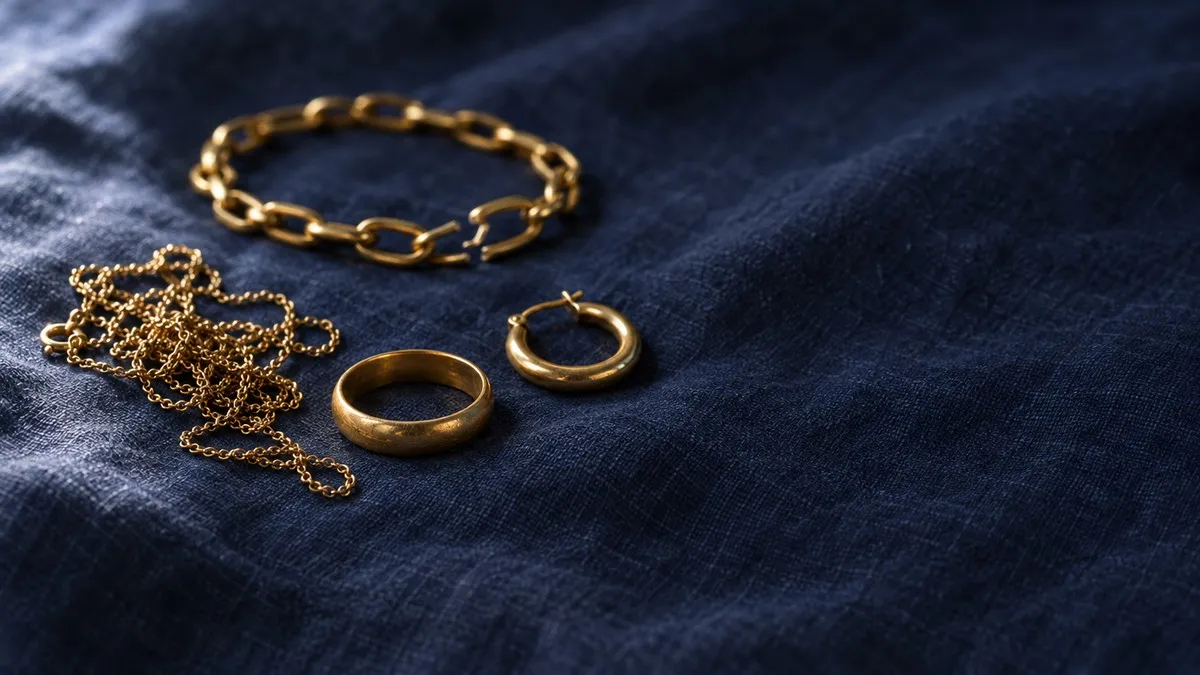
The best place to sell gold jewelry depends on what the piece is. Plain or broken gold sells by weight, and a dedicated gold buyer, a refiner or an established mail-in buyer usually pays the most against melt value. A signed, antique or stone-set piece can be worth more as jewelry, so a jeweler, a consignment shop or an auction house is the better first stop. Pawn shops pay the least almost every time.
With gold near record prices this autumn, more people are clearing out drawers of old chains, single earrings and rings that no longer fit. The problem is that two buyers on the same street can offer very different amounts for the same chain. This guide compares seven places to sell gold jewelry by what they pay, how fast you get the money and which pieces each one suits, with a worked example so you can check any offer yourself.
Where to Sell Gold Jewelry at a Glance
The payout column is the share of melt value, meaning the value of the pure gold in the piece at the day's spot price. These are broad ranges from published buyer guides, not quotes.
| Rank | Buyer | Typical payout | Speed | Best for |
|---|---|---|---|---|
| 1 | Local gold buyer or coin shop | 60 to 80% | Same day | Most plain and broken gold |
| 2 | Refiner | 90 to 98% | 1 to 4 weeks | Larger lots of scrap |
| 3 | Mail-in gold buyer | 50 to 90% | About 1 to 2 weeks | No good local buyer |
| 4 | Local jeweler | 50 to 80% | Same day | Wearable pieces they can resell |
| 5 | Online marketplace | Sale price minus fees | Days to weeks | Pieces worth more than their gold |
| 6 | Consignment or auction | Hammer price minus 15 to 20% | Months | Signed and high-value pieces |
| 7 | Pawn shop | 30 to 60% | Minutes | Emergency cash only |
The gap between the top and the bottom of this table is often more than double for the same piece. The rest of this guide explains where each number comes from and when the ranking changes.
How We Compared the Buyers
Each buyer was judged on five things that decide what actually ends up in your account.
The first is payout as a share of melt value, because that is the one number you can check for yourself. The second is speed: some buyers hand you cash before you leave, others take weeks. The third is transparency, meaning whether the karat test and the weighing happen where you can see them and whether the offer comes with a written breakdown.
The fourth is risk. Shipping gold, leaving it on consignment or waiting for an auction all put the piece out of your hands for a while. The fifth is fit: a buyer that is excellent for a bag of broken chains can be the worst place for a signed bracelet, because it pays only for the metal.
The ranking favours the buyer that suits most people with ordinary gold jewelry. If your piece is signed, antique or set with a significant stone, skip ahead to the jeweler and auction sections first.
Work Out Melt Value Before You Sell Gold Jewelry
Every fair offer for scrap gold starts from melt value, so work it out before you walk into a shop. You need three things: the weight in grams, the karat and the spot price.
On November 13, 2026, Kitco quoted gold at $3,878.20 per troy ounce at 10:34 a.m. ET, which is $124.69 per gram of pure gold. A troy ounce is 31.1 grams, about 10% heavier than the ounce on a kitchen scale, which is a common source of confusion when people check prices.
Jewelry is never pure gold. Multiply the price per gram by the gold content of the karat:
| Karat | Gold content | Melt value per gram on Nov 13, 2026 |
|---|---|---|
| 10k | 41.67% | $51.96 |
| 14k | 58.33% | $72.73 |
| 18k | 75.00% | $93.52 |
| 22k | 91.67% | $114.30 |
Some buyers quote in pennyweight, written dwt, instead of grams. One pennyweight is about 1.56 grams, and Kitco listed pure gold at $193.91 per pennyweight on the same morning, so a 14k pennyweight was worth about $113.11 in metal.
Spot moves every day, so a quote is only comparable with others taken the same day. Kitco showed $4,057.10 per ounce early on November 11 and $3,878.20 two days later, a drop of $178.90. On a large lot, that swing is bigger than the difference between two decent buyers.
The karat stamp is a starting point
The stamp tells you what the piece claims to be, not what it is. Plated and filled pieces sometimes carry marks that look like karat stamps, and a worn stamp can be misread. Our guide on how to tell if gold is real covers the home checks, but the buyer's own test is what sets the price. A reputable buyer tests each piece separately rather than weighing everything as one lot at the lowest karat.
1. Local Gold Buyers and Coin Shops
For most people with plain, broken or unwanted gold, a dedicated local gold buyer is the best mix of payout, speed and control. These are the shops whose main business is buying precious metal, often called coin shops, and they sell what they buy on to a refiner.
According to Gold Toolkit's comparison, dedicated gold buyers typically pay 60 to 80% of melt value, and their net margin after rent, staff, insurance and refining is estimated at roughly 7 to 10%. That thin margin is why their offers sit well above a pawn shop's.
Why it ranks first
The piece never leaves your sight. A good buyer weighs it on a visible, calibrated scale, tests the karat in front of you and shows how the offer was calculated. You can walk out if the number is low, and you can visit two or three shops in an afternoon.
What to watch for
Quality varies from shop to shop. A long-established buyer with a public track record behaves very differently from a pop-up counter in a hotel room. If a shop will not tell you the weight it measured, the karat it found and the spot price it used, take the piece elsewhere.
Coin shops also buy bullion coins and bars, where the payout is much closer to spot. Gold Toolkit puts bullion buy-backs at 93 to 98% of melt, but that range applies to coins and bars, not to jewelry, which has to be refined before anyone can resell the gold.
2. Refiners
A refiner melts scrap, assays it and turns it into fine gold, so selling to one directly skips a middleman. Gold Toolkit puts refiner payouts at 90 to 98% of melt value, the highest of any channel for plain gold.
The catch is size and time. Some refiners accept any amount from individual sellers, while others set minimums of $10,000 or more, and the process typically takes one to four weeks from shipping to payment because it includes a fire assay and settlement.
Minted Metal, another buyer guide, puts refiner payouts lower, at 70 to 90% of melt, and notes that refiners pay smaller percentages on lots under about one ounce of gold content, on mixed lots of uncertain purity and on 10k pieces. The two figures are not contradictory so much as describing different lot sizes.
A refiner makes the most sense when you have a meaningful amount of plain scrap and no reason to hurry. For a single ring, the minimums and the wait usually wipe out the extra percentage.
3. Online Mail-In Gold Buyers
Mail-in buyers send you a prepaid, insured envelope. You ship the gold, they test and weigh it, and they send an offer you can accept or decline. If you decline, a reputable buyer returns the pieces at no charge.
Published estimates of what they pay disagree more than for any other channel. Gold Toolkit puts mail-in buyers at 70 to 90% of melt value with payment in five to ten business days. Minted Metal puts them at 50 to 75%, with higher headline offers sometimes reserved for larger shipments. The honest reading is that the spread between mail-in operators is wide and most do not publish it.
Protecting yourself before you ship
Photograph every piece and weigh everything at home so you have a record. Check how much the shipment is insured for, since standard coverage is often around $5,000 and a larger lot may need more. Confirm in writing that a declined offer means a free return, and treat any company that will not promise that as one to skip.
Mail-in makes most sense when there is no reputable gold buyer near you, or when you have compared local offers and want one more quote. The trade-off is that you cannot watch the testing, so you are relying on the buyer's report.
4. Local Jewelers
A jeweler can be the best or the worst place to sell gold jewelry, depending on whether the piece can be sold again as jewelry.
When NerdWallet interviewed jewelers, Maryland jeweler Fausto Argueta said he typically takes gold in at scrap value but will sometimes buy desirable estate jewelry for its resale value, polishing and restoring it before selling it on. That is the case where a jeweler can beat a gold buyer: a wearable piece in a style people still want.
For ordinary scrap, jewelers are less predictable. Gold Toolkit puts jeweler payouts at 50 to 80% of melt, and Minted Metal says chain stores tend to sit at the bottom of the jeweler range because their business is selling new jewelry, not buying old gold.
Trade-in versus cash
Many jewelers will offer more if you take store credit toward a new piece instead of cash. That can be good value if you were going to buy jewelry anyway. If you want money, compare the cash offer, not the trade-in figure.
Buying gold has become a real part of the jewelry business. In INSTORE's 2026 Big Survey of independent jewelers, buying gold off the street ranked third among the reasons stores gave for better results, behind custom work and lab-grown diamonds. More competition among buyers is good for sellers, but only if you collect several offers.
5. Online Marketplaces
Selling the piece yourself online is the only route where the price is set by a buyer who wants to wear it rather than melt it. That matters for vintage designs, signed pieces and anything whose look is worth more than its gold.
You pay for that in fees and effort. eBay's seller fees for most Jewelry & Watches listings are 15% of the total sale when it is $5,000 or less, and 9% when it is over $5,000, plus a per-order fee of $0.40 on orders over $10. The fee is calculated on the total amount of the sale, including shipping and tax, not only on the item price.
What the fee does to a plain chain
Take a 14k chain with $727.30 of gold in it, the example used below. If it sold for exactly its melt value, the 15% fee would be $109.10, plus $0.40 per order, leaving $617.80 before shipping and insurance. That is about 85% of melt, close to a good local buyer's best offer, with more work and more risk of returns.
An online sale is worth the effort only when a buyer will pay well above melt value. For plain scrap, it rarely beats a local gold buyer once the fees are counted. You also handle photography, the listing, insured shipping and any dispute yourself.
6. Consignment Shops and Auction Houses
For signed and high-value pieces, the right buyer is the one who sells to collectors. According to Jewelers Mutual, an auction house is the place for a signed piece by a maker such as Cartier or Van Cleef & Arpels, especially with its paperwork and packaging, or for a collection of fine pieces too large for a jeweler to sort.
Auction houses take a commission of 15 to 20% of the final hammer price, Jewelers Mutual says, and some add fees for photography, marketing or repairs. On a $10,000 hammer price, that commission is $1,500 to $2,000. Expect to send photos first, and look for a house that uses jewelry specialists with recognised gemological qualifications.
Consignment
A consignment shop holds the piece and pays you after it sells, minus its cut. Terms vary widely between shops, so get the commission, the minimum price and how long they will hold the piece in writing before you hand anything over.
Both routes take months rather than days. They make sense when the piece is clearly worth more as jewelry than as gold, and they are poor value for anything ordinary, which most auction houses will decline anyway.
7. Pawn Shops
Pawn shops are the fastest way to turn gold into cash and almost always the lowest offer. Gold Toolkit puts their payouts at 30 to 60% of melt value, and Minted Metal puts outright pawn shop purchases at 20 to 50%.
The reasons are structural. Gold is a sideline for most pawn shops, they rarely deal directly with a refiner, and their pricing has to cover overhead across everything else they buy and sell.
When a pawn shop does make sense
The one case for a pawn shop is a loan, not a sale. If you need money for a short time and want the piece back, you can borrow against it and redeem it later, paying interest. If you are done with the piece, selling outright to a better buyer pays more. Pawning gold you never intend to reclaim turns a sale into a loan plus interest.
What the Same 14k Chain Pays at Each Buyer
Here is one piece run through every channel: a 10-gram 14k chain, with melt value at $727.30 on Kitco's November 13 price. The ranges are the published percentages above applied to that number, not offers.
| Buyer | Payout range | What you would receive |
|---|---|---|
| Pawn shop | 30 to 60% | $218 to $436 |
| Local jeweler | 50 to 80% | $364 to $582 |
| Mail-in gold buyer | 50 to 90% | $364 to $655 |
| Local gold buyer | 60 to 80% | $436 to $582 |
| Refiner | 90 to 98% | $655 to $713, if they accept a lot this small |
| Online marketplace at melt | 15% fee plus $0.40 | $618 before shipping |
The same chain can pay roughly $220 at the bottom of one range and over $650 at the top of another, in the same week. Nothing about the chain changed; only the buyer did. That is why the single most useful step is collecting three quotes and comparing each one against your own melt figure.
Higher karat helps. Our comparison of 10k vs 14k resale value shows why a 10k piece carries less gold per gram and why some buyers apply bigger deductions to it.
Is It Scrap or Jewelry? Check Before You Sell
The biggest mistake is selling a piece by weight when it would sell for more as jewelry. NerdWallet tells the story of Suellen Kirk, a Pennsylvania gold buyer, who went through a box of costume jewelry a customer wanted to sell cheaply and found several thousand dollars of 14k gold inside. The lesson works both ways: sort everything before anyone weighs it.
Three kinds of piece deserve a second look before they go to a scrap buyer. Signed pieces carry a maker's name alongside the karat stamp. Antique and estate pieces may be worth more for their period and workmanship. Pieces set with stones need the stones assessed separately, because a scrap buyer pays only for the metal.
A quick read on resale value
Primo Worth gives you a first idea of what a piece might sell for as jewelry rather than as metal. You snap a photo, and in Jewelry mode the app reads the metal, karat, stones and hallmarks it can see and gives an estimated value with a price range, checked against recent eBay sales where they exist. The sold listings are shown with their photos, prices and dates, so you can judge whether the matches look like your piece.
If those comparable sales sit well above your melt figure, the piece is worth showing to a jeweler, a consignment shop or an auction specialist before a scrap buyer. If they sit near or below it, sell it as gold.
Keep the limits in mind. Primo Worth gives an AI estimate, not a professional appraisal, and a photo cannot confirm what the metal is, what karat it is or what a stone is. The estimate is not what a buyer will pay you; it is a reference point to judge offers against.
What to Look for in a Gold Buyer
A fair buyer is easy to recognise once you know what to ask for. Whichever channel you choose, these checks separate a reasonable offer from a bad one:
- Testing in front of you. Each piece is tested on its own, and you are told the karat found for each one, not a single figure for the whole lot.
- A visible, calibrated scale. You see the weight, and the buyer tells you whether it is in grams or pennyweight.
- A written breakdown. The offer shows weight, karat, the spot price used and the percentage paid, so you can check it against your own melt figure.
- No pressure. Both store owners NerdWallet spoke with said a seller should never feel obliged to accept, and a good buyer will suggest a better route for a piece worth more than they can pay.
- A free return on mail-in offers. A declined offer should mean your gold comes back at no cost, insured.
Get at least three quotes on the same day, since spot moves daily. If one offer is far below the rest, it is a signal to walk away, not a starting point for haggling.
Remove anything that is not gold before you go. Stones, pearls, steel clasps and springs add weight but no gold, and a scrap buyer pays only for the precious metal. Keep sentimental pieces aside until last, because they are the ones people most often regret selling in a hurry.
The Bottom Line
The best place to sell gold jewelry is decided by the piece, not by the nearest sign that says "we buy gold". Plain and broken gold sells by weight, and a dedicated local gold buyer, a refiner for larger lots or an established mail-in buyer usually pays the most against melt value. Signed, antique and stone-set pieces deserve a jeweler, a consignment shop or an auction house first, and a pawn shop is the right choice only when you want a loan and the piece back.
Work out melt value from the day's spot price before any conversation, sort scrap from jewelry before anything is weighed, and compare at least three offers taken on the same day. With those three steps, a low offer is obvious the moment you see it.