If you want to know how to tell if gold is real, start by reading the karat stamp, checking it for plating letters, holding a strong magnet to it, and then measuring its density in water. If it passes all four, an acid test or a jeweler's X-ray scan settles the rest. No single home test proves a piece is gold, but three or four together catch most fakes.
That matters because a fake rarely fails in an obvious way. Plated brass looks right, a stamped number can be faked, and some counterfeits are built from metals that weigh almost as much as gold. Below are seven checks in the order that costs you the least, what each one can and cannot catch, and what to do when the results disagree.
What You'll Need
Most of these tests use things you already have. The acid kit is the only purchase most people make, and you can skip it if you plan to take the piece to a jeweler anyway.
- A loupe or a phone camera zoomed in, to read stamps that are a millimetre tall
- A strong neodymium magnet, since a fridge magnet is too weak to show anything
- An unglazed ceramic tile, or the rough underside of a plate or mug
- A jewelry scale that reads to 0.01 gram, a small cup of water and a length of thread
- An acid test kit with a touchstone, if you want a home answer on karat
Keep the order in mind before you start. The first four checks leave no mark at all, the streak test leaves a small one, and the acid test removes a little metal by design.
How to Tell If Gold Is Real in 7 Steps
Work through these in sequence and stop when a piece clearly fails. A pass on one step only means you move to the next.
Step 1: Read the karat stamp
Look inside a ring band, on the clasp of a chain or necklace, or on the post of an earring. US gold is usually stamped with a karat mark such as 10K, 14K or 18K. European and older pieces often carry a three-digit fineness number instead, which states the gold content in parts per thousand: 417 is 10 karat, 585 is 14 karat, 750 is 18 karat and 999 is pure gold.
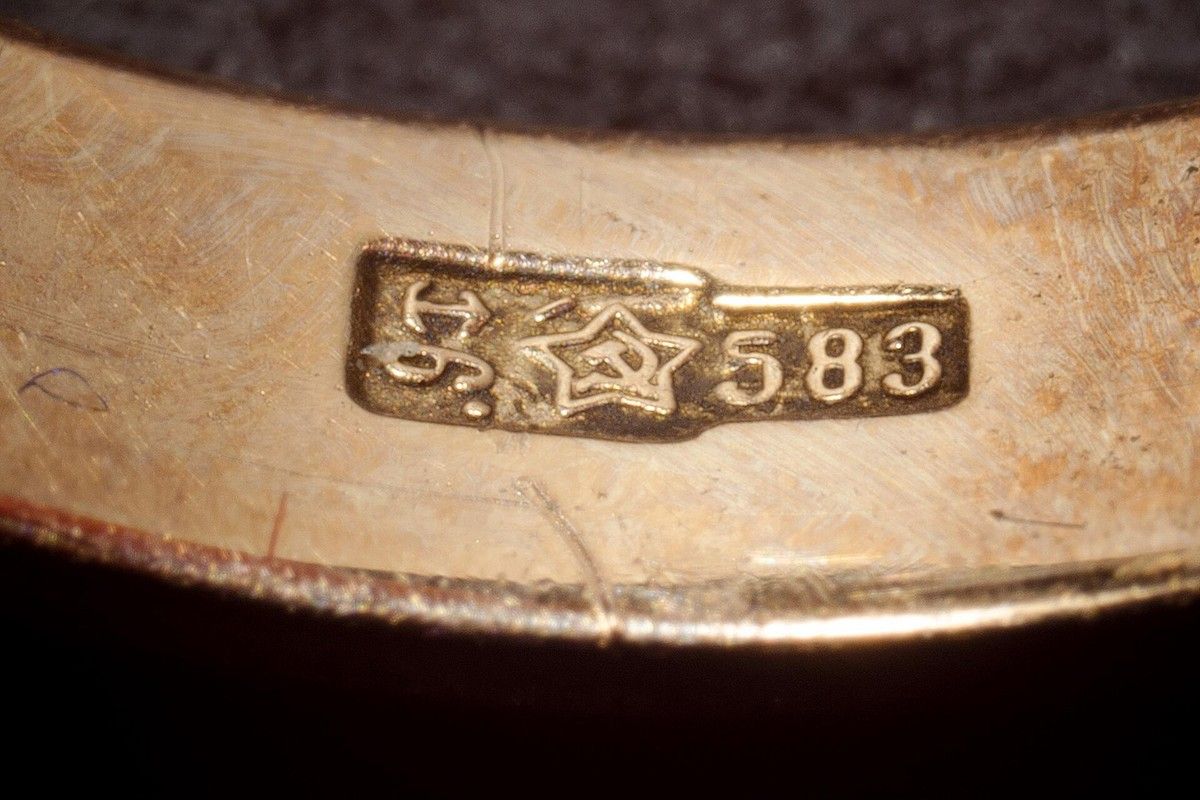
The ring above reads 583, the Soviet standard, which means 58.3 percent gold and sits just under a 585 stamp. The consumer guidance from the Federal Trade Commission adds a second thing to look for: a trademark or maker's mark beside the karat mark. Its advice to buyers is blunt, if a piece shows a karat mark with no trademark next to it, don't buy it.
A stamp tells you what the piece claims to be, not what it is. Fakes are stamped too, so treat the number as the claim the next tests have to confirm. If you want help reading an unfamiliar mark, our guide on reading hallmarks and karat stamps covers the common ones.
Step 2: Look for plating letters
A karat number followed by letters often means the gold is only a layer over another metal. These are the marks to watch for:
- GP or GEP: gold plated or gold electroplated
- HGE or HGP: heavy gold electroplate or heavy gold plate
- GF: gold filled, a thicker layer bonded to a base metal
- RGP: rolled gold plate, often with a fraction such as 1/20 or 1/40
- Vermeil: gold over a sterling silver base
The FTC's Jewelry Guides set what these words mean in the US. Gold filled must carry a layer of at least 10 karat gold making up at least 1/20 of the metal's weight, and a thinner layer has to state its fraction, as in "1/40 14K gold overlay". Gold electroplate needs at least 0.175 microns of gold. A piece stamped 14K GF is real gold on the outside and something cheaper inside, which is honest labelling but a very different value from solid 14K.
Step 3: Check the color and the worn edges
Look where the piece rubs against skin or other jewelry: the underside of a ring, the clasp end of a chain, the corners of a pendant. The FTC notes that plating wears away over time, depending on how the item is worn and how thick the plating is. Gold flashed or gold washed pieces have the thinnest layer of all and wear through first.
If you see a silver, grey or reddish metal showing through on high points, the piece is plated. Solid gold wears too, but it wears to more gold. This is a visual check, so it only catches plating that has already worn through.
Step 4: Try a strong magnet
Gold is not magnetic. Hold a neodymium magnet against the piece and watch for any pull. If it sticks, the piece is not solid gold, or it has a steel core.
The catch is that a pass proves little. A guide from Peer Metals points out that brass, copper and tungsten are not magnetic either, and those are exactly the metals used in many fakes. On a chain, test the links rather than the clasp: Lily Dia Jewellery notes that a real gold clasp often hides a small steel spring that will pull on a magnet. Think of the magnet as the first screen that removes the cheapest fakes in seconds.
Step 5: Run the ceramic streak test
Drag the piece firmly across unglazed ceramic and look at the mark it leaves. According to the US Geological Survey, real gold leaves a golden yellow streak on unglazed porcelain, while pyrite, known as fool's gold, leaves a dark green to black one. Most fake jewelry metals leave a black or grey line.
This test does scratch the piece slightly, so use an edge or the inside of a band, never the face of a coin or a finished surface you care about. It also only reads the metal that touches the tile. A thick plated layer can leave a gold streak, so a gold line on a piece already stamped GF or GP tells you nothing new.
Step 6: Measure density with water
Density is the hardest property to fake cheaply, because gold is far heavier for its size than the common base metals. The method gemologists use, described in a GIA study of gold testing, is density equals the weight in air divided by the weight in air minus the weight in water.
At home, the simplest version goes like this. Weigh the piece dry. Then place a cup of water on the scale, zero it, and lower the piece into the water on a thread so it hangs fully submerged without touching the cup. The new reading in grams equals the volume of water pushed aside in cubic centimetres. Divide the dry weight by that number.
Peer Metals gives these rough targets: about 19 for 24 karat, 15.5 to 16.5 for 18 karat, 13 to 14 for 14 karat, and 11 to 12 for 10 karat. A result far below the stamped karat points to plating or a cheap alloy. Use a scale that reads to 0.01 gram, because a small ring displaces only a fraction of a gram of water and rounding swamps the result.
Step 7: Use an acid kit, or let a jeweler do it
An acid kit is the classic home test for karat. You rub the piece on a black touchstone to leave a streak, then put a drop of the acid for a given karat on it. If the streak holds, the gold is at least that karat; if it dissolves, it is lower or not gold. The GIA study describes the tools and reports that touchstone testing can read within 10 to 20 parts per thousand, and as close as 5 with experience.
The method has real limits. A Thermo Fisher summary lists several: the result only rounds to the nearest acid in the kit, you have to rub gold off the piece, plating is hard to spot without a deep scratch, and the solutions are corrosive. It also warns that some stainless steel grades acid test as 18K white gold while containing no precious metal at all.
How to Tell If Gold Jewelry Is Real: Chains, Rings and Hollow Pieces
The seven steps work best on a solid piece with no stones, and most jewelry is not that simple. The GIA study notes that density testing only works on objects without stones, because a diamond or a glass stone changes the weight to volume ratio. It also notes that density cannot catch a gold-plated item filled with a metal of similar density.
Gold chains and necklaces
A chain is the piece people most often ask about, and the one where home tests are least reliable. A hollow chain drags the density result down even when the gold is real, so skip the water test on a hollow chain. Test several links with the magnet, keep it away from the clasp, and read the stamp on the clasp tag or the end ring. If a chain is stamped 14K, passes the magnet and shows no wear through on the links, it is worth an acid or XRF test before you sell or buy it.
Rings and pieces with stones
For a ring with stones, rely on the stamp, the worn edges and the magnet, then go to a jeweler. Don't try to estimate density with the stone in place, and keep acid away from any stone or pearl. Heavy wear on the underside of the band, where it rubs every day, is often the clearest sign of plating on a ring.
What a Jeweler Uses Instead
If home tests disagree or the piece is worth real money, a jeweler or dealer has better tools. The most common is an X-ray fluorescence analyzer, often shortened to XRF. APMEX describes it as non-damaging, since it reads the metal without a scratch, but it only measures the first few micrometres of the surface. A piece with a tungsten core can pass an XRF scan, which is why APMEX also warns that tungsten is used in counterfeit gold to copy its weight.
Some jewelers use electronic testers that read karat from the surface. For bullion and large lots, fire assay has been the reference method for centuries; it consumes a sample of the metal, so it is not something you would do to a ring you plan to keep.
For most jewelry, an XRF scan plus the stamp and a magnet check is as far as you need to go. Peer Metals puts a scan at a dealer at anywhere from free to about $10.
Tips for Better Results
APMEX's advice is to use more than one test, and that is the single most useful habit here. Each test catches a different kind of fake: the magnet catches steel, the streak catches dark base metals, density catches light alloys, and acid catches plating if the scratch goes deep enough.
Start with the tests that leave no mark and move toward the ones that do. Write down what the stamp claims before you begin, so every later result has something to agree or disagree with. Test in the same spot you would expect a jeweler to test, on the inside of a band or the back of a clasp, never on a visible face.
Be wary of the home tests that keep circulating online. Peer Metals lists toothpaste, vinegar and biting as tests that tell you nothing reliable, and biting can dent a soft piece.
Troubleshooting Common Issues
There is no stamp at all
Old pieces, resized rings and some handmade jewelry lose or never had a mark. A missing stamp is not proof of a fake, but it removes your starting claim, so the density and acid tests matter more.
It passed the magnet but failed the streak
The magnet only rules out iron and steel. A black streak means the surface you scratched is not gold, which usually points to plating over brass or copper.
The density lands between two karats
Small pieces give noisy numbers, and alloys of the same karat vary with their mix of silver, copper and zinc. Repeat the measurement two or three times and use the average. A result that sits a little off the target is normal; one that is several points below the stamped karat is not.
Your skin turned green or black
That comes from copper or nickel in the alloy reacting with sweat and skin, according to Lily Dia Jewellery, and 9K and 14K gold contain more copper than 18K. Skin marks do not tell real gold from fake.
What Real Gold Is Worth Once You Know
Once a piece tests as solid gold, the metal sets a floor on its value. On November 11, 2026, Kitco quoted gold at $4,054.10 per troy ounce, or $130.34 per gram. A 5 gram chain stamped 14K holds about 2.9 grams of pure gold, which works out to roughly $380 of metal at that price. GoldPrice.com notes that refiners and scrap dealers typically pay 85 to 95 percent of that melt value, and pawn shops often pay less. The difference between karats adds up quickly, as our comparison of 10k and 14k gold shows.
A branded or designer piece can sell for well above melt, and that is where recent sold prices help more than the spot price. Primo Worth's Jewelry mode reads metal, karat, stones and hallmarks from one photo and gives an estimated value checked against recent eBay sales where they exist, with the sold listings shown so you can judge the matches yourself.
It does not test the metal. A photo cannot confirm whether gold is solid, plated or fake, so Primo Worth gives you an AI estimate, not a professional appraisal, and the tests above or a jeweler are still how you confirm what a piece is made of.
The Short Version
Start with the stamp and the plating letters, because they tell you what the piece claims to be. A magnet rules out steel, the streak test rules out dark base metals, and a density reading near the stamped karat is the strongest home evidence you can get. Acid and a jeweler's XRF scan settle karat, each with its own blind spots.
Use at least three tests, skip the vinegar and the bite, and keep anything with stones or a hollow body for a professional. When the results agree with the stamp, you can price the piece from the gold it holds and from what similar pieces have recently sold for.