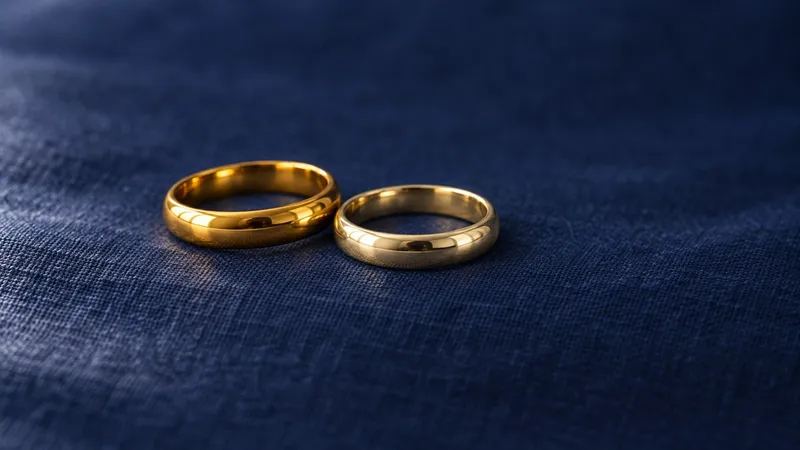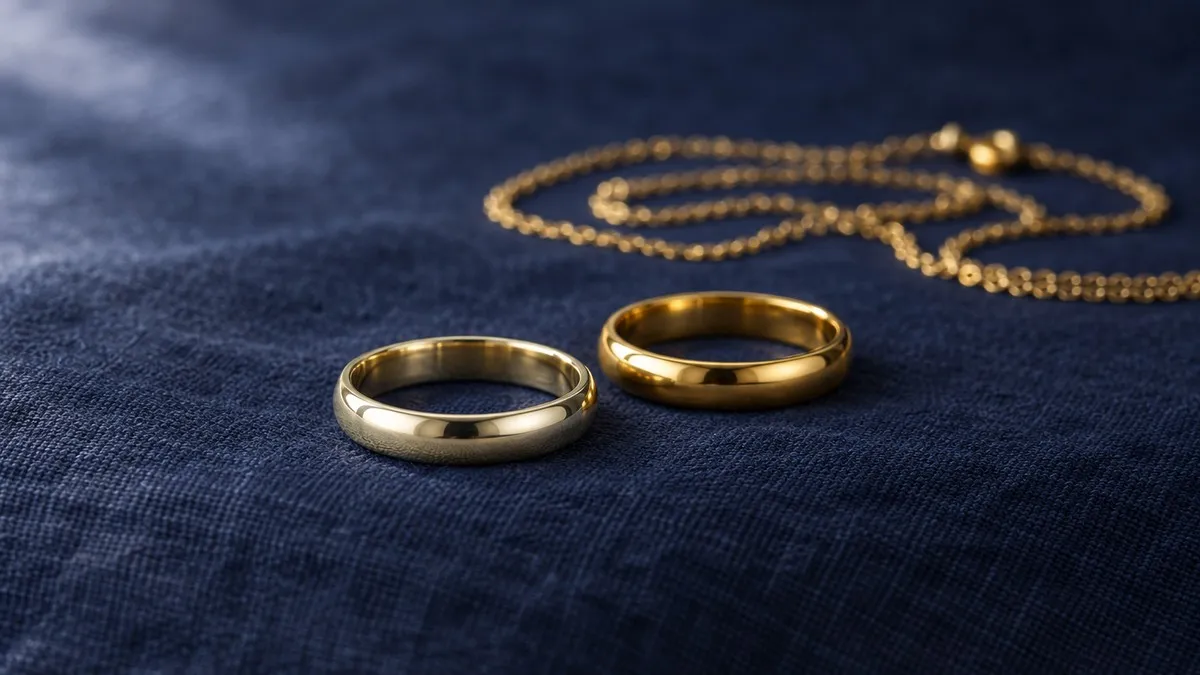
The difference between 10k vs 14k gold comes down to how much of the metal is gold. 10k gold is 41.7% pure gold and 14k gold is 58.5%, so a 14k piece holds about 40% more gold than a 10k piece of the same weight. That makes 10k cheaper and harder wearing, and 14k warmer in color and worth more when you sell it.
If you are choosing a ring, the quick verdict is simple: 10k for hard daily wear on a tight budget, 14k for the better balance of color, value and durability. If you already own the piece, the karat stamp decides most of what its metal is worth. Below you will find what each stamp means, how the two behave on your hand and your skin, and what a gram of each was worth at the gold price on October 31, 2026.
10k vs 14k Gold at a Glance
| 10k gold | 14k gold | |
|---|---|---|
| Gold content | 41.7% | 58.3% to 58.5% |
| Common stamps | 10K, 10KT, 417 | 14K, 14KT, 583, 585 |
| Melt value per gram, Oct 31, 2026 | $51.96 | $72.89 |
| Wear | Harder, resists scratches better | Slightly softer, still made for daily wear |
| Yellow color | Paler | Warmer and richer |
| Best for | Budget pieces, hard-working rings | Wedding bands, pieces you may sell later |
The melt values are the gold content multiplied by the spot price of $3,875.65 per troy ounce that GoldPrice.com reported on October 31, 2026. Gold moves every trading day, so read those figures as a dated snapshot, not as today's price.
What 10k Gold Is
10 karat gold is 10 parts gold out of 24, which works out to 41.7%. The rest, more than half the metal, is a mix of other metals. In the yellow 10k alloy the World Gold Council lists, that mix is 52% silver and 6.3% copper.
In the United States, 10 karat is the lowest purity that can be sold as gold. The World Gold Council calls 10 karat the legal minimum standard in the US, while the UK, France, Austria, Portugal and Ireland allow 9 karat. So 10k is real gold, just the least pure gold a US jeweler can call gold.
Its strengths are price, hardness and scratch resistance. Its weaknesses are a paler yellow, more alloy metal against your skin, and less gold value in every gram. For a piece that takes knocks every day and will never be sold for its metal, those trade-offs often make sense.
What 14k Gold Is
14 karat gold is 14 parts out of 24, which is 58.3% on paper. Most 14k jewelry is made slightly richer than that. The World Gold Council explains that manufacturers adopted the European practice of making 14k slightly over 14 karat, which is why the stamp on most pieces reads 585 rather than 583.
The yellow 14k alloy in the same table is 58.3% gold, 30% silver and 11.7% copper. The council also names 14 karat as the most popular karat in the US, which matters when you sell: a buyer sees far more 14k than anything else and prices it with confidence.
Its strengths are a richer color, more gold per gram and durability that still suits daily wear. Its weaknesses are a higher price and a surface that scratches a little more readily than 10k.
Purity and Karat Stamps
How to read 10k and 14k stamps
A 10k piece is usually stamped 10K, 10KT, 10 Kt or 417. A 14k piece is stamped 14K, 14KT, 14 Kt, 583 or 585. The number stamps are fineness in parts per thousand, so 417 means 417 parts of gold in 1,000. Look inside a ring band, on the clasp of a chain or on the post of an earring. Our guide to reading hallmarks and karat stamps covers the maker's marks that often sit beside them.
The FTC's jewelry guides, published in the federal regulations, say a gold alloy may be described as gold only when the karat sits right before the word, as in "14 Karat Gold" or "14 Kt. Gold". The same guides set rules for plated and filled pieces, whose gold layer has to be at least 10 karat. A stamp such as 14K GF, 10K GP, HGE or RGP means a thin gold layer over another metal, and it is worth a small fraction of a solid piece.
How far a stamp may be off
US law allows a small margin. Under 15 U.S.C. 295, the metal in a piece, tested without its solder, may sit no more than 3 parts per thousand below the stamp. With the solder included, the whole piece may sit up to 7 parts per thousand below it, or 3 for watchcases and flatware.
In practice, a 585 stamp promises at least about 58.2% gold in the metal itself, and a 417 stamp at least about 41.4%. A stamp is still the maker's claim, not a test result. Old pieces, imports and resized rings can carry a stamp that no longer matches the metal, so a jeweler confirms the karat with an acid test or an XRF reading before a serious sale.
Durability: Which Holds Up Better
Pure gold is too soft for jewelry that gets worn every day, which is why it is alloyed in the first place. The World Gold Council notes that mixing other metals into pure gold gives it more durability as well as changing its color.
10k gold carries 58.3% other metals against 41.7% in 14k, so it is the harder of the two. It resists the fine scratches and small dents that build up on a ring worn every day, especially on a hand that lifts, grips and works. If the piece will be worn hard and rarely taken off, 10k is the more forgiving choice.
The gap is real but modest. 14k is the most popular karat in the US, and it holds up well under normal wear. The bigger durability question for both is design: thin bands, hollow chains and worn prongs fail in any karat. A jeweler can check the prongs on a stone setting once a year, whichever karat you choose.
Color: 10k vs 14k Yellow, White and Rose Gold
Yellow gold
With less than half its weight in gold, 10k yellow is a paler, cooler yellow. 14k yellow is warmer and closer to the color most people picture as gold. Side by side the difference is easy to see; a single piece worn on its own is much harder to place.
White gold
White gold is made by alloying gold with white metals such as palladium or silver, and the World Gold Council adds that it is usually plated with rhodium for a harder, brighter surface. In the council's table, 10k white is 41.7% gold, 47.4% silver, 0.9% zinc and 10% palladium, while 14k white is 58.3% gold, 32.2% silver and 9.5% palladium.
Under fresh rhodium plating, 10k and 14k white gold look the same. The plating wears with time, and the alloy beneath starts to show. Re-plating is routine work for a jeweler, so a dull white gold ring is rarely a sign that anything is wrong with the metal.
Rose gold
Rose gold takes its color from copper. The 10k rose alloy in the council's table is 38.3% copper against 32.5% in 14k rose, so 10k rose leans pinker and redder, while 14k rose is softer and closer to peach.
Skin Reactions and Nickel
Most reactions blamed on gold are reactions to nickel. The dermatology reference DermNet advises assuming that all metal jewelry contains some nickel unless it is stainless steel, 18 or 24 karat gold, sterling silver or pure platinum. Neither 10k nor 14k is on that list.
White gold is where this matters most. DermNet says white gold is usually alloyed with nickel and that its rhodium plating, which shields the skin at first, wears off over months or years. The World Gold Council takes a different view: its white gold compositions are nickel free, and it describes nickel-containing white gold as a small share of the alloys in use. The two sources disagree on how common nickel is, so ask the seller what is in the alloy rather than assuming.
If you know you react to nickel, ask for a nickel-free or palladium white gold, or step up to 18k. Between the two karats here, 14k puts less alloy metal against your skin than 10k, which is a point in its favor for sensitive skin, though not a promise.
10k vs 14k Gold Value: What Each Is Worth
Melt value per gram
At the spot price of $3,875.65 per troy ounce on October 31, 2026, one gram of pure gold was worth about $124.61. Multiply that by the gold content and you get the melt value: $72.89 a gram for 14k at 58.5%, and $51.96 a gram for 10k at 41.7%. A 14k piece stamped 583 rather than 585 comes out slightly lower.
| Piece weight | 10k melt value | 14k melt value |
|---|---|---|
| 2 grams | $103.92 | $145.78 |
| 4 grams | $207.84 | $291.56 |
| 10 grams | $519.60 | $728.90 |
| 20 grams | $1,039.20 | $1,457.80 |
The weights are round examples, not the typical weight of any piece. Weigh yours on a scale that reads to 0.1 gram, without stones, and multiply by the per-gram figure. At any gold price, 14k is worth about 1.4 times as much as the same weight of 10k.
What a buyer pays for scrap
Melt value is the ceiling for a piece sold as scrap, not the offer. A buyer pays a share of it, and there is no standard rate. JM Bullion, for one, states a minimum of 80% of melt for gold jewelry. At 80%, the 4-gram 14k band above would bring about $233.25, and the same band in 10k about $166.27.
Get two or three quotes, and ask each buyer to weigh and price every karat separately rather than as one pile. Mixed lots are where 14k most often gets paid as 10k. Take out any stone you think has value before a piece goes for melt, because scrap buyers pay for gold weight only.
When a piece is worth more than its gold
A signed designer piece, a well-made vintage chain or a ring with a good stone can sell for well above melt, and that value comes from comparable sales, not from the karat. This is where Primo Worth helps: its Jewelry mode reads the metal, karat, stones and hallmarks from one photo, and checks the value against recent eBay sales where they exist, with the sold listings shown so you can judge how close each match is.
It is an AI estimate, not a professional appraisal. A photo cannot confirm what a metal is, so a 14K stamp on a plated piece looks the same in a picture as one on a solid piece, and the karat still needs a jeweler's test before a large sale.
Which Should You Choose?
The right karat depends on how the piece will be worn and whether you might sell it one day.
- Choose 10k if you work with your hands, want a ring that shrugs off knocks, or are buying on a tight budget.
- Choose 14k if you want a warmer yellow, a wedding or engagement ring you will wear for decades, or more gold value if you ever sell.
- Choose 14k or 18k if you have sensitive skin, and ask about the white gold alloy before you buy.
If you are buying secondhand, compare the asking price per gram with the melt value per gram. A 10k chain priced like 14k is a poor deal no matter how good it looks, and a 14k chain sold near its 10k melt value is worth a closer look at the stamp.
10k vs 14k white gold
For white gold, the choice leans more on budget and skin than on looks, since rhodium plating makes both karats the same bright white. The 10k white alloy in the World Gold Council table carries slightly more palladium, while 14k carries more gold. If you plan to keep a white gold ring for life, 14k gives you more metal value for the same re-plating routine.
Selling 10k or 14k Gold You Already Own
Start with the stamp. Check inside the band, on the clasp and on any tag, and note the karat for each piece. Sort your pieces into one pile per karat, weigh each pile, and work out its melt value at that day's spot price. That number tells you whether an offer is fair before you walk in.
Plain chains and bands without a maker's mark usually sell close to melt, so the scrap math above is most of the answer. Signed pieces, vintage jewelry and anything set with stones deserve a second look. Snap a photo in Primo Worth to see what similar pieces sold for, where sales exist, and then decide whether the piece belongs with a scrap buyer, a jeweler or a resale listing. Our guide to finding the value of almost anything walks through reading those sold prices.
Keep in mind that the estimate is not what a buyer will pay. Scrap offers sit below melt, resale prices depend on condition and timing, and a jeweler's test is the step that settles what the metal actually is.
The Bottom Line on 10k vs 14k Gold
10k gold is 41.7% gold, the US minimum for anything sold as gold, and it is the harder, cheaper and paler of the two. 14k gold is 58.3% to 58.5% gold, the most popular karat in the US, warmer in color and worth about 1.4 times as much per gram. At the October 31, 2026 spot price, that meant $51.96 a gram for 10k and $72.89 a gram for 14k in melt value.
Choose 10k for hard daily wear and a lower price, and 14k for color, long-term wear and resale. Read the stamp, weigh the piece and work out its melt value before you sell, and expect a scrap buyer to pay a share of that figure rather than all of it. A stamp is the maker's claim, and a jeweler's test is what confirms it.