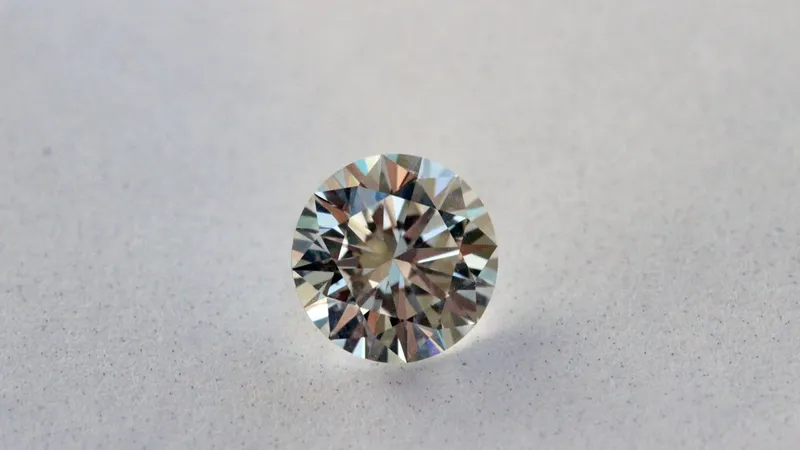
Moissanite vs diamond comes down to one trade. Moissanite costs a small fraction of a diamond and throws more rainbow fire, while a diamond is harder, sparkles with whiter light and is the only one of the two with an established resale market. The two look close enough that a basic diamond tester can mistake one for the other.
That last point matters most when the ring is already in your hand: one you inherited, found in a drawer or bought secondhand. This guide compares the two stones on durability, sparkle, color and price, then turns to the part most comparisons skip: what each one is worth once it has been bought, and the checks that show which one you are holding.
Moissanite vs Diamond at a Glance
| Moissanite | Natural diamond | Lab-grown diamond | |
|---|---|---|---|
| Material | Silicon carbide | Carbon | Carbon |
| Mohs hardness | 9.25 | 10 | 10 |
| Refractive index | 2.65 to 2.69 | 2.42 | 2.42 |
| Dispersion (fire) | 0.104 | 0.044 | 0.044 |
| Light through the stone | Doubly refractive | Singly refractive | Singly refractive |
| Thermal tester reads | Diamond | Diamond | Diamond |
| Resale market | Very thin | Established, below retail | Thin, prices still falling |
The short verdict: moissanite is the better buy for the look on a budget, and a diamond is the better buy if you care about tradition, whiter sparkle or getting some money back later. A lab-grown diamond sits between them on price and shares every physical property with a mined one.
What Moissanite Is
Moissanite is silicon carbide, a different mineral from diamond, named after the French chemist Henri Moissan. Natural moissanite is extremely rare, so every moissanite stone in jewelry is made in a lab. Gemologists call it a diamond simulant: a material that imitates diamond without sharing its chemistry or its properties.
When the first gem-quality synthetic moissanite reached jewelers, GIA's journal described it in a 1997 study of the new diamond substitute as much closer to diamond in overall appearance than the simulants before it. The same paper lists its refractive indices as 2.648 and 2.691, a dispersion of 0.104, a hardness of 9¼ and a specific gravity of 3.22.
Moissanite has no grading system of its own that the trade relies on. Listings often borrow diamond terms such as D color or VVS1 clarity, and some come with a card from a seller-side outfit such as GRA. Those words describe the stone's look; they are not a report from a gemological lab like the ones issued for diamonds.
What Counts as a Diamond
A diamond is crystallized carbon, whether it formed deep in the earth or in a reactor. Lab-grown diamonds have the same chemical, physical and optical properties as mined ones, which is why a gemological lab, rather than a jeweler's eye, is what tells them apart.
The FTC's jewelry guidance expects a seller to describe a lab-grown diamond with a word that tells you it was not mined, such as lab-grown or laboratory-created. Moissanite is never a diamond of either kind, so a listing that calls it a "moissanite diamond" is mixing two different stones.
That distinction drives most of what follows. A lab-grown diamond behaves exactly like a mined one on every home test. Moissanite behaves like a diamond on some tests and gives itself away on others.
Hardness and Durability
Diamond tops the Mohs scale at 10, and only another diamond scratches it. Moissanite sits at 9.25, just below it and above sapphire, so it holds a polish well in a ring worn every day. GIA's consumer guide to simulants lists synthetic moissanite as safe for ultrasonic cleaning, the same routine most jewelers use for diamond rings.
In practice the hardness gap is small for a stone you wear every day. Diamond resists scratching best, and moissanite comes close enough that most owners never notice the difference.
Durability is the one category where the two stones nearly tie. If hardness is your main worry, either one is a sound choice for an engagement ring.
Sparkle: Brilliance Against Fire
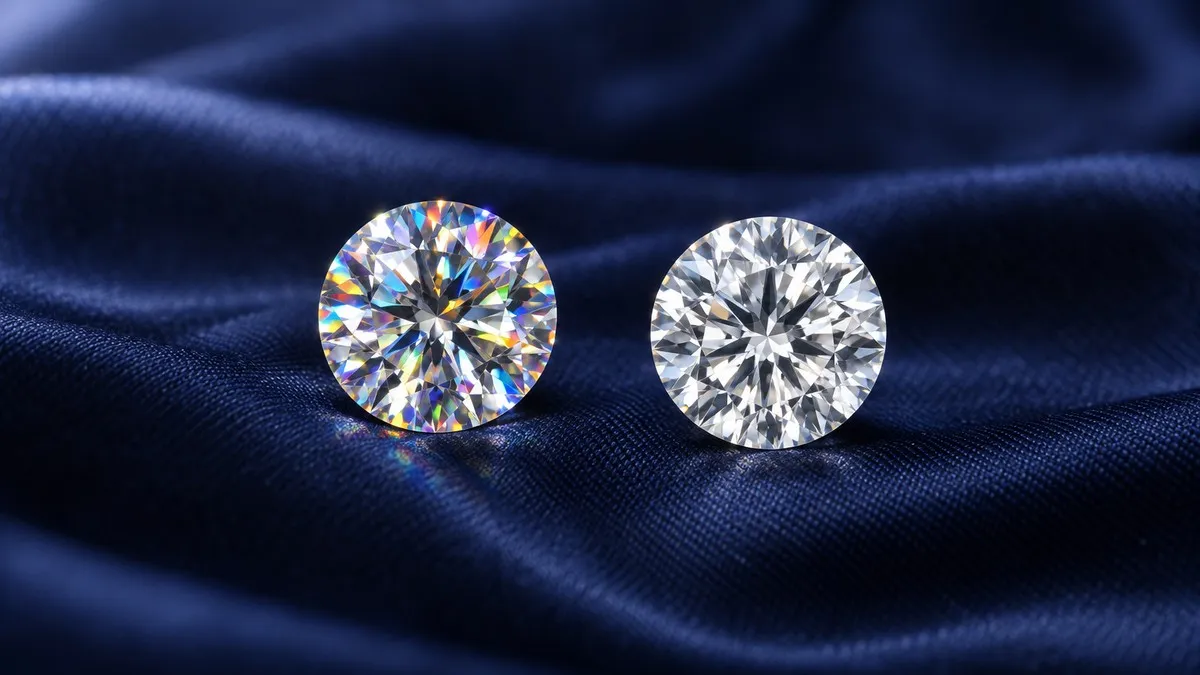
This is where moissanite vs diamond stops being close. Moissanite's refractive index, 2.65 to 2.69, is higher than diamond's 2.42, so it bends light more sharply and returns a lot of it to your eye. Its dispersion, 0.104 against diamond's 0.044, is more than twice as high.
Dispersion is what jewelers call fire: white light splitting into flashes of color. A diamond shows mostly white brilliance with some color. Moissanite shows strong rainbow flashes, most visible in sunlight and in larger stones. Some people love that look; others find it reads as "too much" next to a diamond.
The doubling effect
Moissanite is doubly refractive. Light entering it splits into two rays, so when you look into the stone at certain angles, the back facet edges appear doubled and the inside can look slightly fuzzy. Diamond is singly refractive, and its facet edges look crisp from every direction. You need magnification to see it, which makes it the most useful home check later in this guide.
Most people cannot tell the two apart at arm's length, especially without a diamond beside the moissanite for comparison. The differences show up in sunlight, under a loupe and over time as you get to know the stone.
Color and Clarity
Diamonds are graded on a color scale from D, colorless, to Z, light yellow or brown, and color is one of the biggest drivers of a diamond's price. Moissanite sold today is usually near-colorless, though larger stones can look slightly warm.
Clarity works differently too. A diamond report maps its inclusions. For moissanite, the GIA study notes a tell: fine needle-like inclusions running perpendicular to the top facet, which a gemologist can spot under magnification.
If you are trying to read the marks and grades on a piece you already own, our guide on how to read hallmarks and karat stamps covers the stamps inside the band, which often say more about value than the stone does.
Moissanite vs Diamond Price
The price gap is the reason moissanite exists as a jewelry stone. These are the latest figures we found, each from a named source and dated:
| Stone | Price | Source and date |
|---|---|---|
| Natural diamond, 1 carat | $3,898 average, down 51% from $8,007 in 2021 | Rapaport Group data, September 2026 |
| Lab-grown diamond, wholesale | $73 to $142 per carat for IGI-graded rounds | Edahn Golan, Q3 2026 |
| Moissanite, 1 carat loose | About $225 at one seller | Gema&Co, August 2026 |
The natural figure comes from CNBC's report on diamond prices reaching record lows, which ties the fall to a supply glut and to competition from lab-grown stones. Lab-grown stones have fallen much further. The wholesale price list from Edahn Golan Diamond Research shows its lab-grown index down 92% since tracking began in July 2018.
Retail is not wholesale
Shop prices for lab-grown stones sit far above that wholesale range. One retailer's October 2026 analysis found high-grade loose lab-grown stones listed at $800 to $900 per carat against about $80 at wholesale. The gap between what a store charges and what the trade pays is the first thing to understand about resale.
In a finished ring the gap between moissanite and lab-grown can be smaller than the loose prices suggest. One retailer's ring with only the center stone changed cost $1,325 with a 1 carat moissanite and $1,699 with a 1 carat lab-grown diamond, both checked on October 7, 2026.
Resale Value: Moissanite vs Diamond
Price paid and resale value are different numbers for every stone in this guide. A buyer, whether a jeweler, a pawn shop or a private buyer, prices a stone against what the trade pays for it, not against what a shop charged you.
Natural diamonds. They have the most established resale market, because they are graded by labs and traded worldwide. Even so, a used diamond rarely sells for what it cost new, and the Rapaport figures above show that natural prices themselves fell by half in five years. A diamond holds some value; it is not a store of value.
Lab-grown diamonds. With wholesale prices near $100 per carat and still sliding, a lab-grown stone bought at retail resells for a small share of its price. Retailers who sell them quote figures of 20 to 40% retained, but those are sellers' numbers, and wholesale prices for larger stones have fallen fastest.
Moissanite. Sellers of moissanite describe its resale value as minimal, and there is no lab grading system for buyers to trade against. A moissanite stone usually resells for a small part of an already low price.
The metal can be worth more than the stone
For a moissanite or lab-grown ring, the band often carries more value than the center stone. Fortune reported gold at $4,032 an ounce on October 23, 2026, so a heavy 14k or 18k band has scrap value that does not depend on what the stone turns out to be.
That is where a first estimate helps before you visit a buyer. Primo Worth's Jewelry mode reads the metal, karat, stones and hallmarks it can see in one photo, then gives an estimated value checked against recent eBay sales where they exist, with the sold listings shown so you can judge how close the matches are. It is an AI estimate, not a professional appraisal.
How to Tell Moissanite From a Diamond
Most home tests you will find online were written to catch glass and cubic zirconia, not moissanite. The fog test and the water test do not separate moissanite from diamond at all. These checks do, in rising order of reliability:
- Loupe check. With a 10x loupe, look through the top of the stone at an angle toward the back facets. Doubled facet edges point to moissanite; crisp single edges point to diamond. Turn the stone and look from several directions, since the doubling shows in some directions and not others.
- Sunlight check. Strong rainbow flashes across the whole stone in direct sun lean toward moissanite. It is a hint, not proof, because a well-cut diamond also shows fire.
- Inscription check. Look at the girdle, the thin outer edge, under magnification. Lab-grown diamonds graded by a lab often carry a laser inscription such as "LG" marking them as lab-grown.
- Electrical tester. A multi-tester that measures electrical conductivity separates moissanite from most diamonds.
- Gemological lab. A lab report is the only result that settles natural, lab-grown or moissanite with confidence.
Why a thermal tester is not enough
The classic pen-style diamond tester measures how fast heat moves through the stone. Moissanite conducts heat much like diamond, so it often reads as diamond on these devices. The FTC warns jewelers about exactly this false positive.
Electrical testers have their own blind spot. According to IGI's tester guide, some lab-grown diamonds made by the HPHT method keep traces of a metal catalyst that conducts electricity, and blue diamonds containing boron conduct too. Both can read as moissanite. IGI's own advice is that informal detection is no substitute for a lab.
Primo Worth will not answer this question for you either: a photo cannot confirm whether a stone is moissanite or diamond. Run the loupe and tester checks first, or ask a jeweler, then price the piece as what it really is.
Who Should Choose Moissanite and Who Should Choose a Diamond
Moissanite suits you if you want a large, bright stone on a modest budget, you enjoy rainbow fire, and you do not expect to sell the ring later.
A natural diamond suits you if the tradition of a mined stone matters to you, you prefer white brilliance over colored flashes, and you want a stone with a lab report and an existing resale market. Accept that its price can fall, as the last five years showed.
If you are selling rather than buying, the choice is already made. What counts then is knowing which stone you have, which metal holds it, and what similar pieces have actually sold for, rather than what they were listed at. Our guide to finding what something is worth walks through reading sold prices for any item.
Is a Lab-Grown Diamond the Better Middle Ground?
For many buyers, yes. A lab-grown diamond is a diamond: hardness 10, the same refractive index, the same white brilliance and no doubling under a loupe. It costs far less than a natural stone of the same size and grade, and in a finished ring it can cost only a few hundred dollars more than moissanite.
The catch is value over time. Wholesale prices have fallen for years, and retail prices are still catching up with them. A lab-grown diamond is a stone to buy because you like it, not because you expect to sell it for close to what you paid.
The Bottom Line
Moissanite and diamond look alike at a glance but differ in almost everything that matters after the purchase. Moissanite is nearly as hard as diamond, sparkles with more color and costs a fraction of a diamond. A diamond, natural or lab-grown, is harder still, shows whiter light and carries the only real resale market of the three, though even that market has lost about half its value since 2021.
If you are holding a ring and wondering which stone it is, a loupe and an electrical tester narrow it down, and a gemological lab settles it. Once you know, judge its value by recent sold prices for similar pieces, and remember that the gold in the band may be worth more than the stone it holds.