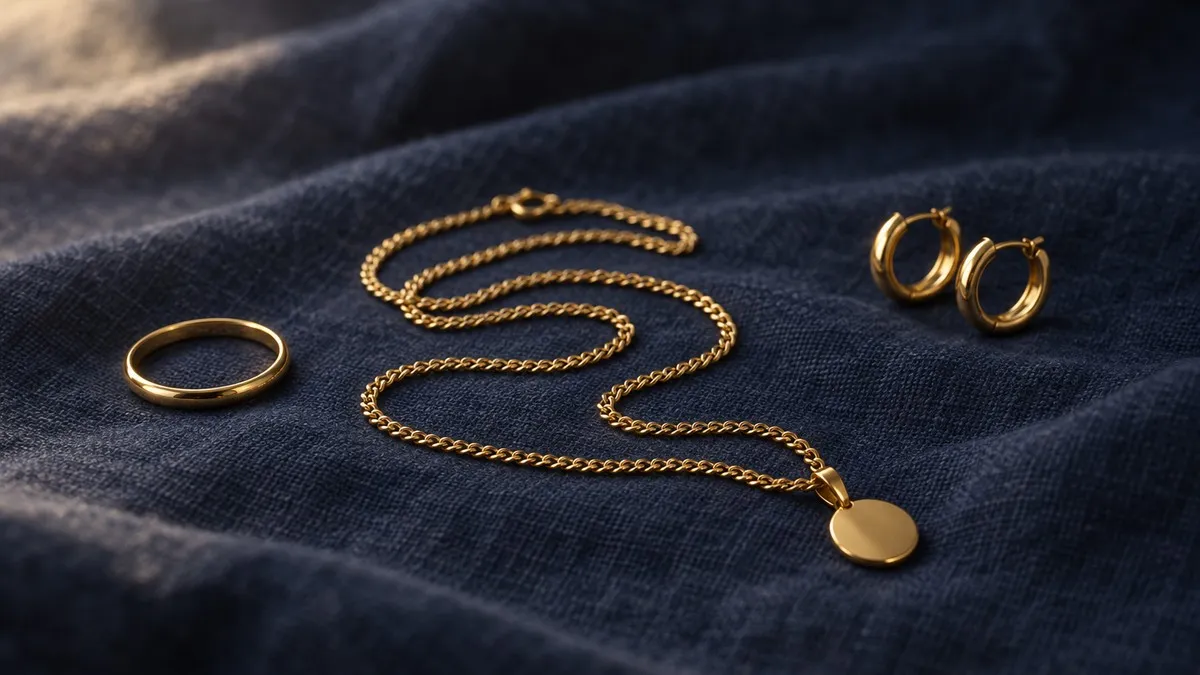
The 14k gold value per gram was about $68.60 on November 23, 2026, the melt value of one gram of 14k gold at a spot price of $3,647.30 per troy ounce. That is the value of the gold inside the piece, not the cash a buyer hands over. Pawn shops, jewelers, mail-in buyers and refiners all pay a share of melt, and that share runs from roughly half to the mid nineties depending on who you sell to.
If you have a 14k ring, chain or bracelet and want to know what it is worth, you need three numbers: its weight in grams, its purity, and the day's spot price. This guide gives you the formula, a chart you can read your piece off, the payout ranges buyers work to, and the cases where a 14k piece is worth more than its metal.
How 14k Gold Value Per Gram Is Calculated
Gold is quoted per troy ounce, and a troy ounce is 31.1035 grams. Divide the spot price by 31.1035 and you get the price of one gram of pure gold. Multiply that by the purity of 14k gold and you have its melt value per gram.
The formula is: spot price per troy ounce ÷ 31.1035 × 0.585 = 14k gold value per gram.
On November 23, 2026, the Kitco gold quote stood at $3,647.30 per troy ounce at 2:36 p.m. New York time. That puts pure gold at $117.26 a gram and 14k gold at $68.60 a gram. For a piece of any weight, multiply its grams by that per-gram figure.
The same math works for any karat. 14k is 14 parts gold out of 24, the rest silver, copper, zinc or palladium depending on the colour. White and rose 14k carry the same share of gold as yellow, so a gram of each has the same melt value, even though the white piece looks nothing like the yellow one.
Why the stamp says 585 and not 583
Strictly, 14 out of 24 is 58.33 percent, which would be stamped 583. According to the World Gold Council, most manufacturers adopted the European practice of making 14k slightly over 14 karat, so the fineness mark on most 14k jewelry is 585. Some price sites use 58.33 percent and some use 58.5 percent, which is why two calculators can disagree by about 20 cents a gram on the same day.
The US also allows a small shortfall. Under the National Stamping Act, cited in the federal jewelry guides, a gold part with no solder may test up to three parts per thousand below its mark, and a part with solder up to seven. A buyer who assays your piece can find it a touch under 585 without anyone having done anything wrong.
In the US, 10 karat is the legal minimum for an item to be called gold, and 14 karat is the most popular, the World Gold Council notes. That is why most of what sits in American jewelry boxes is 14k or 10k.
14k Gold Value Chart by Weight
The chart below uses the November 23, 2026 spot price of $3,647.30 and a purity of 58.5 percent. The three right-hand columns show what the same piece brings at 50, 80 and 90 percent of melt, the range where most offers land. Figures are rounded to the dollar.
| Weight | 14k melt value | At 50% of melt | At 80% of melt | At 90% of melt |
|---|---|---|---|---|
| 1 g | $69 | $34 | $55 | $62 |
| 2 g | $137 | $69 | $110 | $123 |
| 3 g | $206 | $103 | $165 | $185 |
| 5 g | $343 | $171 | $274 | $309 |
| 7 g | $480 | $240 | $384 | $432 |
| 10 g | $686 | $343 | $549 | $617 |
| 15 g | $1,029 | $514 | $823 | $926 |
| 20 g | $1,372 | $686 | $1,098 | $1,235 |
| 30 g | $2,058 | $1,029 | $1,646 | $1,852 |
Reading the chart for rings and chains
MeltValue puts a typical band at 3 to 7 grams, so most rings sit in the first rows of the chart. Heavier chains sit in the bottom rows, and that is where the gap between a 50 percent offer and a 90 percent offer becomes hundreds of dollars.
The chart goes stale with the spot price. For today's figure, the scrap gold calculator on this site runs the same formula at the current price for any weight and karat.
Per pennyweight and per troy ounce
Many gold buyers quote in pennyweight, written dwt. One pennyweight is 1.555 grams, and 20 pennyweights make a troy ounce. At the same spot price, 14k gold is worth about $106.68 per pennyweight and $2,133.67 per troy ounce of 14k metal.
Keep the units straight when you compare offers. A quote of $60 per pennyweight sounds close to $68 per gram, but it is only about $38.58 a gram, a little over half of melt. The consumer guidance from Alaska's weights office warns that truncated or misused conversion factors are one of the ways sellers get paid less than they are due, and it gives the factors to carry with you: 1 gram is 0.643 pennyweight, and 1 pennyweight is 1.555 grams.
How Much Is 14k Gold Worth to a Buyer?
Nobody between you and a refinery pays full melt. Each buyer has to cover testing, refining, shipping and their own margin, and the size of that cut depends far more on the kind of buyer than on your piece.
The ranges different price trackers publish do not agree, so treat them as bands rather than rules:
- Pawn shops: the price tracker MeltValue puts the best pawn offer around 50 percent of melt, with low offers near 30 percent; MyGoldCalc's comparison puts walk-in pawn cash at 40 to 65 percent.
- Local jewelers and gold buyers: MyGoldCalc puts them at 60 to 80 percent of melt, and MeltValue counts 75 to 80 percent as a strong specialist offer.
- Mail-in buyers and refiners: GoldPrice.com's scrap calculator notes that refiners and dealers typically pay 85 to 95 percent of melt for gold, with the top of that range reserved for larger lots.
At $68.60 a gram, a 10 gram chain is $686 in melt. A pawn shop at 50 percent offers about $343; a refiner at 90 percent pays about $617. That $274 difference is why the first number you hear should never be the one you take.
Scrap gold price for mixed lots
New Jersey's consumer affairs division tells sellers to separate gold by karat and to get three offers before selling. Sort your 10k, 14k and 18k pieces before you go, so each group is weighed and priced at its own purity. Selling 14k at a 10k rate costs you about 29 percent of its gold value before any other cut.
We compared the payout, speed and trade-offs of each kind of buyer in our guide on where to sell gold jewelry.
Weigh Your 14k Gold Before Anyone Else Does
The weight is the one number you can check at home, and it moves the result more than anything else. A kitchen scale that reads to 0.1 gram is enough to know whether a buyer's figure is in the right place, and a jeweler's scale that reads to 0.01 gram is better for small pieces.
New Jersey's consumer affairs office sets out what to expect from a buyer there: the weighing and any purity test happen in plain view, the scale carries a dated inspection seal from the past 12 months, prices are posted, and you leave with a receipt listing the metal, fineness, weight and price paid. Even where your state's rules are looser, those are fair things to ask for.
What to subtract before you multiply
Not every gram on the scale is 14k gold. Take these out of the weight before you use the chart:
- Stones: a diamond or coloured stone adds weight but no gold, so subtract the stone weight first, as MeltValue advises for rings.
- Clasps and findings: a clasp can carry its own mark, different from the chain, so read it separately and ask a buyer to weigh it apart.
- Gold-filled and plated pieces: a mark such as 1/20 14K GF or 14K GP means a thin layer of gold over base metal, not solid 14k. Its melt value is a small fraction of the chart above, as our guide to gold filled and plated stamps explains.
Hollow chains and hollow hoops weigh far less than they look, so a big piece can sit low in the chart. That is not a buyer cheating you; there is simply less gold in it.
When 14k Jewelry Is Worth More Than Its Gold
Melt value is a floor for plain gold, not a ceiling for every piece. GoldPrice.com's calculator notes that branded jewelry, coins and antiques can be worth more than their metal. A signed piece from a known maker, a period design that collectors look for, or a ring set with a good diamond can sell to a retail buyer for more than any scrap offer.
How to check whether a piece sells above melt
The way to find out is to look at what similar pieces have actually sold for, not at asking prices. Search sold listings for the maker's name and the type of piece, and compare items in the same condition. If the sold prices sit well above the melt figure for the weight, selling it as jewelry rather than as scrap is worth the extra effort.
Primo Worth can give you a first read from one photo. Its Jewelry mode reads the metal, karat, stones and hallmarks it can see, then checks the piece against recent eBay sales where they exist and shows those sold listings so you can judge the matches yourself. The result is an AI estimate, not a professional appraisal, and it is not a promise of what a buyer will pay.
A photo also cannot confirm what a metal is. If a stamp is worn or missing, a jeweler's acid or electronic test is what tells you whether a piece is 14k, and that is a step worth taking before you price anything heavy. An estimate from Primo Worth can help you decide which pieces are worth that trip.
Why the 14k Gold Price Per Gram Moves Every Day
Because the formula starts from the spot price, the value of your 14k gold changes every trading day. 2026 shows how far it can move. The World Gold Council reports that gold set its record high on January 29, 2026, and finished October at $3,913 per ounce, down 6.3 percent for the month and about 25 percent below that January peak.
At October's close, 14k gold was worth about $73.60 a gram in melt. By November 23 it was $68.60. On a 20 gram chain, that five dollar gap is about $100 of melt value, before any buyer takes a cut.
You cannot time the market from a jewelry box, and no one knows where the price goes next. What you can do is check the spot price on the day you sell, run the formula yourself, and measure every offer against that number. A buyer quoting yesterday's or last month's price is a buyer to ask questions of.
Putting the 14k Numbers Together
The 14k gold value per gram is the spot price divided by 31.1035, times 0.585. At the November 23, 2026 spot of $3,647.30, that came to $68.60 a gram, $106.68 a pennyweight and $2,133.67 for a troy ounce of 14k metal.
What you are paid is a share of that melt value: half or less at a pawn shop, more at a specialist buyer, and 85 to 95 percent at refiners and dealers for larger lots. Weigh your pieces at home, take out stones and steel parts, keep karats apart, and convert every pennyweight quote to grams before you compare.
Plain 14k gold is worth its melt. Signed, antique or set pieces can be worth more, and their sold prices, not their weight, show by how much.