Peace dollar value starts with silver. Each coin struck from 1921 to 1935 holds 0.77344 troy ounces of pure silver, which came to about 40.50 dollars at the spot price of 52.36 dollars an ounce on the morning of November 10, 2026. Most Peace dollars, including almost every 1922, are worth close to that figure when worn, while a short list of dates and mint marks, led by the 1921, the 1928 and the 1934-S, sells for hundreds or thousands of dollars.
If you have a jar of old silver dollars or a single coin from a relative, the useful question is which of the 24 regular date and mint combinations you hold and how much wear it shows. This guide covers how to read the coin, the melt floor today, what a 1922 is worth, a value chart for every major date, the key dates, the two great rarities and what condition does to the price.
Peace Dollar Value at a Glance
These ranges come from the PCGS Price Guide, updated on November 6, 2026, and the silver price on November 10. Each is explained further down.
- Common dates, worn (1922, 1923 and most others): close to the silver value, so about 40 dollars and up for a coin without a holder.
- Common dates, uncirculated: about 95 dollars in Mint State 60 and 150 to 175 dollars in Mint State 65 for a coin in a PCGS holder.
- Better dates in top condition: 1924-S, 1925-S, 1927-D, 1927-S and 1928-S list from about 900 to 1,650 dollars in Mint State 64, and a 1928-S reaches 18,500 dollars in Mint State 65.
- Key dates: the 1921 starts at about 170 dollars worn and the 1928 at about 210 dollars, while an uncirculated 1934-S lists from 2,750 dollars.
Silver sets the floor. Collector demand sets everything above it, and for most of the series that demand only appears once a coin shows no wear.
How to Identify a Peace Silver Dollar
The Peace dollar was designed by Anthony de Francisci and struck in 90% silver from 1921 to 1928 and again in 1934 and 1935, according to the GOVMINT mintage chart. It replaced the Morgan dollar as the country's circulating silver dollar and was the last one struck for circulation in silver.
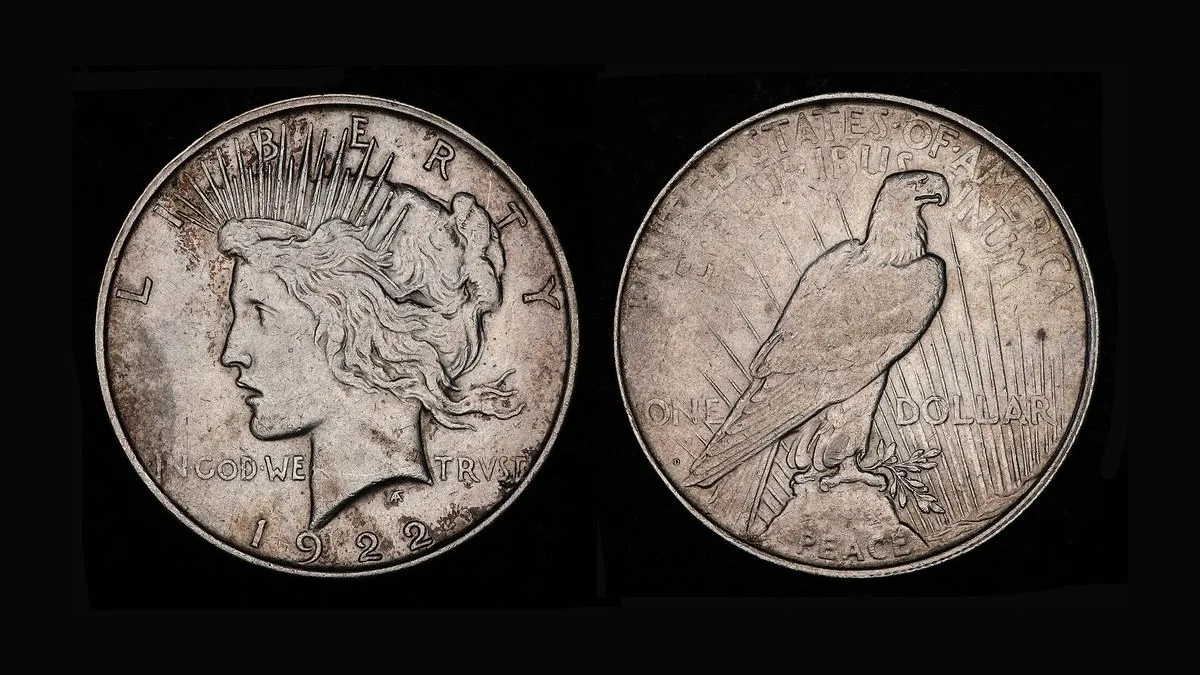
The front shows Liberty's head facing left, wearing a crown of rays, with LIBERTY across the top, IN GOD WE TRUST below her face and the date at the bottom. The back shows a bald eagle perched on a rock with an olive branch in its talons, ONE and DOLLAR on either side and the word PEACE on the rock. Each coin weighs 26.73 grams, measures 38.1 millimeters across and is 90% silver and 10% copper.
The coin exists because of a law. The Pittman Act of 1918 sent millions of silver dollars to the melting pot to supply silver to Britain during World War I, and then required the Mint to replace them. Production stopped in 1928 when the last of that silver had been struck and restarted in 1934 under a new act that had the Mint buy domestic silver.
Where the mint mark is
Turn the coin to the eagle side and look low on the left, just below the word ONE and above the tip of the eagle's wing. D means Denver and S means San Francisco. No letter means Philadelphia.
The mint mark often matters as much as the date. In the PCGS guide, a 1928 from Philadelphia lists at 210 dollars in Good, while a 1928-S lists at 90 dollars in the same condition. The letter is small, so use a magnifier on a worn coin.
Which mints struck which years
Philadelphia struck the 1921 alone. All three mints struck coins in 1922 and 1923, Philadelphia and San Francisco in 1924 and 1925, all three again in 1926 and 1927, Philadelphia and San Francisco in 1928, all three in 1934 and Philadelphia and San Francisco in 1935. So a 1924-D or a 1928-D does not exist, and a coin that claims to be one has been altered.
Modern Peace dollars are a different coin
Since 2021, the US Mint has struck Peace dollars again as collector coins in .999 silver, each with 0.858 troy ounces of silver. The 2021 issue had a mintage of 199,940, and the 2026 coins carry a 1776 to 2026 dual date and a Liberty Bell privy mark for the semiquincentennial.
A Peace dollar dated 2021 or later is a modern issue. None of the prices below apply to it, and its value follows its silver content and demand for that release.
Peace Dollar Melt Value Today
A vintage Peace dollar holds 0.77344 troy ounces of pure silver. At 52.36 dollars an ounce, the spot price PCGS showed on the morning of November 10, 2026, that is about 40.50 dollars of silver per coin. Four days earlier, at 51.97 dollars, it was about 40.20 dollars.
That number is the floor of the market, not the price every coin brings. According to the Red Book, the standard US price reference cited in the Wikipedia entry for the series, heavily worn Peace dollars of most years list for little more than their bullion value. The two exceptions it names are the 1921 and the 1928.
For a worn common date, today's silver price matters more than any chart. A printed table set when silver was higher or lower can be off by tens of dollars on a coin whose value is mostly metal. Key dates barely notice the silver price.
Millions of these coins have already gone back into the pot. GOVMINT notes that Peace dollars were melted in large numbers during World War II under the Wartime Act of 1942, which is part of why mintage figures overstate what survives.
1922 Peace Dollar Value
The 1922 is the coin most people find, and it is the most searched date in the series for good reason: Philadelphia struck 51,737,000 of them, Denver 15,063,000 and San Francisco 17,475,000. That is more than any other year, and it keeps the price of a typical 1922 close to its silver.
In the PCGS guide, a 1922 from Philadelphia lists at 90 dollars in Good, Very Fine and Extremely Fine alike, 95 dollars in Mint State 60, 100 dollars in Mint State 63 and 150 dollars in Mint State 65. Those are prices for coins already in a PCGS holder. A worn 1922 without one, the kind found in a drawer, trades much closer to the 40.50 dollar melt value.
When a 1922 is worth more
Condition is the first way up. The same guide lists a 1922 at 600 dollars in Mint State 66 and 8,000 dollars in Mint State 67, the top of the scale for this date. The 1922-D climbs faster, from 575 dollars in Mint State 65 to 75,000 dollars in Mint State 67, and the 1922-S lists at 1,450 dollars in Mint State 65 because few survive in that condition.
The second way up is a variety. Before the Mint lowered the design for regular production, it struck 35,401 coins dated 1922 from the old high relief dies, according to APMEX, and melted most of them. Those are covered under the great rarities below. A 1922 that looks ordinary is almost certainly the regular low relief coin.
Peace Dollar Value Chart by Date and Mint Mark
The table shows the main dates from the PCGS Price Guide, last updated November 6, 2026 and read on November 10. PCGS describes these as average dealer asking prices for coins in PCGS holders, not sold prices. Good is a heavily worn coin with a readable date, Extremely Fine shows light wear on the high points, and Mint State 60 to 65 are uncirculated coins from plain to choice. A dash means the guide gave no figure in that column.
| Date and mint | Good | Extremely Fine | Mint State 60 | Mint State 64 | Mint State 65 |
|---|---|---|---|---|---|
| 1921 | $170 | $260 | $650 | $1,750 | $4,000 |
| 1922 | $90 | $90 | $95 | $110 | $150 |
| 1922-D | $90 | $90 | $95 | $235 | $575 |
| 1922-S | $90 | $90 | $95 | $275 | $1,450 |
| 1923 | $90 | $90 | $95 | $110 | $175 |
| 1924-S | $90 | $90 | $260 | $1,500 | - |
| 1925-S | $90 | $90 | $150 | $900 | - |
| 1927-D | $90 | $90 | $285 | $1,600 | $4,000 |
| 1928 | $210 | $300 | $525 | $1,300 | $4,500 |
| 1928-S | $90 | $90 | $225 | $1,600 | $18,500 |
| 1934 | $90 | $90 | $175 | $475 | $900 |
| 1934-D | $90 | $90 | $175 | $650 | $2,000 |
| 1934-S | $90 | $165 | $2,750 | $9,750 | $11,500 |
| 1935 | $90 | $90 | $135 | $400 | $900 |
| 1935-S | $90 | $90 | $325 | $1,000 | $1,800 |
What the chart shows
Two patterns stand out. Almost every date sits at the same 90 dollar level until it reaches Mint State, which suggests that a worn Peace dollar in a holder is priced as silver plus the cost of the holder. And the gaps open only at the top, where a 1928-S in Mint State 65 lists at 18,500 dollars while a 1922 in the same condition lists at 150.
How to read the guide figures
These prices only apply to coins PCGS has already examined and sealed. PCGS states that its guide is a starting point, built from dealer price lists, websites, auctions and coin shows. A raw coin in the same condition usually sells for less, since the buyer takes on the risk and the cost of sending it in.
The Key Dates Worth the Most
A few coins carry most of the value in the series. Each is worth checking for before you sell a group of Peace dollars at melt.
1921, the first year in high relief
The 1921 was struck only in Philadelphia, 1,006,473 coins, and all of them in high relief. That deeper design shortened the life of the dies and made the coins hard to stack, so the Mint lowered it from 1922. You can spot a 1921 by its date, and by Liberty's hair and the eagle's feathers, which stand noticeably higher than on later coins.
In the PCGS guide, it lists at 170 dollars in Good, 260 dollars in Extremely Fine, 4,000 dollars in Mint State 65 and 150,000 dollars in Mint State 67. Even a worn 1921 is worth four times its silver.
1928, the lowest mintage
Philadelphia struck only 360,649 Peace dollars in 1928, the lowest regular mintage of the series according to GOVMINT, less than half the 848,000 of the next lowest, the 1927. It is scarce in every condition, which is why it lists at 210 dollars in Good, 525 dollars in Mint State 60 and 4,500 dollars in Mint State 65.
Check the mint mark first. A 1928-S, with an S above the eagle's wing tip, is a different coin, common when worn and worth 90 dollars in Good. A Philadelphia 1928 has no letter at all.
1934-S, the condition rarity
San Francisco struck 1,011,000 coins in 1934, not a small number, but few were saved before they wore. GOVMINT calls the 1934-S infamous for being difficult to find in high Mint State, and the prices show it: 90 dollars in Good, 165 dollars in Extremely Fine, then 900 dollars at About Uncirculated 55, 2,750 dollars in Mint State 60 and 11,500 dollars in Mint State 65.
A 1934-S with little or no wear is the most important coin to look for in an ordinary group of Peace dollars. The jump from lightly worn to uncirculated is larger than for any other date.
Dates that matter only when unworn
Several dates look like common coins until they show no wear. The 1924-S lists at 90 dollars in Good and 1,500 dollars in Mint State 64. The 1925-S had a mintage of 1,610,000, and GOVMINT notes that many were struck weakly, with soft detail in the eagle's feathers and Liberty's hair, which makes sharp examples scarce.
The 1927-D and 1927-S each list at 850 dollars in Mint State 63 and reach 32,500 and 70,000 dollars in Mint State 66. The 1928-S follows the same pattern, from 1,600 dollars in Mint State 64 to 88,000 dollars in Mint State 66.
The 1934, 1934-D, 1935 and 1935-S each had fewer than 2 million coins struck, according to APMEX, and the 1934 from Philadelphia, at 954,057, is the last Peace dollar with a mintage under one million. APMEX notes that its price jumps begin at Mint State 60. APMEX also lists a 1934-D with a doubled die on the front, a variety worth a closer look with a magnifier.
The Peace Dollar Rarities You Will Probably Never Hold
Two Peace dollars make headlines but almost never turn up in a family collection. Knowing about them helps you read listings that use their names loosely.
The 1922 high relief and the proofs
The 35,401 high relief coins dated 1922 were struck before the design was lowered, and most were melted, according to the APMEX key dates guide. The Mint struck both proofs and regular coins with those dies. On the PCGS price changes page dated November 9, 2026, a 1922 high relief proof listed at 375,000 dollars in Proof 65, and a matte finish high relief coin at 200,000 dollars in Proof 63.
A 1922 that looks like every other 1922 is the regular coin. Any listing that calls one high relief needs an examination service's holder behind the claim.
The 1964-D that should not exist
In 1965 the Denver Mint struck 316,076 Peace dollars dated 1964 under a law passed in 1964, during a national coin shortage. The decision drew opposition in Congress, and the coins were ordered melted before release. According to the American Numismatic Association, none has been found, and because the coins were never issued as money, any that surfaced would remain government property.
Coins sold as 1964-D Peace dollars do exist, struck privately over old silver dollars, and they are novelties, not Mint products.
How Condition Changes Peace Dollar Value
Collectors and dealers describe condition on a scale from 1 to 70. Coins below 60 show wear, and coins from 60 to 70, called Mint State, show none. For most Peace dollars, the whole of the collector premium sits above 60.
To judge a coin yourself, look at the high points under good light: Liberty's cheek and the hair above her forehead and ear, and the eagle's head, neck and the feathers at the top of the wing. Those wear first. A coin with flat, smooth spots there has circulated. A coin with full frosty luster across the fields and no rub on the cheek may be uncirculated.
Strike is not wear
Some dates, such as the 1925-S, often left the press with soft detail in the hair and feathers. That looks like wear but is not, and it lowers the price of an unworn coin anyway, because buyers pay more for a sharp one. Luster is the tell: a weakly struck coin still shines where a worn coin has dulled.
Never clean a Peace dollar
Cleaning, polishing or dipping a coin removes the surface that buyers look for, and an experienced buyer spots it quickly. A cleaned key date loses much of its premium. If a coin is dark or toned, leave it as it is and store it away from rubber and PVC holders, which can damage silver.
When a holder is worth the fee
For a common date that is clearly worn, sending a coin to PCGS or NGC costs more than it adds. For a 1921, a 1928, any 1934-S, or any date that looks uncirculated, an independent examination is what lets you ask the prices in the chart above.
Where Peace Dollar Prices Come From
Several kinds of numbers circulate, and they measure different things. The PCGS and NGC price guides show dealer asking prices for coins in their own holders. Bullion dealers quote worn common dates against the silver price. Auction records show what top coins brought on a given day, sometimes years ago.
Marketplace sold listings show what ordinary coins changed hands for recently, which makes them the most useful source for a typical worn Peace dollar. Compare like with like: the same date, the same mint mark, the same condition, sold recently and after any big move in silver. When you are ready to sell, the guide to where to sell coins compares dealers, auctions and online buyers.
Checking a Peace Dollar From a Photo
Reading the date, finding the mint mark and judging the wear on a dark, toned coin takes practice, and matching each coin against several guides takes time. Primo Worth shortens the first step. It is free to download, with three free scans. In Coin mode, you snap a photo and it identifies the denomination, year and mint mark, with a read-out on rarity and what drives the value.
The estimate is the median of comparable sales, checked against recent eBay sales where they exist, and the sold listings appear below it so you can judge whether the matches fit your coin. When there are no comparable sales, the app falls back to a web estimate, and sometimes shows no value at all.
Primo Worth gives an AI estimate, not a professional appraisal. A photo cannot tell an added mint mark from a real one or settle whether a coin is About Uncirculated or Mint State, so a coin that looks like a key date still belongs with a specialist. If the same box holds the larger, older silver dollars, the Morgan silver dollar value guide covers those dates the same way.
Peace Dollar Value in Short
Most Peace dollars are common dates worth about their silver, roughly 40.50 dollars at the November 10 spot price, with coins in a holder listing near 90 dollars. The 1922, by far the most common date, follows that rule unless it is uncirculated or one of the rare high relief coins.
The value climbs with three things: a key date, meaning the 1921 or the 1928 from Philadelphia; an unworn coin from a condition rarity such as the 1934-S, 1924-S, 1925-S, 1927-D, 1927-S or 1928-S; and the silver price for everything else. Read the mint mark below ONE first, then the date, then the wear on Liberty's cheek and the eagle's wing. Leave the coin uncleaned, compare it with recent sales of the same date, mint and condition, and remember that a coin dated 2021 or later is a modern issue with its own market.