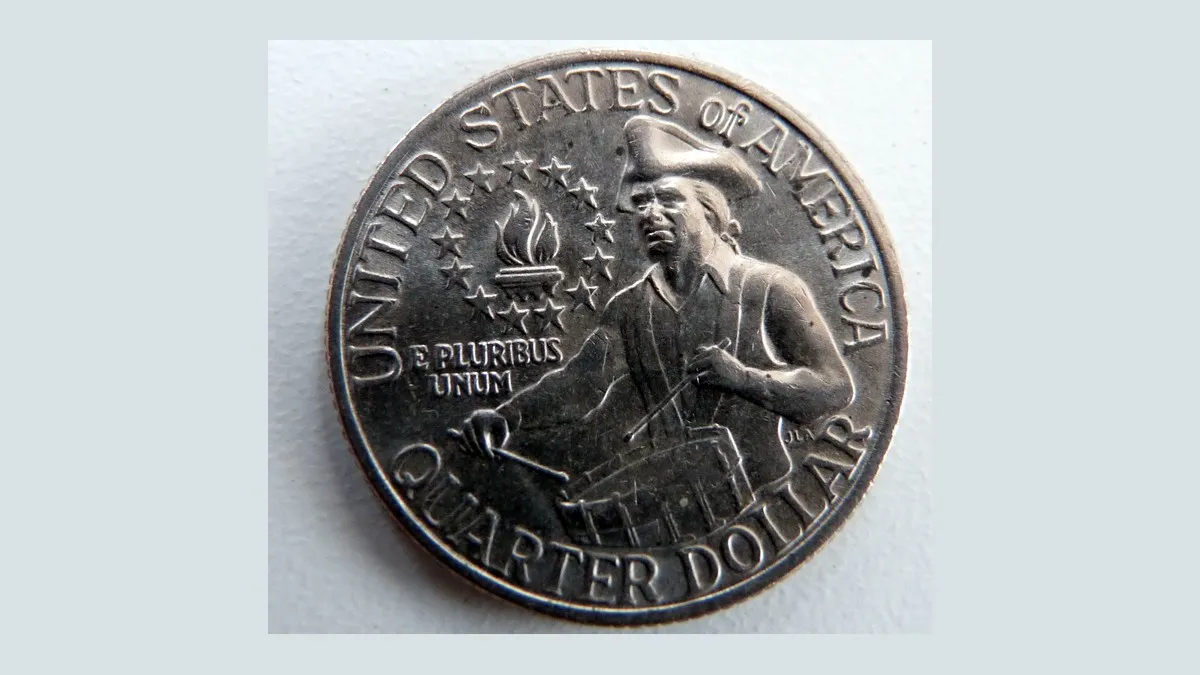
A bicentennial quarter value is 25 cents for almost every coin you will ever hold. The Mint struck about 1.67 billion of the 1776-1976 drummer boy quarters for circulation, so a worn one from a coin jar is worth face value. The exceptions are the 40% silver quarters with an S mint mark, worth about $3.34 in silver on 19 November 2026, a few documented errors, and a tiny number of coins in near-perfect condition.
If you have seen a headline about a bicentennial quarter selling for thousands, that sale happened. What the headline leaves out is how unusual that one coin was. This guide takes the six most repeated myths about these quarters, checks each against the mint records and auction data, and shows you how to sort the coins you have in a few minutes.
Bicentennial Quarter Value at a Glance
Every bicentennial quarter carries the dual date 1776-1976 and the colonial drummer reverse. What separates a 25-cent coin from a collectible one is the mint, the metal and the condition.
| Version | Mint mark | How many | Typical value |
|---|---|---|---|
| Clad, circulated | none or D | 1.67 billion combined | 25 cents |
| Clad, uncirculated | none or D | from mint sets | a few dollars |
| Clad proof | S | 7,059,099 | a few dollars |
| 40% silver, uncirculated | S | about 11 million struck | silver melt and up |
| 40% silver proof | S | about 4 million struck | silver melt and up |
If your quarter has no mint mark or a D and shows wear, you can stop here: it is worth 25 cents. The rest of this post is about the coins that sit outside that line, and the stories that make ordinary coins sound like they do.
Myth 1: The 250th Anniversary Made Them Rare
With the United States marking its 250th year in 2026, a wave of articles suggested that bicentennial coins would finally rise in value. Mintage says otherwise. The US Mint records show final circulating totals of 1.67 billion quarters, 521.9 million half dollars and 220.6 million dollar coins when bicentennial production ended in 1976.
That was the plan from the start. The Mint wanted the coins spread as widely as possible so that ordinary Americans would carry a reminder of the anniversary. In the three months to 30 June 1976, quarter production ran 140 percent above the same period a year earlier.
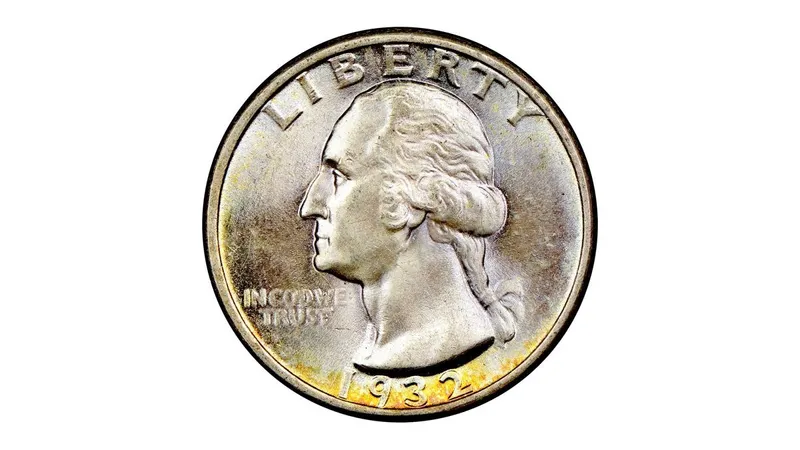
An anniversary does not remove coins from circulation. Talking to GOBankingRates, Ted Ancher of APMEX put the scale in context: the collectible 1932-D and 1932-S Washington quarters have a combined mintage under one million, while the bicentennial quarter passed 1.6 billion. A coin made in those numbers stays common no matter how many birthdays the country celebrates.
Myth 2: There Is a Rare 1975 Quarter
People search for a 1975 quarter because they assume one must exist. It does not. The Mint struck bicentennial quarters through both 1975 and 1976, and every one of them carries the same 1776-1976 dual date. No quarter dated 1975 was ever made.
So a "1975 quarter" for sale is either a bicentennial quarter described wrongly or something that is not a regular US coin. The same dual date appears on the bicentennial half dollar and dollar, which were struck over the same two years.
Myth 3: A Quarter With No Mint Mark Is a Rare Error
Look to the right of Washington's ponytail, just above the date. A D means Denver struck the coin. No letter at all means Philadelphia, which did not put a mint mark on its quarters in 1976.
A bicentennial quarter with no mint mark is the most ordinary version there is, not a missing-mark error. Philadelphia struck 809,784,016 of them and Denver 860,118,839. A circulated example of either is worth face value, and the absent letter is exactly what you should expect to see.
Myth 4: Every S Mint Mark Means Silver
San Francisco struck three kinds of bicentennial quarter, and only two contain silver. The S on the coin tells you where it was made, not what it is made of.
The authorizing law called for 45 million silver bicentennial coins across the three denominations. According to PCGS News, that target proved far too ambitious: the Mint kept selling the silver sets on and off until 1986 and then melted what was left, for a net of roughly 11 million uncirculated and 4 million proof sets. San Francisco also struck 7,059,099 clad proofs for the regular proof sets, and those carry an S with no silver in them at all.
The silver coins were never released into circulation. They were sold in three-coin collector sets, uncirculated ones in a blue envelope and proofs in a red box, as 24/7 Wall St. describes them. A worn S quarter that came out of a till is therefore almost certainly not silver.
How to Tell a Silver Bicentennial Quarter at Home
You need two checks and a kitchen scale that reads to a hundredth of a gram:
- Weight. PCGS lists the 40% silver coin at 5.75 grams. A clad quarter of the same series weighs 5.67 grams.
- Edge. Ancher's eye test: whitish edge reeds suggest silver, while a reddish brown copper stripe means a clad coin worth face value.
- Finish. A proof has mirror-like fields and frosted raised design. An uncirculated silver coin has normal satin luster with an S beside the ponytail.
The weight difference is only eight hundredths of a gram, which is why no one can judge it by hand and why the "every S is silver" idea keeps spreading. Our guide to silver quarter edges and melt values walks through the edge test on the older 90% silver coins as well.
Silver Bicentennial Quarter Value Today
A 40% silver quarter holds 2.30 grams of pure silver, which is 0.0739 troy ounces. With silver at $45.17 an ounce on 19 November 2026, according to Kitco's spot price, that metal is worth about $3.34. That is the floor for any silver bicentennial quarter, and it moves every trading day with the silver price.
PCGS estimates that more than a million silver bicentennial quarters survive, so an ordinary uncirculated one sells for that floor plus a modest premium. A dealer buying a single worn coin will usually pay below melt.
Myth 5: One Sold for $19,200, So Mine Is Worth Thousands
This is the myth with a real number behind it. On 9 June 2019, Heritage Auctions sold a 1976-S silver quarter in Mint State 69 for $19,200, and that sale still stands as the auction record on PCGS CoinFacts. The same page calls the coin very common in worn condition and notes that only examples in Mint State 68 or higher appear scarce.
Mint State 69 sits one step below perfect on the 70-point scale that PCGS and NGC use. The record coin was one of a handful in that condition. 24/7 Wall St., reading PCGS's records, found only two other sales at that level: $6,600 at Heritage in December 2021 and $5,060 at another sale. The same report counts 17 auction results for Mint State 68 examples, which ranged from $55 to $153.
Why One Step of Condition Changes Everything
That gap between $153 and $5,060 is the whole story. PCGS counts about 2,500 silver bicentennial quarters in Mint State 68 and seven in 69, per the same report. The difference between the two is too fine for an untrained eye to judge, so a coin that looks flawless in its set is far more likely to be a 68 or lower.
The clad Denver coin follows the same pattern. CoinWeek's collector guide reports that Mint State 66 examples generally sell for $10 to $40 and Mint State 67 for $30 to $100. The few in Mint State 68 sell for thousands: a PCGS example brought $5,170 at Legend in January 2018, while an NGC example sold for $1,740 in May 2022. CoinWeek counted 14 PCGS and 15 NGC coins in that top condition as of September 2025, out of 860 million struck.
Single sales can mislead in the other direction too. PCGS lists the auction record for the silver proof quarter as $13,500 for a heavily worn example on eBay in March 2019, a price that tells you nothing about what the next one is worth. A record is one buyer on one day. Use the range of recent sales for coins in your coin's condition, never the single highest price.
Myth 6: Anything Odd-Looking Is a Valuable Error
Bicentennial quarters do have real errors and varieties. They are scarce, and most coins that look strange are damaged or worn rather than mis-struck. CoinWeek says of the Denver coin that it "is not a priceless rarity despite what sensationalist articles promoted online suggest."
The 1976-D Doubled Die Varieties
The Cherrypickers' Guide lists two doubled die obverse varieties on the 1976-D quarter, and both PCGS and NGC recognise them. The first, known as FS-101, shows doubling on LIBERTY, and on early strikes of that die also on IN GOD WE TRUST and the date. The second, FS-102, shows moderate doubling on LIBERTY alone. A 2019 Heritage listing called FS-101 "easily the most significant die variety of the Bicentennial type."
As of September 2024, CoinWeek reported 59 FS-101 and 97 FS-102 coins recorded by PCGS, plus 23 and 3 at NGC. These exist, but they are counted in dozens against hundreds of millions of ordinary Denver quarters.
Striking Errors and Overstrikes
Major striking errors do appear. CoinWeek records a 1976-D quarter obverse die cap, where a coin stuck to the die and struck others into a cap shape, that sold for $2,880 at Stack's Bowers. Mint Error News has documented a unique S proof bicentennial quarter struck over a 1967 dime. Coins like these are recognised specialists' pieces, not something you find in a roll.
What Is Usually Not an Error
The most common false alarms are easy to rule out:
- A filled or blob-like D. A clogged die or ordinary wear softens the mint mark. It is neither a doubled die nor a missing mark, and on a coin this common it rarely adds much.
- Flat, shelf-like doubling. This is machine doubling from a loose die, which adds no premium. A true doubled die shows rounded, raised second images.
- Missing or soft details. Heavy wear, cleaning and damage after the coin left the Mint all remove detail, and none of them is a minting error.
If a coin passes those checks and still shows clear doubling or a mis-strike, a specialist at PCGS or NGC can examine it. That fee only makes sense for a coin with a visible reason to submit it.
How to Check What Your Bicentennial Quarter Is Worth
Start with the mint mark and edge. A clad P or D coin that has circulated is a 25-cent piece, so spend it or keep it for the design. An S coin that weighs 5.75 grams is silver and worth at least its melt value. Anything else, from an uncirculated set to a possible doubled die, deserves a closer look at recent sold prices before you decide.
Primo Worth can help with that last step. Snap a photo in Coin mode and it identifies the denomination, year and mint mark, then checks recent eBay sales where they exist, showing the sold listings so you can judge how close each match is. It gives an AI estimate, not a professional appraisal: a photo cannot confirm whether a quarter is silver, settle its condition on the 70-point scale or tell a true doubled die from machine doubling. That still takes a scale, a loupe and, for the rare coin, a specialist's examination.
When a coin does turn out to be more than face value, our comparison of where to sell coins covers dealers, auctions and online buyers. A Primo Worth estimate gives you a starting figure to compare their offers against, and you can try three scans free.
Bicentennial Quarter Value in Short
Almost every 1776-1976 quarter is worth 25 cents because 1.67 billion were struck for circulation, and the 250th anniversary has not changed that. There is no 1975 quarter, and a missing mint mark simply means Philadelphia.
The silver coins carry an S, weigh 5.75 grams and came from collector sets, which puts their floor at about $3.34 on 19 November 2026. The big prices belong to a few coins in Mint State 68 or 69 and to recognised errors such as the 1976-D doubled dies and die caps. Judge your own coin by the recent sales of coins like it, not by the record headline.