If you are working out how to tell if silver is real, read the marks first, then run two checks that cost nothing: a strong magnet on the body of the piece and, for coins, a scale that reads to 0.01 gram. A stamp such as 925 or STERLING, no pull from the magnet and the right weight together make solid silver likely. Only a test on the metal itself, done by a jeweler or a dealer, confirms it.
That matters because silver-colored metal is everywhere. Plated spoons, nickel silver trays, brass chains with a 925 tag and copied silver dollars all turn up in the same drawers and flea market boxes as the real thing. The steps below work for any piece, then go object by object through the three things people ask about most: chains, flatware and coins.
What You'll Need to Tell If Silver Is Real
You can do most of this at a kitchen table. A loupe or a phone camera with a macro mode reads the tiny marks. A strong neodymium magnet, not a fridge magnet, shows a weak pull that a household one would miss. A digital scale that reads to 0.01 gram is the single most useful tool for coins, and a pair of calipers helps with them too.
Leave the bleach, the lighter and the hardware store acid in the cupboard. Each of them damages the surface you are trying to judge, and none of them tells you how much silver is in the piece. The troubleshooting section explains why.
If you are not even sure what the object is, start with a photo. Primo Worth identifies an item from one photo: Jewelry mode reads the metal, karat, stones and hallmarks it can see, and Coin mode reads the denomination, year and mint mark. A photo cannot confirm what a metal is, so the app does not tell real silver from plate. It gives you a name to look up and an estimated value once you know what you have.
Step 1: Read the Silver Marks
Marks are where every check starts, and in the US they carry legal weight. Under the FTC's Jewelry Guides, a product may be called sterling only if it is at least 925 parts per thousand pure silver, and coin silver only if it is at least 900. The word silver on a plated piece has to be qualified so a buyer knows it is only a coating.
Look on the underside, the back of a handle, the inside of a ring band, or the tag beside a clasp. Marks are small and often worn, so tilt the piece under a single light until the letters cast shadows.
Marks that point to solid silver
STERLING, STER, 925 and .925 all claim sterling, which is 92.5 percent silver. Continental European pieces often carry 800, 830 or 900, which are solid silver at a lower fineness. Britannia silver is 958, and fine silver is 999 or FS. English sterling carries a small walking lion, the lion passant, alongside a town mark and a date letter rather than a number.
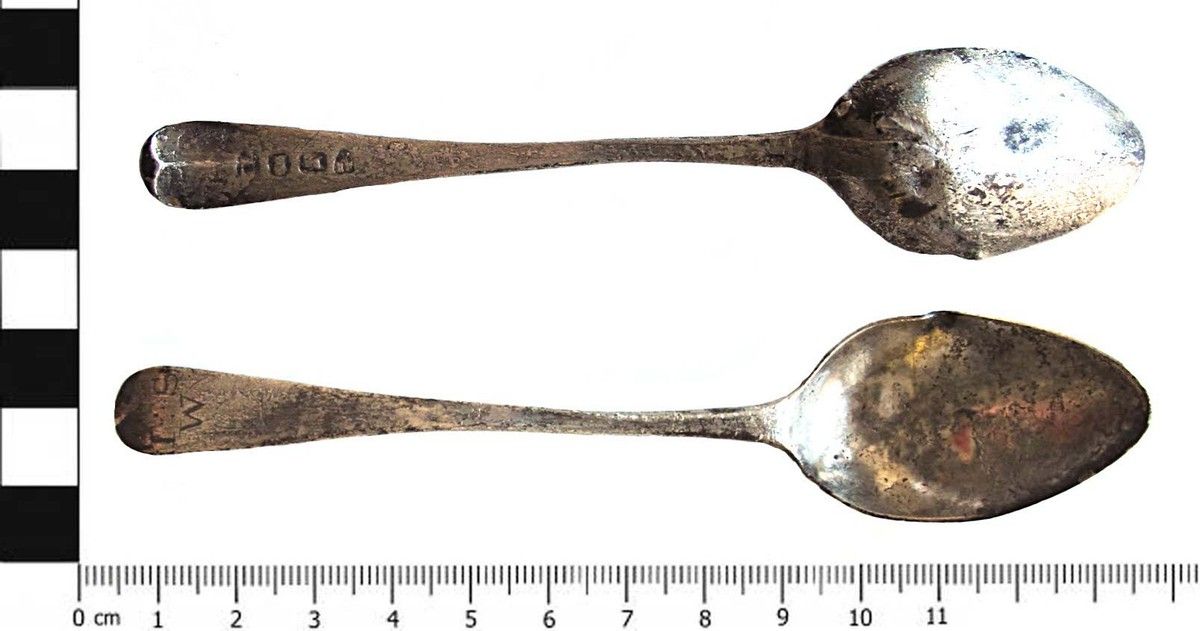
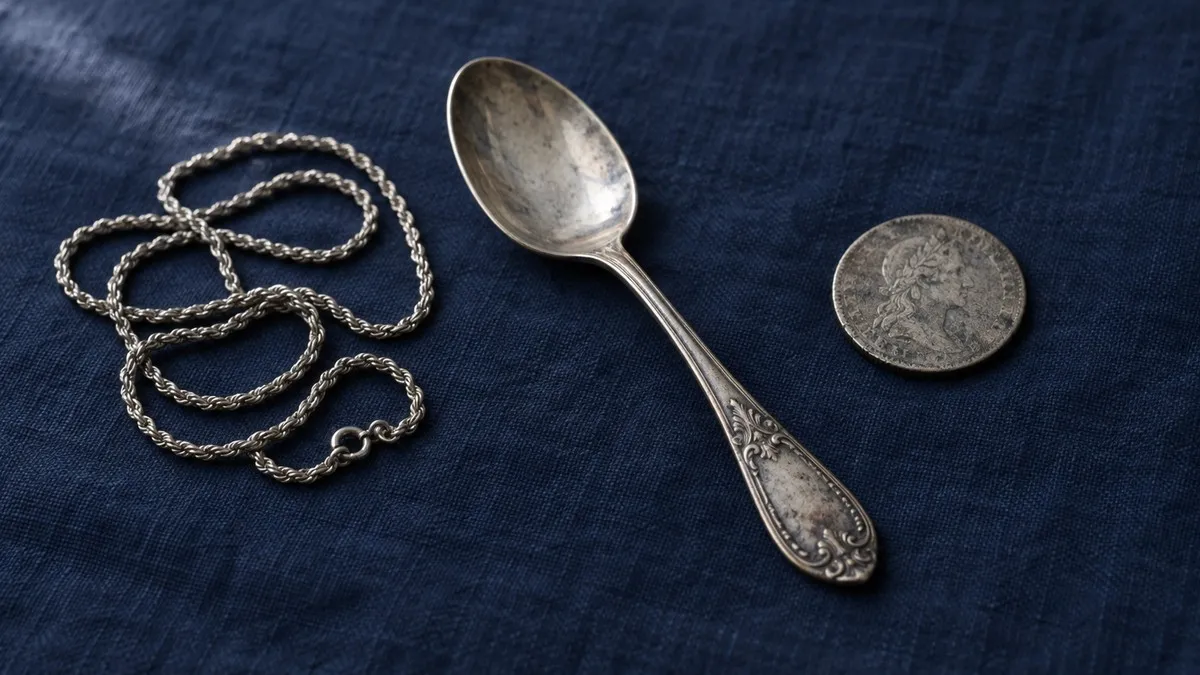
The spoon above shows how small these marks are: three castles for Newcastle, a lion for sterling and the maker's initials, all within a few millimeters on the back of the handle.
Marks that mean plate or no silver at all
EP, EPNS (electroplated nickel silver), EPBM, SP, silver plate, A1, Quadruple Plate and IS all describe a thin silver layer over another metal. Nickel silver, German silver and alpaca contain no silver whatsoever: they are alloys of copper, nickel and zinc. On flatware, 1847 Rogers Bros is a plate line, and the 1847 is a founding date, not the year your spoon was made.
A stamp is a claim, not a proof. Stamps are easy to copy, and old solid silver can be unmarked because the mark wore away. Use the mark to decide what to check next.
Step 2: Use a Magnet on the Body, Not the Clasp
Silver is not magnetic. Bring a strong magnet close to the body of the piece, or hang a light piece from a thread and see whether it swings toward the magnet. If the body of the piece pulls, it is not solid silver: there is steel or iron under the surface.
Test the right part. Jewelers Mutual points out that necklace and bracelet clasps often hold a small steel spring, so a clasp that reacts says nothing about the chain. Knife blades and some hinges are steel by design as well.
The magnet only works in one direction. A piece that ignores it has passed nothing, because copper, brass, aluminum and lead are not magnetic either. Many cheap fakes are plated brass or copper alloys, and those stay on the table just as real silver does.
Step 3: Try the Ice Test Side by Side
Silver conducts heat better than any other metal, with copper close behind. Put one ice cube on the piece and an identical cube on a steel or ceramic surface at the same room temperature. On a thick silver object, the first cube starts melting noticeably faster, because the metal pulls heat into it.
The trouble is everything else that changes the result. The bullion dealer APMEX calls the ice test unreliable in practice: a piece warm from your hand or a lamp skews it, and without a timed comparison you cannot read anything into it. Copper and silver-plated copper behave almost like silver, and a thin, hollow or stone-set piece holds too little heat to show a difference.
Treat a fast melt as a hint that a thick object is a good heat conductor. It cannot say whether that conductor is silver, or how pure it is. Skip it on jewelry with stones, pearls or glued parts.
Step 4: Check Wear, Color and Tarnish
Wear tells you about what is underneath. Look at the edges, the high points of a pattern and the back of a spoon bowl, where hands and drawers rub hardest. A yellow or reddish tone showing through a silver surface usually means plating has worn off a brass or copper base.
Tarnish is a reaction, not a verdict. The dark layer on old silver is mostly silver sulphide, formed by sulfur compounds in the air, and rubbing a piece on a soft white cloth often leaves a gray or black mark. Other metals darken too, so a black mark does not prove silver, and a bright piece that never tarnishes may simply have a protective coating or a recent polish.
Resist the urge to polish hard to see what is under the tarnish. Every polish removes a little silver, and on plated or hollow pieces the silver layer is thinner than it looks. Leave a piece as it is until someone has read it.
Step 5: How to Tell If a Silver Chain Is Real
Chains are the hardest silver item to judge at home, because they are light, thin and often mixed. Start with the tag beside the clasp and the clasp itself, then remember that a 925 clasp does not make the whole chain sterling. Replacement clasps are common, and a plated chain can be finished with a sterling one.
Run the magnet along the links, away from the clasp. A pull anywhere along the body rules out solid silver. Then look closely at the links that take the most wear, near the clasp and at the back of the neck. Plated chains often show a darker or yellower base metal there, or flake where links rub against each other.
The ice test is close to useless on a chain, since there is too little metal to hold heat. Weight helps more: a solid sterling chain feels dense for its thickness, while a hollow chain of the same look weighs far less. Hollow is not fake, but it does mean less silver, which matters when you come to sell.
Step 6: How to Tell If Silverware Is Real Silver
Flatware is the easiest category to read, because American makers stamped it plainly. Turn a fork or a spoon over and read the back of the handle. STERLING plus a maker's name, such as Gorham, Wallace, Towle, Reed & Barton or Tiffany & Co., means solid silver. Community, Holmes & Edwards and 1847 Rogers Bros on the same spot mean plate, no matter how heavy the piece feels.
Pick up a fork or spoon rather than a knife. Nearly all sterling place knives are hollow-handled: two thin sterling shells around a core of cement or pitch, with a stainless steel blade. That is why a magnet grabs the blade of a real sterling knife, and why the knives in a set carry much less silver than they weigh.
Candlesticks, compotes and trophies marked WEIGHTED or REINFORCED follow the same pattern: a thin sterling skin over a filled core. They are real sterling on the outside, but a kitchen scale overstates their silver by a wide margin. Our guide to sterling silver value shows how silver buyers count only the weighable pieces of a set.
Step 7: How to Tell If a Silver Coin Is Real
Coins have one big advantage over jewelry: every real one was made to a published weight. The US Mint switched dimes, quarters and half dollars from 90 percent silver to copper-nickel clad over a copper core in 1965, and the clad coins are lighter. A scale that reads to 0.01 gram separates them in seconds, and the copper stripe on the edge of a clad coin gives it away without a scale at all.
| Coin | Silver years | Silver weight | Clad weight |
|---|---|---|---|
| Dime | 1964 and earlier | 2.50 g | 2.268 g |
| Quarter | 1964 and earlier | 6.25 g | 5.67 g |
| Half dollar | 1964 and earlier | 12.50 g | 11.34 g |
| Morgan and Peace dollar | 1878 to 1935 | 26.73 g | none |
The clad weights come from the US Mint specifications. Kennedy half dollars from 1965 to 1970 sit in between: 40 percent silver at 11.5 grams. Our silver quarter guide walks through the edge test in more detail.
Fake silver dollars
Silver dollars top most lists of counterfeited US coins, and cheap copies are usually plated brass or copper-nickel. Circulation wears a few tenths of a gram off a real Morgan, so a coin that reads a full gram or more under 26.73 grams is not explained by wear. Check the date too: classic Morgans were struck from 1878 to 1904 and again in 1921, so a Morgan dated 1910 was never made. The Mint has struck new Morgan and Peace dollars since 2021, also at 26.73 grams, so a recent date on one of those is not a red flag by itself.
Better fakes pass every home test. NGC has documented Morgans with a mint mark added to a common coin, altered dates and dies cut with lasers, some in real silver at the correct weight. For a common date that risk is small; for a key date, only a coin dealer or a service such as PCGS or NGC settles it.
Primo Worth's Coin mode reads the year and mint mark from a photo, which helps with the date check, and checks its estimate against recent sold listings where they exist. It cannot weigh the coin or tell a struck copy from the real thing.
Step 8: Have a Jeweler or Dealer Test It
When the marks, the magnet and the scale agree, you have a strong lead. When they disagree, or the piece looks valuable, take it to someone who tests metal for a living. X-ray fluorescence, called XRF, is the standard non-destructive test: an analyzer reads the metal content of a small spot and leaves no mark. Because it reads one spot, ask which part was tested, since a clasp, a link and a pendant can each give a different answer.
Acid testing is older and destructive. The jeweler files a hidden spot and applies a reagent whose color shows the silver content. On a plated piece, a test on the surface alone can read as silver, which is why the filing matters and why it belongs with a professional.
A free test at a buyer's counter is fine for learning what you have. For an estate, an insurance question or a key-date coin, a written report from an independent jeweler or a coin service is what counts.
Troubleshooting Common Issues
The piece is marked 925 but a magnet pulls it
Check exactly where the pull is. A clasp spring, a pin stem or a knife blade can be steel on a real silver piece. If the body itself pulls, the stamp is wrong, and the piece is plated steel or iron.
There is no mark, but it passes the magnet
Unmarked silver exists, especially older pieces, foreign pieces and small items where the mark wore off. It is also exactly what plated brass looks like. This is the case where an XRF or acid test is worth the trip.
Someone online said to use bleach or a lighter
Skip both. Bleach corrodes the surface by design, and plated silver reacts the same way until the plating is gone. A flame can discolor metal and damage stones, pearls, enamel and glue, and it measures nothing about fineness. Scratching or filing at home leaves a permanent mark.
Tips for Better Results
These habits make every check above more reliable.
- Photograph the marks in sharp side light before you do anything else, so you can read them later or share them with a buyer.
- Weigh first and test second; a scale reading never damages anything.
- Test several spots on a piece, especially a chain or a set, because parts are often replaced.
- Keep plated and solid pieces in separate bags once you know which is which.
Once you know what a piece is, Primo Worth gives an estimate from one photo, checked against recent eBay sales where they exist, with the sold listings shown so you can judge the matches. It is an AI estimate, not a professional appraisal, and it is not what a buyer will pay.
What the Checks Add Up To
No single home test proves silver. Marks tell you what the maker claimed, the magnet rules out steel, the scale settles most coin questions, and wear shows what sits under a plated surface. The ice and cloth tests add hints at best.
Read chains with the clasp set aside, flatware by the back of a fork rather than a knife, and coins by weight and date. When the results agree, you have a strong lead; when they disagree or the piece might be valuable, an XRF or acid test by a jeweler or dealer is what confirms the metal.