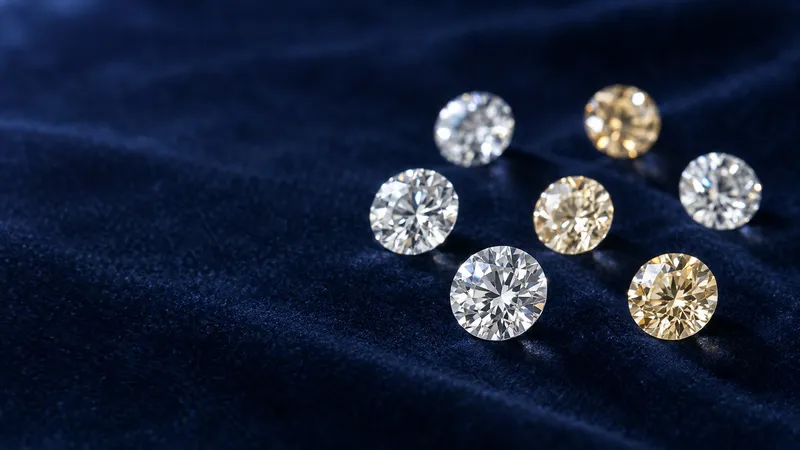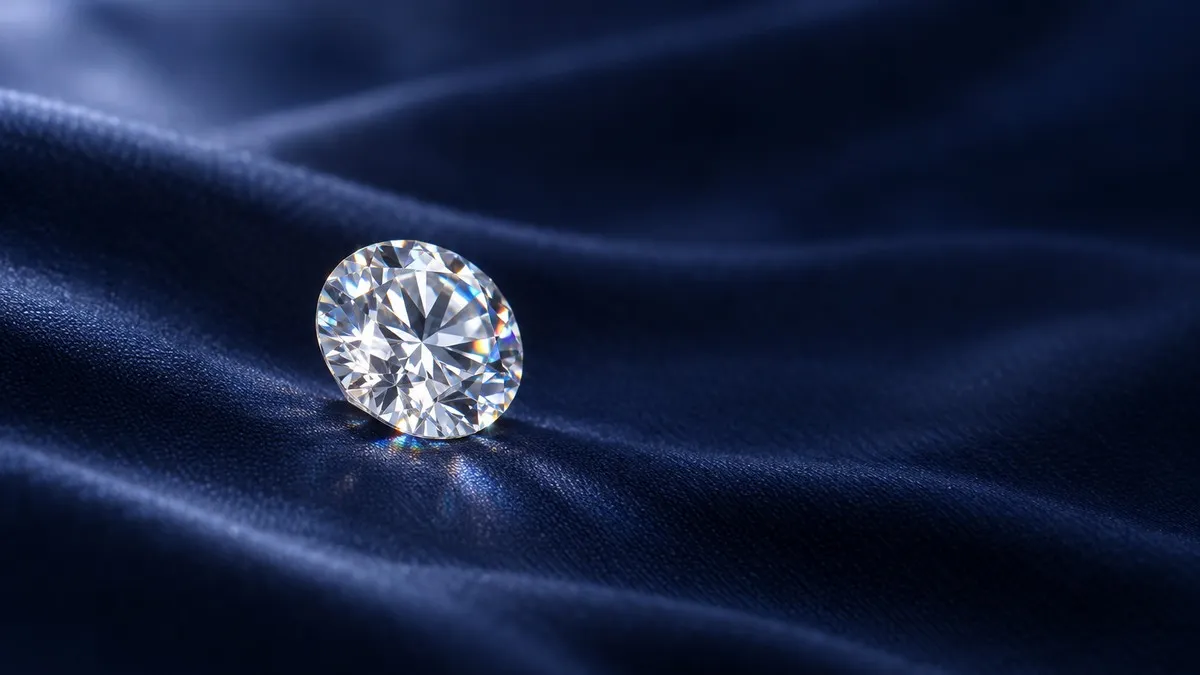
A diamond clarity chart ranks how free a diamond is of internal inclusions and surface blemishes, on 11 grades from Flawless (FL) down to Included (I3), all judged by a trained grader at 10x magnification. The grades are set under a loupe, not by the naked eye, which is why two diamonds a full grade apart can look identical on a hand and still differ a lot in price.
If you are reading a lab report, comparing two stones, or wondering about a ring you already own, the useful question is rarely "what grade is it" on its own. It is where your stone sits against the eye-clean line: the point below which inclusions start to show without magnification. This guide walks through every grade, the five factors a grader weighs, the inclusions you will see named on a report, and what each step on the scale does to value.
What a diamond clarity chart measures
Clarity describes the absence of birthmarks. Diamonds form under extreme heat and pressure, and tiny crystals, fractures and growth irregularities get trapped along the way. Features inside the stone, or reaching into it from the surface, are called inclusions. Features confined to the surface, such as a scratch or a nick, are called blemishes.
The scale most of the world uses is the GIA International Diamond Grading System, which the Gemological Institute of America created in 1953. Before it, jewelers described clarity with loose words like "loupe clean" or "piqué" that meant different things to different people. Today a VS2 means the same thing in New York, Antwerp or Tokyo, which is what makes the chart useful when you compare stones from different sellers.
According to GIA's clarity guide, most diamonds fall into the VS (very slightly included) or SI (slightly included) groups. Flawless stones are so rare that most jewelers have never seen one.
The diamond clarity scale chart, grade by grade
The 11 grades sit in six groups. The descriptions below follow GIA's own wording, and the last column is the general pattern for a well-cut round diamond under about 1.5 carats, not a promise for any single stone.
| Grade | Name | What a grader sees at 10x | Usually eye-clean? |
|---|---|---|---|
| FL | Flawless | No inclusions, no blemishes | Yes |
| IF | Internally Flawless | No inclusions, only blemishes | Yes |
| VVS1, VVS2 | Very, Very Slightly Included | Inclusions very hard to see | Yes |
| VS1, VS2 | Very Slightly Included | Minor inclusions, seen with effort | Almost always |
| SI1, SI2 | Slightly Included | Noticeable inclusions | SI1 often, SI2 less often |
| I1, I2, I3 | Included | Obvious inclusions, may dull brilliance | Rarely |
FL and IF
A Flawless diamond shows nothing at 10x, inside or on the surface. Internally Flawless shows no inclusions but has minor surface blemishes, which a polisher can sometimes remove. Both grades carry a premium you pay for rarity rather than for anything you can see.
VVS1 and VVS2
Inclusions at these grades are extremely difficult (VVS1) to very difficult (VVS2) for a skilled grader to find under magnification. To the eye, a VVS stone and a Flawless one look the same.
VS1 and VS2
VS inclusions range from difficult to somewhat easy to see at 10x and are described as minor. IGI describes this band as the balance point for most buyers: the stones look clean without the price of the top grades.
SI1 and SI2
At SI, a grader notices inclusions readily under the loupe. An SI1 can still look clean face-up, especially in a round brilliant, but an SI2 is where visible marks become common. This is the "SI diamond clarity chart" question many shoppers search: SI1 is a careful buy, SI2 needs the stone or a clear video in front of you.
I1, I2 and I3
Included diamonds have obvious inclusions at 10x that may affect transparency and brilliance. At I2 and I3 you can often see them without any magnification, and large fractures can affect how durable the stone is.
The five factors behind each grade
A clarity grade is not a count of flaws. GIA weighs five characteristics of what the grader finds, and a single badly placed inclusion can drop a stone further than several small ones tucked away.
- Size: larger inclusions are easier to see and lower the grade more.
- Number: how many characteristics there are and how easily they are found.
- Position: an inclusion under the table, the large top facet, is the most visible; one near the girdle edge can hide behind the facets.
- Nature: whether it is an internal inclusion or a surface blemish, and whether it reaches the surface.
- Relief: the contrast between the inclusion and the diamond around it. A dark crystal stands out far more than a white one.
The International Gemological Institute (IGI) gives a clear example of how these factors combine: a diamond with several large opaque crystals grouped under the table will grade much lower than one with a single tiny pinpoint near the edge. The same logic is why two stones with the same grade can look different. One may have its inclusion in the worst spot allowed for that grade, the other in the best.
Inclusions you will see named on a report
A grading report usually carries a plot, a diagram of the diamond with symbols marking each characteristic. The names on it come from a standard list, and GIA publishes a glossary that defines the common ones.
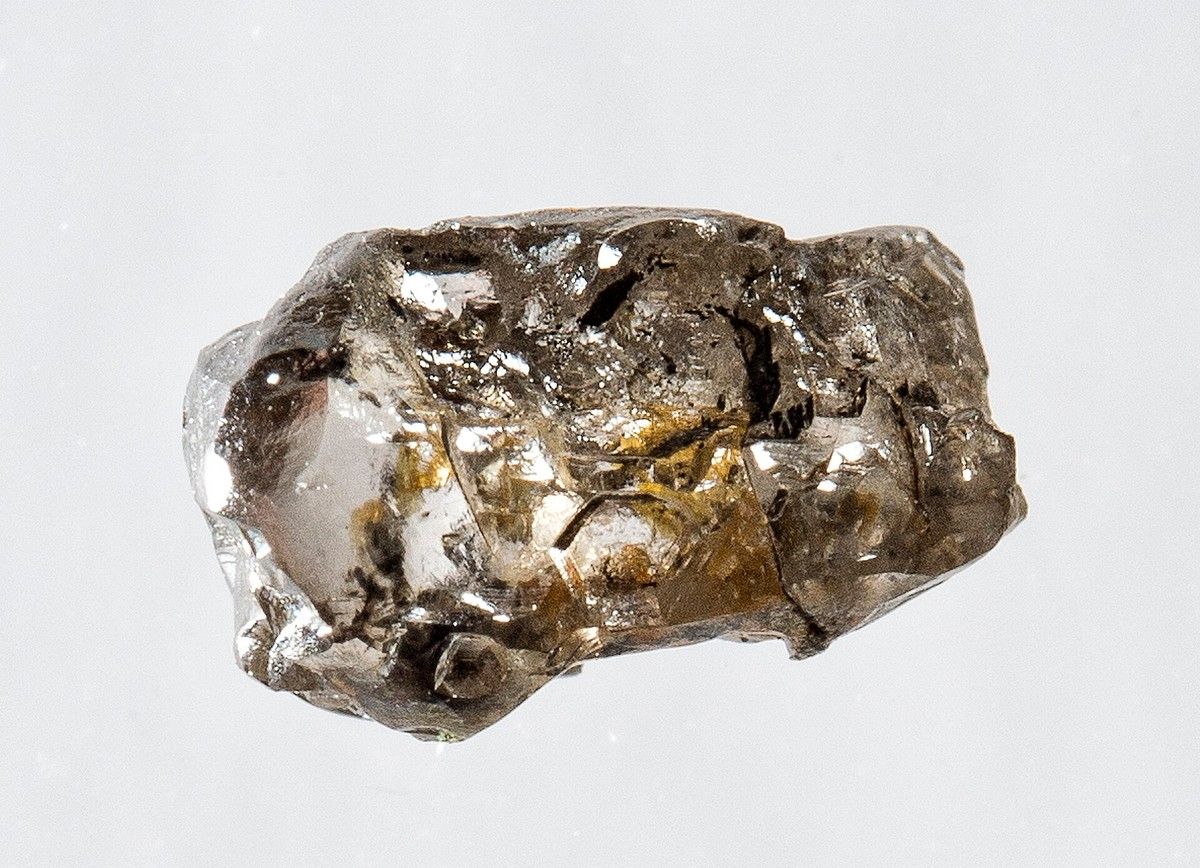
A pinpoint is a very small crystal that looks like a dot at 10x, and a cloud is a tight group of pinpoints too small to tell apart, which together look hazy. A crystal is a mineral trapped inside the diamond as it grew, and it can be clear, white or dark. A needle is a long, thin crystal. Internal graining shows as faint lines or curves from irregular growth.
The ones to read carefully are the breaks. A feather is the trade term for a fracture, often white and feathery. A cavity is an opening left when part of a feather breaks away or a surface crystal drops out, and a chip is shallow surface damage, usually at the girdle or a facet edge.
Feathers and durability
Most inclusions are a question of looks. Feathers can be a question of strength. In its guide to clarity, GIA notes that a feather or other surface-reaching inclusion can chip if the stone is struck right on it, and that very deep feathers, reaching from crown to pavilion or about a third of the way into the stone, can pose durability concerns. A feather that reaches the surface can also collect dirt over the years, so on a ring you wear daily, it is worth knowing where it sits.
Where the eye-clean line falls
"Eye-clean" is not a grade, and GIA does not use the term. It is an industry phrase for a diamond whose inclusions you cannot see without magnification. IGI points out that the traditional 4Cs were never designed to say whether a person can see an inclusion, because eyesight, distance, lighting and viewing angle all vary.
A practical test, as laid out in StoneAlgo's buying guide, is to look at the stone face-up in good light from a normal distance, no closer than about six inches. By that standard, FL through VS1 should be fully eye-clean, VS2 is clean in the large majority of stones, SI1 often is, and SI2 and the I grades usually are not.
Shape moves the line
Cut style changes how much an inclusion shows. Round, oval and cushion brilliants scatter light through many small facets, which hides minor inclusions. Step cuts such as the emerald and the Asscher have long, open facets that work like a window into the stone.
GIA compares looking into an emerald cut to gazing into a clear icy pool, and its VVS versus VS guide shows step-cut center stones at VS1 and higher for that reason. If you are shopping for an emerald or Asscher cut, move your floor up a grade or two compared with a round of the same size. Size matters too: a VS2 that looks clean at one carat can show an inclusion in a stone above two carats.
How diamond clarity changes the price
When cut, color and carat weight are equal, price per carat rises with clarity. The interesting part is how unevenly it rises, because the biggest jumps often sit at grades your eye cannot tell apart.
In the same GIA guide, a 2023 wholesale pricing sheet showed a 1.00 carat, D color, VVS1 diamond costing up to 40% more than a VS1 of the same weight and color. In a second example, two 1.00 carat, G color, Excellent cut rounds, one VVS1 and one VS2, looked the same, and the VVS1 cost 15% more.
Retail listings show the same effect at the VS2 and SI1 boundary. StoneAlgo's 2022 snapshot of 1 carat G VS2 rounds on Blue Nile ran from $6,345 to $7,206, and the cheapest VS2 was 26% more expensive than the cheapest SI1. Those figures are dated and will have moved, but the pattern holds: the step from SI1 to VS2 is where a lot of buyers pay for certainty that a stone is eye-clean, and a cheap SI1 is often cheap because something shows.
Clarity versus the other Cs
Because clarity above VS rarely changes what you see, the money a higher grade costs can go to cut quality or carat weight instead. Color works the same way, and our diamond color grades guide covers where that scale stops being visible.
Clarity grades on lab-grown diamonds
Lab-grown diamonds carry clarity characteristics too, from pinpoints to feathers, and how they are graded has changed. Since October 1, 2025, GIA no longer gives lab-grown stones the color and clarity grades it created for natural diamonds.
As JCK reported, GIA now describes a lab-grown diamond as Premium or Standard. Premium needs VVS clarity or higher, D color and Excellent polish, symmetry and cut. Standard needs at least VS clarity, E to J color and Very Good finish. Stones below those minimums get no GIA assessment at all. GIA's president explained that most lab-grown diamonds fall into a very narrow range of color and clarity.
Other labs, IGI among them, still issue full clarity grades for lab-grown stones. So if a listing shows "VS1" on a lab-grown diamond, check which lab wrote it, and if a GIA report shows "Premium" or "Standard", that is the whole clarity story it will tell.
Reading clarity on a diamond you already own
Most of the diamonds people ask about are not loose stones with a fresh report. They are an inherited engagement ring, a pair of studs from a drawer, or a pendant from an estate sale. The first step is to look for paperwork: an old grading report, or a laser inscription on the girdle that ties the stone to one.
Without a report, a 10x loupe and good daylight will show you whether anything obvious sits under the table. That tells you roughly which side of the eye-clean line the stone falls on, but it will not give you a grade. Only a gemologist working under controlled light and viewing angles can do that. If you are not yet sure the stone is a diamond at all, start with these home diamond tests before worrying about clarity.
A first value estimate before the jeweler
Primo Worth can give you a starting point. Snap a photo of the piece in Jewelry mode and it identifies the metal, karat, stones and hallmarks it can read, then checks the piece against recent eBay sales of comparable jewelry where they exist, with the sold listings shown so you can judge the matches.
What a photo cannot do is grade clarity. Primo Worth cannot see inclusions at 10x, confirm that a stone is a diamond, or tell a natural stone from a lab-grown one, and its result is an AI estimate, not a professional appraisal. Use the estimate and the sold listings to decide whether a ring deserves a gemologist's time, and let the gemologist's report settle the clarity grade.
Key takeaways
The diamond clarity chart has 11 grades in six groups, from FL to I3, and every grade is set at 10x magnification rather than by eye. Size, number, position, nature and relief decide where a stone lands, so the location of an inclusion matters as much as its existence.
For looks, the eye-clean line is the one that counts: VS1 and above are clean in almost every stone, VS2 nearly always is in a brilliant cut, SI1 needs checking stone by stone, and step cuts and large stones need higher grades to look the same. For price, the big jumps often sit at grades you cannot see, which is why VS2 is a common recommendation for a stone that has to look clean. Lab-grown stones graded by GIA since October 2025 carry Premium or Standard instead of a clarity grade, and a diamond you already own needs a gemologist, not a photo, before anyone can name its grade.