Most wheat pennies are worth a few cents to a few dollars. A worn 1943 steel cent lists at well under a dollar. The key dates, such as the 1909-S VDB, 1914-D and 1909-S, list from $103 to $860 in Good, the most worn grade the price guides cover, and the 1909-S VDB passes $1,000 from Fine up. The rare off-metal errors reach six figures. This wheat penny value chart pulls the numbers together by date, mint mark and condition, with the source and date for each price.
If you have a jar of old cents from a relative, the work is mostly sorting. Three things decide the value: the date, the mint mark and the condition. Once you know where to look, most coins can be ruled in or out at a glance.
How to Tell You Have a Wheat Penny
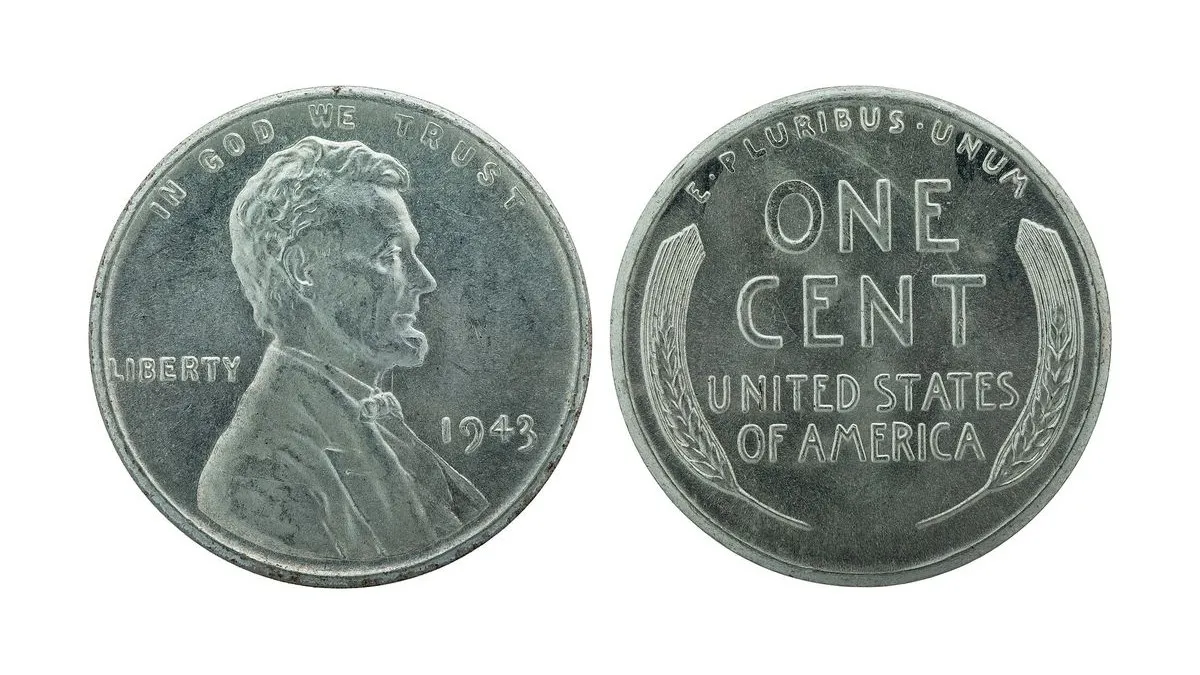
A wheat penny is a Lincoln cent struck from 1909 to 1958. The back shows two wheat stalks curving up either side of the words ONE CENT. From 1959 the reverse changed to the Lincoln Memorial, so anything with a building on the back is a later coin.
The mint mark sits under the date on the front. No letter means Philadelphia, a D means Denver and an S means San Francisco. On wheat cents, a single letter can move the value from cents to hundreds of dollars, so read it with a magnifier and good light before you put a coin in the common pile.
The general method for any old coin, from identifying the series to reading recent sales, is covered in our guide to what an old coin is worth. This post stays with the wheat cent and its numbers.
Wheat Penny Value Chart by Decade
The prices below come from the retail value chart that USA Coin Book publishes, with its numismatic values last updated in February 2026. Each row is a common, high-mintage date from that decade, so it shows what an ordinary cent of those years is worth. Good means heavily worn with the main design visible, Fine shows moderate wear, and Uncirculated, the MS60 column on the chart, means no wear at all.
| Decade | Typical date | Good | Fine | Uncirculated |
|---|---|---|---|---|
| 1910s | 1919 (no mint mark) | $0.30 | $0.49 | $19 |
| 1920s | 1929 (no mint mark) | $0.30 | $0.43 | $10 |
| 1930s | 1939 (no mint mark) | $0.18 | $0.24 | $2.50 |
| 1940s | 1944 (no mint mark) | n/a | $0.06 | $1.24 |
| 1950s | 1955-D | n/a | $0.06 | $0.43 |
The chart gives no Good price for most cents from 1944 on, and the 1909 issues, from the first year of the design, appear with the key dates below. The pattern is clear. Common cents from the 1910s to the 1930s sell for well under a dollar when worn but for $2.50 to $19 when untouched. The 1940s and 1950s cents were struck in the hundreds of millions and sell for pennies unless they have no wear, and USA Coin Book lists 1,435,400,000 cents for the 1944 Philadelphia issue alone.
Lower-mintage dates from the same decades sit above these rows. The 1914 from Philadelphia lists at $1.24 in Good and $81 in Uncirculated, and the semi-key and key dates in the next section are where the real money is.
These are retail guide figures, which is what a dealer might ask. What a buyer actually pays for a single circulated common date is often lower.
Key Date Wheat Penny Values
A handful of dates had small mintages, and collectors who want a complete set have to buy them. That demand is what holds the prices up even in worn condition. Figures again come from USA Coin Book, February 2026.
| Coin | Mintage | Good | Uncirculated |
|---|---|---|---|
| 1909-S VDB | 484,000 | $860 | $2,033 |
| 1955 Doubled Die | n/a | $790 | $5,625 |
| 1914-D | 1,193,000 | $207 | $2,683 |
| 1917 Doubled Die | n/a | $186 | $4,248 |
| 1909-S | 1,825,000 | $103 | $438 |
The 1909-S VDB is the one that passes $1,000 in Fine, at $1,064, and the 1914-D lists at $281 in Fine. The 1931-S belongs on the same list: only 866,000 were struck, the lowest mintage of any regular wheat cent after the 1909-S VDB, and it carries a key-date premium in every grade.
A few semi-key dates sit below these. The 1922-D lists at $25 in Good and $38 in Fine, the 1914-S at $21 and $34, and the 1931-D at $8.64 and $11. The 1936 Doubled Die starts at $34 in Good.
The 1909-S VDB carries the designer's initials, V.D.B., at the bottom of the reverse. Initials alone are not enough: the 1909 Philadelphia VDB with no mint mark had a mintage of nearly 28 million and is a common coin. You need both the S and the VDB.
The 1955 Doubled Die is the one most people can spot without a magnifier. The date, LIBERTY and IN GOD WE TRUST all show a strong second outline, as if the coin had been printed twice slightly out of line.
The 1922 No D
In 1922 only the Denver Mint struck cents, so every 1922 cent should carry a D. According to PCGS CoinFacts, the coins without one came from an obverse die that was filed down, likely after the dies clashed, and the filing took the mint mark with it. PCGS estimates about 15,000 survive in all conditions, and USA Coin Book's February 2026 chart lists the No D at $556 in Good and $721 in Fine.
Coins struck from the other die pairs, which PCGS now certifies as Weak D whatever is left of the mint mark, sell for much less. PCGS points to a sharply struck word TRUST and a second 2 in the date stronger than the first as signs of the valuable Strong Reverse. Its records show an MS64 brown example selling for $38,775 at Legend Rare Coin Auctions in December 2016.
1943 Steel Penny Value
The silver-colored 1943 cent is the wheat penny people most often think is rare, and it almost never is. According to the U.S. Mint, nearly all cents that year were struck in zinc-coated steel because copper was needed for the war effort. The American Numismatic Association counts over a billion steel cents across the three mints. PCGS explains that the new cents were easily mistaken for dimes and rusted where the thin zinc coating wore through, and in 1944 the Mint went back to a copper alloy, some of it from spent shell casings.
| 1943 steel cent | Mintage | Good | Fine | Very Fine | Uncirculated |
|---|---|---|---|---|---|
| 1943 (no mint mark) | 684,628,670 | $0.18 | $0.36 | $0.43 | $3.08 |
| 1943-D | 217,660,000 | $0.24 | $0.43 | $0.49 | $3.62 |
| 1943-D doubled mint mark | n/a | $19 | $50 | $61 | $123 |
USA Coin Book prices, February 2026. The 1943-S, the lowest mintage of the three at about 191.6 million, lists at $0.30 in Good and $7.29 in Uncirculated. A circulated 1943 steel cent is worth roughly 20 to 50 cents, more if it still has its bright mint surface. The one variety worth looking for is the 1943-D with a boldly doubled mint mark, where the D shows a clear second outline.
Many steel cents you find have dark spots or rust, the same weakness that ended the steel cent after one year. Rust adds nothing, and a rusty coin sits at the bottom of the range.
1943 Copper and 1944 Steel Pennies
The famous rarities run the other way. A few leftover bronze blanks from 1942 stayed in the presses when 1943 production started, and a few steel blanks slipped into 1944 production. In a 1999 release the U.S. Mint put the number of 1943 copper-alloy cents known at about 40. The first one offered for sale, in 1958, brought more than $40,000.
Prices have climbed a long way since. USA Coin Book lists a 1943 Philadelphia bronze cent at $154,859 in Extremely Fine and $438,300 in Uncirculated, and its one known 1943-D bronze cent at $477,655 in Extremely Fine. The American Numismatic Association's 1943 cent exhibit notes that the only 1943 cent ever given a Red color designation by a grading service sold for over $1 million in 2017.
The reverse error is rarer still. According to PCGS records, experts estimate 25 to 30 1944 steel cents survive, and the auction record is $180,000 for an MS64 example sold by Heritage Auctions in June 2021. A 1944-D steel cent graded MS62 sold for $122,000 at Heritage in January 2026.
These numbers are why the 1943 copper penny shows up in so many headlines. The odds that one in a family jar is real are very small, and the next section explains why.
The Magnet Test and Common Fakes
The U.S. Mint's own advice is simple: hold a 1943 cent to a magnet, and if it sticks, it is steel, not copper. A real 1944 steel cent will stick too, while an ordinary 1944 cent will not. If a 1943 cent does not stick, the Mint advises having an expert examine it.
The magnet rules out the most common fakes. The Mint lists two: steel cents coated with copper, and 1945, 1948 and 1949 cents with the date altered to read 1943. A plated steel coin still sticks to the magnet. An altered date passes the magnet test, so a copper 1943 that does not stick still needs a close look at the date. The ANA exhibit adds that companies once copper-plated real 1943 steel cents and sold them openly as novelty items, under slogans such as "Fool Your Friends!"
Fake and Altered Key Dates
Key dates get faked too. PCGS calls the 1914-D one of the most frequently counterfeited U.S. coins of the 20th century and advises against buying one that has not been certified. It is a frequent target for alteration as well as outright counterfeits. PCGS lists circular hub marks inside the upper loop of the 9 in the date as one sign of a real 1914-D. It also describes a fake made from a 1944-D: the designer's initials on Lincoln's shoulder only appeared from 1918, so a 1914-D that shows them, or traces of them, has been altered.
Any coin that might be a five or six-figure error needs a professional coin service such as PCGS or NGC before you sell it, insure it or turn down an offer for it.
How Condition Changes the Number
The charts show how fast value rises with condition. A 1914-D goes from $207 in Good to $2,683 in Uncirculated, more than a tenfold jump. On common dates the jump is even bigger in relative terms: a 1944 cent goes from $0.06 in Fine to $1.24 in Uncirculated.
Age sets what to expect. PCGS's Lincoln cent guide shows a coin worn down to Good as typical for a 1910s date, and notes that cents saw less use in the 1950s, so most survivors from those years are at least Very Fine or Extremely Fine. The older the coin, the more wear is normal, and the more an unworn example of the same date is worth.
Color matters on uncirculated copper. New cents are red, and they darken to red-brown and then brown over the years. Red coins bring the most.
The one rule every dealer repeats: never clean a coin. The American Numismatic Association's advice is to keep a coin as you found it, since cleaning in most cases destroys its value and experienced collectors spot a cleaned coin easily. The same applies to the other coins in an old jar, as our guide to buffalo nickel value explains for that series.
Checking a Jar of Wheat Pennies
Sorting a few hundred cents goes faster in passes than coin by coin.
- Pull the key dates first. Look for 1909, 1914, 1922, 1924, 1926, 1931 and 1955, then check each one's mint mark and, for 1909 and 1955, the VDB initials or doubling.
- Magnet every 1943 and 1944. Set aside any copper-colored 1943 that does not stick and any 1944 that does.
- Separate the bright coins. Uncirculated common dates with full red color are worth more than worn ones of the same date.
For the coins that survive the first pass, Primo Worth can speed up the lookup. It is free to download, and you can try three scans free. In Coin mode you snap a photo and it identifies the denomination, year and mint mark, with a note on rarity and what drives the value. The estimate is checked against recent eBay sales where they exist, with the sold listings shown so you can compare condition with your own coin.
Primo Worth gives an AI estimate, not a professional appraisal. A photo cannot tell a copper-plated 1943 steel cent from a real bronze one or confirm a doubled die, so the magnet and a professional coin service still come first for anything that looks like an error.
What a Wheat Penny Is Worth
Most wheat pennies are common coins worth a few cents to a few dollars, and a worn 1943 steel cent belongs in that group. The value sits in a short list of dates and mint marks: the 1909-S VDB, 1914-D, 1909-S, the 1922 No D and the 1955 and 1917 Doubled Dies, which list from $103 to $860 even in Good, with the 1909-S VDB above $1,000 from Fine up, and the low-mintage 1931-S beside them.
Above them sit the 1943 bronze and 1944 steel errors, with only dozens known and prices in six figures, along with plenty of fakes. Read the date and mint mark first, put every 1943 and 1944 on a magnet, keep the coins as they are, and treat every price as a dated guide rather than a promise.