Indian head penny value depends almost entirely on the date and the wear. Most of the coins struck from 1880 to 1909 list at 2 to 8 dollars when worn and about 40 to 110 dollars when unworn, according to the PCGS Price Guide on November 13, 2026. A short list of dates, led by the 1877 at about 650 dollars and the 1909-S at about 400 dollars even in heavily worn condition, is where the real money sits.
If you found a few of these cents in a jar, an old purse or a relative's desk, the useful question is which of the roughly 50 dates you hold and how much of the word LIBERTY you can still read on the headband. This guide covers how to identify the coin, the melt value, a value chart by date, the key dates and varieties, what common dates such as the 1890 and 1907 are worth, how condition moves the price and how to spot an altered key date.
Indian Head Penny Value at a Glance
The figures below come from the PCGS Price Guide, last updated on November 13, 2026, for coins in a PCGS holder. Each one is explained further down.
- Common dates from 1880 to 1909, worn: mostly 2 to 8 dollars in Good 4, the most worn level at which the date and design still read clearly, with a few such as the 1885 and 1886 at 10 to 12 dollars.
- Common dates, unworn: about 42 to 110 dollars in Mint State 60, the lowest uncirculated level.
- Scarcer 1860s and 1870s dates: the 1866, 1867 and 1868 list from 46 to 55 dollars in Good 4, and the 1869, 1871 and 1872 from 90 to 110 dollars.
- Key dates: the 1908-S starts at about 75 dollars, the 1909-S at about 400 dollars and the 1877 at about 650 dollars in Good 4.
A coin with no holder, the kind found loose in a drawer, usually trades below these figures. They are a ceiling for ordinary coins and a guide to which dates deserve a closer look.
How to Identify an Indian Head Penny
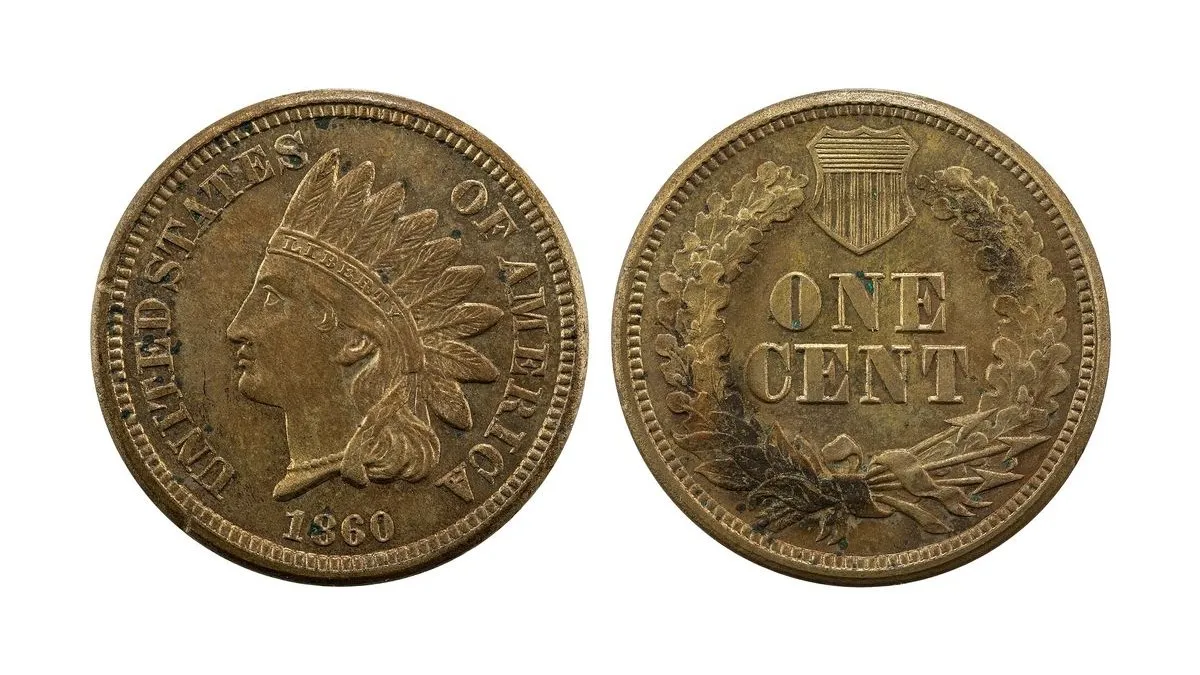
The Indian Head cent was the country's one-cent coin from 1859 to 1909. Chief Engraver James B. Longacre designed it, and the front shows Liberty facing left in a feathered headdress, with LIBERTY on the band, UNITED STATES OF AMERICA around the edge and the date at the bottom.
The back changed once. The 1859 coin, a one-year design, shows a laurel wreath around ONE CENT with nothing above it. From 1860 to 1909, the wreath is oak and a small shield sits at the top, which is the version almost everyone finds.
Copper-nickel or bronze
The first coins were struck in copper-nickel, 88% copper and 12% nickel, weighing 4.67 grams. In the spring of 1864 the Mint switched to bronze, 95% copper and 5% tin and zinc, weighing 3.11 grams, and that alloy lasted until the end of the series. Both versions measure 19 millimeters across.
An 1864 cent can be either metal, so a kitchen scale that reads to a hundredth of a gram settles it in seconds.
Where the mint mark is
Only two dates carry a mint mark: the 1908-S and the 1909-S, both from San Francisco. The small S sits on the back, at the bottom, below the wreath and under the ribbon that ties it. Every other Indian Head cent was struck in Philadelphia and has no letter at all.
Why it is called an Indian Head
The portrait is not a Native American. As Collector's Key explains, Longacre wrote to the Mint Director in August 1858 that a feathered headdress would give the cent a distinctly American look, and the figure is Liberty wearing it as a symbol. The popular story that his daughter Sarah posed for it does not hold: she was an adult and married by 1858, and Longacre said the face came from a statue of a crouching Venus.
Indian Head Penny Melt Value
A bronze Indian Head cent holds 3.11 grams of mostly copper, and the live melt figure on USA CoinBook put its metal at about 4 cents in November 2026. A copper-nickel coin from 1859 to 1864 is heavier but no more valuable as metal.
That makes melt value irrelevant for this series. Unlike a silver dime or a silver dollar, an Indian Head cent contains no silver, so the price is set entirely by collectors. Even the most common, heavily worn date sells for many times its metal, because every one of these coins is more than 115 years old and collectors still want them.
The practical consequence: never sell Indian Head cents by weight or as scrap copper. Fifty common dates in Good 4 add up to 100 dollars or more at PCGS guide prices against about 2 dollars of metal, and a single key date hidden among them can be worth more than the rest together.
Indian Head Penny Value Chart by Date
The chart lists the dates people search for most and every date that sells above the common range. The values come from the PCGS Price Guide on November 13, 2026, and the mintages from Mint records as published by NumisDex. Good 4 is heavily worn, Fine 12 shows moderate wear, Extremely Fine 40 shows light wear, and Mint State 60 shows none.
| Date | Mintage | Good 4 | Fine 12 | Ext. Fine 40 | Mint State 60 |
|---|---|---|---|---|---|
| 1859 | 36,400,000 | $22 | $40 | $135 | $440 |
| 1864 copper-nickel | 13,740,000 | $20 | $44 | $125 | $260 |
| 1864 bronze, no L | 39,233,714 (all bronze) | $15 | $32 | $80 | $210 |
| 1864 L on ribbon | part of the bronze total | $65 | $150 | $265 | $470 |
| 1866 | 9,826,500 | $55 | $85 | $200 | $420 |
| 1869 | 6,420,000 | $90 | $260 | $500 | $900 |
| 1870 | 5,275,000 | $60 | $225 | $425 | $825 |
| 1871 | 3,929,500 | $110 | $215 | $500 | $750 |
| 1872 | 4,042,000 | $95 | $275 | $475 | $875 |
| 1877 | 852,500 | $650 | $1,350 | $2,650 | $5,000 |
| 1880 | 38,961,000 | $8 | $17 | $40 | $100 |
| 1886 | 17,650,000 | $12 | $35 | $165 | $275 |
| 1890 | 57,180,114 | $3 | $5 | $22 | $80 |
| 1899 | 53,598,000 | $5 | $10 | $27 | $60 |
| 1907 | 108,137,143 | $2 | $6 | $18 | $52 |
| 1908-S | 1,115,000 | $75 | $125 | $190 | $350 |
| 1909-S | 309,000 | $400 | $475 | $650 | $1,400 |
How to read the chart
Mintage explains most of the pattern. The dates struck in the tens of millions, which covers nearly everything from 1880 to 1909, list in single dollars when worn. The dates struck in the single millions during the 1860s and 1870s list in the tens or hundreds, and the two dates under 1 million sit in a class of their own.
Why guide prices and other charts differ
Every price guide tracks a slightly different market. USA CoinBook, whose dealer figures were last updated in February 2026, lists the 1877 at 666 dollars in Good 4 and the 1909-S at 376 dollars, close to PCGS. Small gaps like these are normal. A chart tells you which tier a coin belongs to, and recent sales of the same date in the same condition tell you the price.
The Key Dates Worth the Most
Four dates carry most of the value in this series. They are worth checking first in any group of Indian Head cents, and they are also the dates most often faked.
1877, the rarest date
The 1877 is the coin every Indian Head collector needs last. Philadelphia struck just 852,500 business strikes that year, the only mintage under several million in the series up to that point, and Q. David Bowers notes that it was even harder to find in circulation than that number suggests.
In the PCGS guide, an 1877 lists at 650 dollars in Good 4, 1,350 dollars in Fine 12, 2,650 dollars in Extremely Fine 40 and 5,000 dollars in Mint State 60. Only the 1909-S comes anywhere near those figures in worn condition, which is why altered 1877s are so common, as a later section explains.
1909-S, the lowest mintage
San Francisco struck only 309,000 Indian Head cents in 1909 before both mints stopped early that spring to make way for the Lincoln cent. That is the lowest mintage in the series, lower than the 1877.
The 1909-S still sells for less than the 1877, at 400 dollars in Good 4 and 1,400 dollars in Mint State 60 in the PCGS guide. According to Bowers, collectors recognized its importance when it was new and saved a number of them, so more unworn pieces survive than the mintage suggests.
1908-S, the first San Francisco cent
The 1908-S was the first cent ever struck in San Francisco, with a mintage of 1,115,000. It was also saved at the time, so it is scarce rather than rare, and the PCGS guide lists it at 75 dollars in Good 4 and 350 dollars in Mint State 60.
Bowers points out a detail that helps with both S-mint dates: their bronze was slightly lighter and more yellow than Philadelphia's, and often shows a streaky, wood-grain look as it tones. A coin that has been dipped loses that look.
1869, 1871 and 1872
These three Philadelphia dates had mintages of 6,420,000, 3,929,500 and 4,042,000. They are the semi-key dates of the series, listing at 90 to 110 dollars in Good 4 and 750 to 900 dollars in Mint State 60 in the PCGS guide. The 1870 is close behind at 60 dollars worn.
Indian Head Penny Varieties That Change the Price
A variety is a coin of a normal date that came from a die with a visible difference. Most need a magnifier to see, and a few are worth far more than the plain coin of the same year.
Five varieties worth checking
- 1864 L on ribbon: in the autumn of 1864, Longacre's initial L was added to the ribbon at the back of Liberty's neck, beside the lowest feather. Bowers estimates about three bronze 1864 cents without the L survive for each one with it, and the PCGS guide lists the L coin at 65 dollars in Good 4 against 15 dollars for the plain bronze coin.
- 1869 over 9: a repunched date where an earlier 9 shows under the last digit. Dealer estimates on CoinCollecting.com put it at 130 to 250 dollars in Good to Very Good, against 90 to 130 dollars for a plain 1869.
- 1873 Doubled LIBERTY: a doubled die where the letters of LIBERTY on the headband show clearly doubled, found only on the Closed 3 version of the date. USA CoinBook lists it at 344 dollars in Good 4 and 9,333 dollars in Mint State 60.
- 1888 last 8 over 7: an overdate where a 7 shows under the final 8. USA CoinBook lists it at 2,033 dollars in Good 4 and 42,844 dollars in Mint State 60.
- 1894 Double Date: the entire date punched twice, which USA CoinBook lists at 92 dollars in Good 4 against about 9 dollars for a normal 1894.
Finding the L on a worn 1864
On a worn 1864, look at the tip of the bust as well. Coins with the L have a sharp, pointed tip, while most bronze coins without it have a rounded one, which helps when the L itself has worn away.
What an 1890, 1907 or Other Common Date Is Worth
The 1890 and the 1907 are among the most searched Indian Head dates, and both are common. Philadelphia struck 57,180,114 cents in 1890 and 108,137,143 in 1907, the largest mintage in the series.
In the PCGS guide, an 1890 lists at 3 dollars in Good 4, 5 dollars in Fine 12, 22 dollars in Extremely Fine 40 and 80 dollars in Mint State 60. A 1907 lists at 2, 6, 18 and 52 dollars at the same levels. The same is broadly true of the 1902, 1903 and 1906, which are also common.
For these dates, condition is the whole story. A worn 1907 is worth a few dollars, while the PCGS guide prices climb steeply above Mint State 60, into the thousands of dollars for the finest unworn coins.
When a common date is worth more
Three things lift a common date above the chart. A full, sharp LIBERTY with crisp feather tips means light wear. Bright mint red on an unworn coin is scarce for any date. And a clear doubled or repunched date can turn a common year into a variety, so check the date under a magnifier before setting the coin aside.
The 1909 from Philadelphia is a small exception among the late dates. With 14,368,470 struck, it is scarcer than the years before it, and USA CoinBook lists it at 12 dollars in Good 4 against 2.50 dollars for a 1908.
How Condition Moves Indian Head Penny Prices
Condition is described on a 1 to 70 scale, and for the scarcer dates a few points on it can double the price. Two things carry most of it: how much of the design has worn away, and the color of the copper.
Read the word LIBERTY
The letters of LIBERTY on the headband wear away in order, which makes them the quickest condition check for this coin. As Collector's Key describes it, a coin with a full, sharp LIBERTY and good feather detail is lightly worn, a coin showing three or four letters is in Very Good, and at Good the word is worn away entirely.
The more of the word you can read, the higher the coin sits on the scale, and for the scarcer dates each step adds real money: the PCGS guide lists an 1869 at 90 dollars in Good 4 and 260 dollars in Fine 12. The hair ribbon and feather ends wear to flat spots as well, and on a heavily worn coin the headband blends into the forehead.
Red, red-brown and brown
A bronze cent leaves the Mint bright copper red and darkens with time. PCGS describes the color of an unworn coin in three steps: Red, with 95% or more of the mint color, Red-Brown, with between 5% and 95%, and Brown, with less than 5%.
Red coins are much scarcer than brown ones among old copper, and the color moves the price of an unworn coin as much as its wear does.
Never clean one
Cleaning is a costly mistake with an old copper cent. Any polish or chemical removes the surface the coin left the Mint with, and no treatment puts back mint red or natural toning, so a cleaned coin sells for less than an uncleaned one in the same condition. Hold the coin by its edge and keep it dry.
Spotting an Altered 1877 or 1909-S
Because the 1877 and the 1909-S are worth so much more than their neighbors, they are the dates fakers target. Some fakes are struck counterfeits, but many are real coins of a cheaper date that have been altered.
The 1877 test
In a PCGS article on altered 1877 cents, the author explains that the date most often reworked into an 1877 is the 1879, with the last 9 tooled to look like a 7. The best check is on the back: on a real 1877 business strike, the lower right of the N in ONE and the upper left of the N in CENT are much weaker than the rest of the lettering. Other dates from the 1870s have strong letters there.
The same article notes that both 7s on a real 1877 have squared-off serifs, and that tooling marks often show where metal was pushed around the last digit. The author had personally inspected more than half of the over 2,000 1877 cents PCGS had seen.
The 1909-S test
A common trick is to add an S to a 1909 cent from Philadelphia, which is worth a small fraction of the 1909-S. Compare the S and its position with photos of known 1909-S coins, and the color of the bronze with Bowers' note about the lighter, yellower San Francisco alloy.
A coin that passes these checks is still worth sending to PCGS or NGC before you buy or sell it as a key date. Their opinion is what a serious buyer will pay for.
Where Indian Head Penny Prices Come From
The PCGS Price Guide and USA CoinBook are dealer guides. They show what a coin of that date and condition is worth at retail, and the PCGS figures apply to coins in a PCGS holder. A raw coin, bought or sold without a holder, usually trades lower: PocketPrice's November 2026 guide puts typical in-person resale prices for Indian Head cents at 1 to 10 dollars, at booths, flea markets and estate sales.
Marketplace sold listings show what ordinary Indian Head cents changed hands for recently. That makes them the best check for a typical worn coin, as long as you compare like with like: the same date, the same variety, the same amount of LIBERTY showing and the same color.
If the same box holds later cents, the wheat penny value chart covers the Lincoln cents that replaced this design in 1909. When you are ready to sell, the guide to where to sell coins compares dealers, auctions and online buyers.
Checking an Indian Head Penny From a Photo
Reading a worn date on a dark brown coin and checking it against a chart takes time, especially with a jar of 50 of them. Primo Worth shortens that first step. It is free to download, with three free scans, and in Coin mode you snap a photo and it identifies the denomination, year and mint mark, with a read-out on rarity and what drives the value.
The estimate is the median of comparable sales, checked against recent eBay sales where they exist, and the sold listings appear below it so you can judge whether they match your coin. When there are no comparable sales, the app falls back to a web estimate, and sometimes shows no value at all.
Primo Worth gives an AI estimate, not a professional appraisal. A photo cannot tell an altered 1877 or an added S from a real one, and it cannot settle the condition of a scarce date, so a coin that looks like a key date still belongs with a specialist.
Indian Head Penny Value in Short
Most Indian Head cents are common dates from 1880 to 1909, worth about 2 to 8 dollars when worn and about 40 to 110 dollars when unworn at PCGS guide prices from November 13, 2026. Their metal is worth about 4 cents, so the price comes entirely from collectors.
The value climbs with four things: a key date, meaning the 1877, the 1909-S or the 1908-S; a scarcer 1860s or 1870s date such as the 1869, 1871 or 1872; a variety such as the 1864 L, the 1873 Doubled LIBERTY or the 1888 over 7; and condition, read first from the word LIBERTY and then from the color. Check the back for an S, check the date for doubling, leave the coin uncleaned, and treat any 1877 or 1909-S as unconfirmed until a specialist has seen it.