Silver hallmarks are the small stamps struck into a silver object to record its purity, who made or sent it, where it was tested and, often, when. Read together, they tell you whether a piece is solid silver, silver plate or neither, and they can date a British spoon to a single year.
That matters before you sell, keep or melt anything. A row of tiny symbols on the back of a fork can separate a Georgian London spoon from a twentieth century plated one that only looks the part. This guide walks through the British system first, because it is the one most other marks imitate, then American sterling and coin stamps, continental numbers, and the plate marks that look like hallmarks but promise very little.
What Silver Hallmarks Tell You
A full British hallmark answers four questions: who, what, where and when. The State Library of Victoria's hallmarking guide sets them out as the sponsor or maker's mark, the standard mark, the assay office mark and the date letter.
The purity mark is the one to find first, because without it nothing else matters. As that same guide puts it, an item with no standard fineness mark, traditional or numerical, is probably silver plate or comes from another country.
Today only three of those marks are compulsory in the UK. Guidance from the London assay office lists the sponsor's mark of at least two letters in a surround, a millesimal fineness number whose surround shape names the metal, and the assay office mark. The date letter became optional in 1999, so a modern piece can be fully hallmarked and still carry no date.
Reading British Hallmarks on Silver
British marks are the reference point for hallmarks on silver worldwide. The system is old: the Goldsmiths' Company traces the date letter back to the fifteenth century, when it identified the warden responsible for each year's testing, and the hall where pieces were tested is probably where the word hallmark comes from.
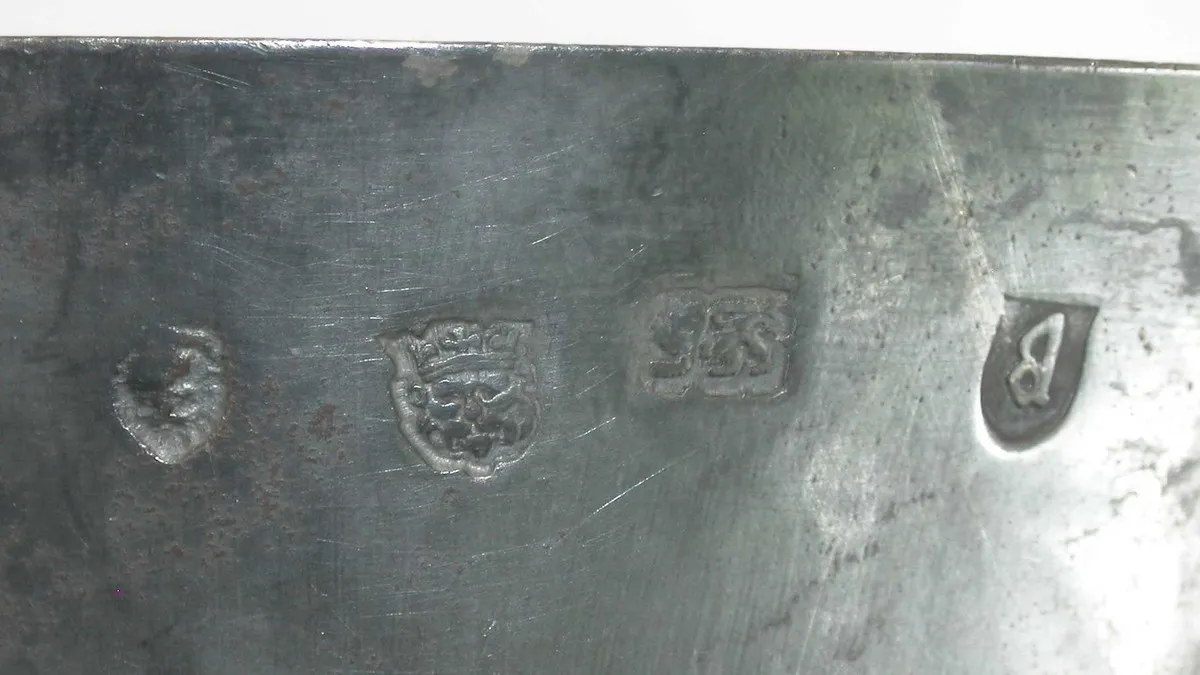
A typical antique British mark has four or five parts, struck in a row:
- Maker's or sponsor's mark: initials in a shaped punch, naming who sent the piece for testing.
- Standard mark: the lion passant for sterling in England, a lion rampant in Scotland.
- Town mark: the symbol of the assay office that tested it.
- Date letter: one letter in a shaped shield for the year of assay.
- Duty mark: the monarch's head in profile, on pieces taxed between 1784 and 1890.
The order of the punches varies by office and period, so read each symbol on its own rather than by position.
The lion passant and other standard marks
The walking lion is the mark most people recognise. According to the Silver Society, the lion passant was introduced in 1544, during the reign of Henry VIII, and it means sterling: 92.5% silver.
Two variants catch people out. From 1697 to 1720 the higher Britannia standard of 95.8% silver was compulsory in England, and the lion passant was replaced by a seated figure of Britannia, while London swapped its leopard's head for a lion's head erased. Britannia has stayed an optional standard since, so a figure of a woman where you expected a lion usually means better silver, not worse.
Scottish silver uses a lion rampant, standing on its hind legs, instead of the walking lion. Irish silver from Dublin carries a crowned harp as the standard mark.
English Hallmarks on Silver: Town Marks
The town mark tells you which assay office tested the piece, which is not always where it was made. The four offices still operating are fixed in Schedule 2 of the Hallmarking Act 1973:
| Assay office | Town mark | Notes |
|---|---|---|
| London | Leopard's head | Crowned until 1821, uncrowned after |
| Birmingham | Anchor | Office authorised in 1773 |
| Sheffield | Crown, later a rose | The rose replaced the crown on silver after the 1973 Act |
| Edinburgh | Castle | Three towers |
Closed offices still turn up on older pieces. The Silver Society lists Chester's sword between three wheatsheaves, Glasgow's tree with a fish, a bird and a bell, and Dublin's seated figure of Hibernia. Glasgow closed in 1964 and Chester in 1962, so either mark puts a piece before those years.
Silver hallmarks with a crown
A crown on British silver usually points to one of two things. On its own as a town mark, it is Sheffield before the changes that followed the 1973 Act. Above a leopard's head, it is London before 1821, when the London leopard lost its crown.
The Silver Society adds that Chester, Exeter, York and Newcastle also struck a crowned leopard's head alongside the lion passant for a time, while Birmingham and Sheffield never used the leopard's head at all. If you see a crowned leopard with a town mark beside it, the town mark decides the office.
How to Read a Date Letter
The date letter gives you the year, but only if you also know the assay office and the cycle. Each office ran its own sequences and changed letters on its own date, and the same letter returns every twenty years or so.
The font of the letter and the shape of its shield matter as much as the letter itself. The Silver Society notes that offices changed both for each cycle so that every year looked different, which is why a lowercase "a" in a plain shield and an uppercase "A" in a shaped one can sit a century apart.
At London, a cycle ran from "a" to "u" or "v" and skipped "j". The letter changed partway through the calendar year when new wardens took office, so an old date letter covers a span such as 1795 to 1796 rather than a single year. Since the modern rules, the date letter changes on 1 January.
Marks that narrow the date
A few marks narrow the range before you open a date chart:
- Figure of Britannia: the Britannia period, compulsory 1697 to 1720 and optional after.
- Monarch's head in profile: the duty period, 1784 to 1890; the Goldsmiths' Company notes the head changed direction in 1786.
- Uncrowned London leopard on sterling: 1821 or later.
- An F in an oval shield: an imported piece, a mark the Silver Society dates from 1867.
Worn marks are common. Polishing over decades "rubs" a hallmark and blurs the fine detail of the letter and shield, so a magnifier and side light help more than any chart when the letter is faint.
American Silver Marks: Sterling and Coin
America never built a national assay system. Its marks are the maker's own claim, backed by law rather than by a testing office.
Before sterling took hold, American silversmiths often worked from melted coins. That "coin silver" could vary in purity, and pieces were stamped COIN or PURE COIN, or carried only the maker's name. After the trade adopted the sterling standard in 1868, pieces were marked STERLING, 925 or 925/1000.
Federal law now defines both words. Under the National Gold and Silver Stamping Act, codified at 15 U.S.C. 297, nothing may be marked "sterling" unless it contains 925 thousandths pure silver, or "coin" unless it contains 900 thousandths, with a tolerance of four thousandths either way.
Pseudo-hallmarks on American silver
Some nineteenth century American makers stamped little rows of symbols that imitate British hallmarks: a lion, a head, a letter. These pseudo-hallmarks carry no assay meaning. The pieces are often coin silver and collectible in their own right, but sellers sometimes list them as English sterling, so check the maker's name before paying a British price.
Continental Silver Marks: 800, 835 and 900
Much of continental Europe marks silver with a fineness number in thousandths rather than a lion. A spoon stamped 800 is 80% silver, 835 is 83.5% and 900 is 90%. None of them is sterling, and all of them are solid silver.
Two national marks are worth knowing. German silver from 1888 onward carries a crescent moon and a crown beside the number, the national mark for silver of at least 800. French silver since 1838 carries the Minerva head, a helmeted profile with a small numeral: a 1 for 950 silver and a 2 for 800, as the dealer M.S. Rau explains in its guide to French marks.
The 900 you see on a European piece is a different claim from the 900 on an American COIN spoon. Both mean the same metal content, but one is a national stamp and the other a maker's word.
Silver Plate Marks: EPNS, A1 and Quadruple Plate
Plate marks are where most disappointment happens. They are designed to look reassuring, and they promise a coating, not solid silver.
The earliest plate was Sheffield plate, thin silver fused onto copper. From about 1840, electroplating took over. A library guide from Victoria explains that EPNS stands for electroplated nickel silver, and that nickel silver contains no silver at all until it is plated. Early Sheffield platers even struck marks resembling hallmarks, until London silversmiths took them to court in 1773.
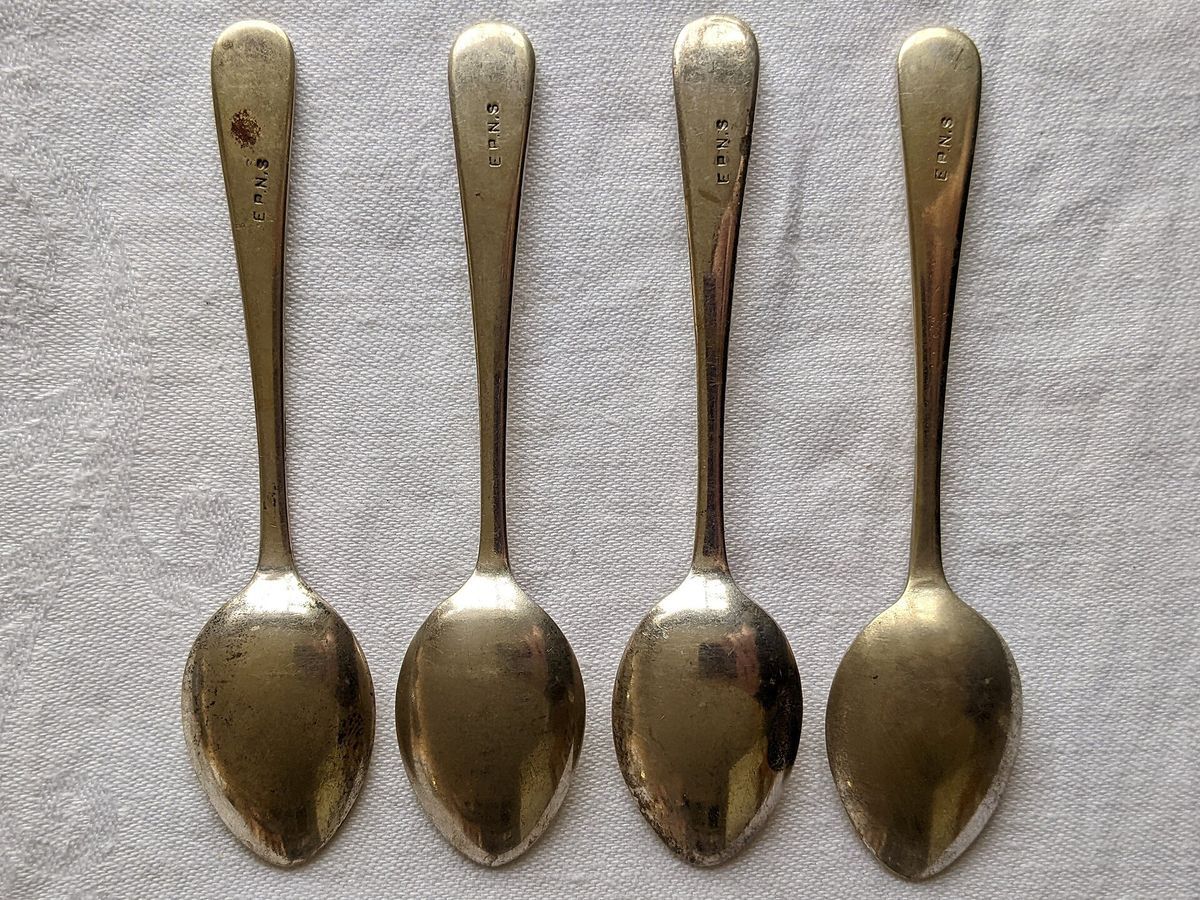
What the letters on plate mean
British platers used letter codes for both the base metal and the plating grade. EPNS is the most common; EPBM means electroplated Britannia metal, and EP simply means electroplated. Grade letters run from A1, the best, down through A, B, C and D. One collector reference records A1 as about 32 grams of silver spread across a dozen spoons or forks, which shows how thin even the top grade is.
American plate has its own vocabulary. QUADRUPLE PLATE marks the heaviest hollowware grade, A1 and AA mark flatware plating weights, and a name like 1847 ROGERS BROS is a brand date, not a year of manufacture or a purity mark.
Every one of these marks means a base metal underneath. A piece stamped EPNS A1 is well made plate, but its metal value is close to nothing, and it sells on design, maker and condition alone.
From Marks to Value
Once the marks tell you what the metal is, value splits into two questions. The first is metal value: weight times fineness times the silver price on the day. Our guide to the value of sterling silver walks through that sum for flatware and scrap.
The second is what a collector will pay above metal. Here the hallmarks earn their keep: a maker's mark, an early date letter or a scarce town mark can lift a piece well beyond its weight. A crisp Britannia-standard mark from the early eighteenth century and a plain 1970s sterling spoon weigh about the same and sell very differently.
Marks can be faked, rubbed or missing. If a piece has no mark at all, or a mark you cannot match, the home checks in our guide on telling if silver is real narrow it down, and a jeweler or assay office can test the metal itself.
Getting a first estimate from a photo
If you have a drawer of mixed silver and want to know where to start, Primo Worth gives a first estimate from one photo. Antique mode reads maker, era, origin and material and adds a short backstory, and Jewelry mode reads metal, karat and hallmarks on smaller pieces.
Primo Worth checks each identification against recent eBay sales where they exist and shows the sold listings, so you can judge whether the matches look like your piece. It is an AI estimate, not a professional appraisal, and a photo cannot confirm what a metal is: a stamp that reads 925 in a picture is still only a claim until someone tests it.
Primo Worth is most useful as a first pass across a drawer of mixed pieces, so you know which ones deserve a closer look with a loupe and a date chart.
Conclusion
Start with the purity mark: a lion passant, a lion rampant, STERLING, 925, COIN or a continental number means solid silver, and EPNS, A1 or QUADRUPLE PLATE means a coating over base metal. The town mark tells you which office tested a British piece, and the date letter, read with its font and shield, gives the year. A duty head places a piece between 1784 and 1890, and a figure of Britannia points to the early eighteenth century or a deliberate higher standard.
American marks are the maker's claim under federal law rather than an assay, and pseudo-hallmarks imitate British ones without their meaning. Read every mark on its own, check it against the office and the period, and let the metal and the maker, not the shine, decide what a piece is worth.